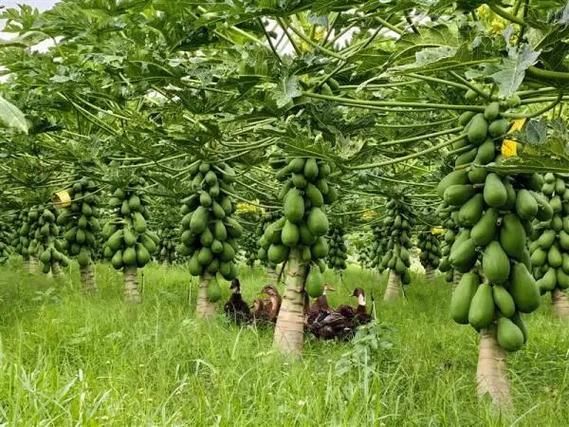
This post (journalist zhang hue pil) recently saw a field survey of the new species of papayas tested at the south china farmer's southern pioneer. In the field, it is estimated that it can produce up to 200 pounds per plant, with an acre production exceeding 10,000 pounds and a commercial fruit rate of 93. 6 per cent, marking the successful outcome of this high-quality new southern species in sanya。
Walking into the base, a ludicrous papaya forest appeared in the curtains, with the sun penetrating through layers of folded palm blades spilling over a green, pear-like fruit. The cucumber cucumbers weigh between one and two pounds per fruit, with a moderate head, and meet the needs of families for single meals. “it is not only remarkable in its appearance, but also in its efficiency and taste.” according to researchers at the heinan academy of agricultural reclamation group ltd., “yowa” papayas were selected by the fruit tree institute of the guangdong academy of agricultural sciences, with the core advantage of high sugar and durable storage. Specialized tests have resulted in 13. 5 per cent soluble solids containing up to 84. 7 milligrams of vitamin c per 100 grams of fruit, thin and non-fibre-free fruit; no residues have been detected from agricultural residues, and the quality of fruit can be found on the international high-end market。
Currently, the domestic market for papayas is highly homogenous, and quality differential varieties are scarce. Aiming at the pains of this industry, the china-south multiculture group introduced “yellow” papayas in 2024, opening up full-chain exploration from scientific experiments to large-scale marketing。
The scientific team selected the hainan farmers for seeding at the south shoba plant site to be tested and adapted to the local climate and soil conditions and to the standardised techniques for high-yield green production, and organized the monitoring and monitoring of the entire spectrum of expansion, planting and care to harvests, based on the science and technology complex located only 100 metres away。
“we at the base focus on two major technical challenges: integrated management of water fertilizers and ecological control of viral diseases.” on-site technicians described the base's ability to effectively contain the spread of diseases and improve the appearance of fruit and storage resistance, using such initiatives as full-cover pest control, biological pest control and integrated management of precision water fertilizers. Long-distance logistics losses have been significantly reduced by longer cycles of mature fruits。
High-quality fruit market recognition. Half a month before the bulk was put on the market, the “yellow flower” papayas had reaped a number of large commercial super-procurement intentions. At the moment, the base fruit has been established in cooperation with the new retailer's box of ma soo-sook, and will be later landed in the country's high-end fresh and fresh cabinets. “the purchase price for the `yuhua' field is expected to increase by more than 30% compared to the traditional papayas.” the relevant directors of the sea-south-south group of bulk industries said that the next step would be to focus on the branding of varieties in an effort to cultivate them as a follow-up to mangoes and lantern mists, followed by a distinctive tropical fruit in hainan。
It is understood that the base will hold a “yowowa” pamphlet field viewing fair in mid-july, inviting fruit distributors and growers from all over the province to perform a live mapping exercise to speed up the transformation of the achievements of the south. In follow-up, the sea-south-south complex will conduct regional adaptation tests in the province's interior city districts, building on the scientific platform of the seed laboratories of tri-ayacca bay; and simultaneously explore the “guava + pomegranate” complex seeding model with the development of an integrated tropical fruit chain system for scientific breeding, standardized planting, precision processing, marketing and branding。
A juicy “yellow flower” is a living example of the transformation of the scientific achievements of the south and an important vehicle for high-impact agriculture with strong tropical characteristics and for the overall revitalization of villages. As more of the high-quality new southern varieties are introduced in tri-sub-scale test species, the country's southern silicon valley industry will continue to be built and its “tri-asian” high-quality tropical agricultural products sold nationally and overseas。