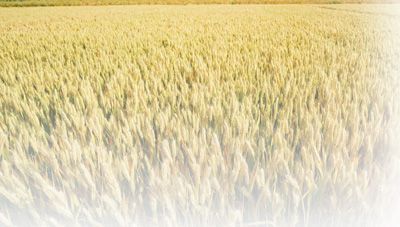
In recent days, wheat is about to mature, yellow and beautiful, with a very good harvest, at the henan experimental base of the crop science institute of the chinese academy of agricultural sciences。
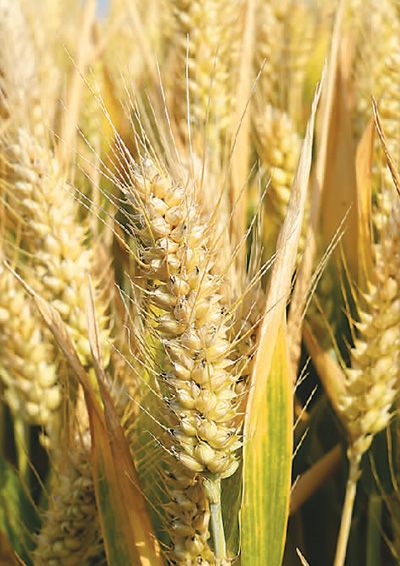
The 300 plentiful fields are well developed。
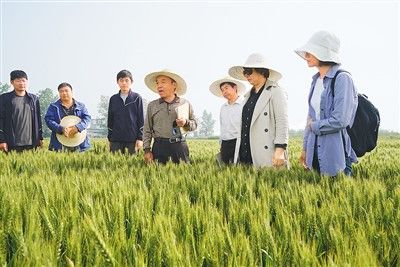
Researcher (right four) and team members at the crop science institute of the chinese academy of agricultural sciences examined field material performance。
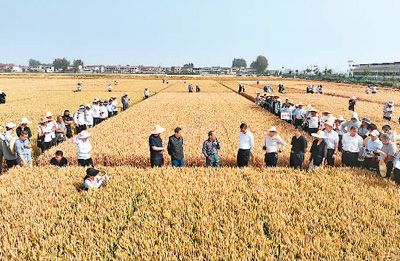
On 24 may, at the henan experimental base of the crop science research institute of the chinese academy of agricultural sciences, breeding units such as scientific institutes and farming enterprises represented on-site viewing the “wheat-icegrass” long-term complex of high-yielding, stable and strong-strength new varieties。
These pictures are provided by the crop science institute of the chinese academy of agricultural sciences
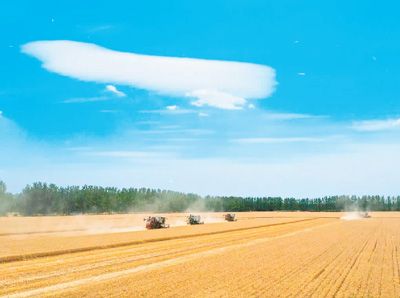
Henan province, west ping county, is the site of a high standard of wheat and wheat fields. People-in-law
At the end of may, the chinese academy of agricultural sciences (caa) crop science research institute in henan's new village, where wheat is about to mature, wheat waves roll over, and a golden yellow field, was home to 90 “wheat-icegrass” ingenuity innovations created by the chinese academy of agricultural sciences' crop science research institute team, with a concentration of 0. 5 acres per species. It is considered to be an important genetic resource that opens up the path of chinese wheat production, provides excellent genetic resources for the innovation of wheat breeding, and injects innovative power into the self-reliance of science and technology for the development of this industry, which is derived from master control。
On 24 may, a workshop was held in the new countryside on the theme “magic-icegrassing” and effective utilization of new distant-dwelling varieties, organized jointly by the crop science institute of the chinese academy of agricultural sciences and the centre for research in china's academy of agricultural sciences. Representatives of over 40 research and research institutes and farming enterprises, among others, observed 90 high-segregated, stable, strong and new varieties of wheat, including the 2023 national review of new varieties of wheat, “popice 03”, and nine new strains that are being tested in the national region。
Wheat – why is the ice-grass marriage so important to industry? "this year's display of the `wheat-icegrass' hybrid series of distant species has been upgraded to reflect a remarkable diversity. These new materials not only maintain their rich and diverse characteristics, but also have compact strains and vertical leaves. It is worth mentioning that they have demonstrated remarkable resistance to major current diseases, such as tube and rhesus, and are also characterized by high-quality strength.” liu xu, a graduate of the chinese academy of engineering and researcher at the chinese agricultural institute, commented。
The world's conundrum of expedition
Ice-grass plants are one of the near wild species of wheat, with extreme resilience and excellent drought, cold and disease resistance. It has a slightly similar ear and wheat, but it is large, with prominent characteristics of small ears and small flowers, in addition to extreme cold resistance and drought resistance, and is highly immune to a variety of wheat diseases, which are considered to be one of the best external sources of genetic excellence for wheat improvement。
It's not easy to mix wheat and ice straw. “the icegrass and wheat look similar in shape, and in fact it's very distant and very difficult to mix.” li would say。
At the beginning of the 1930s, scholars in a number of countries wished to resolve that dilemma, but it was not successful until the 1980s. The international wheat research community is generally of the view that “the intersection of wheat and ice grass is a dead end”。
In 1988, before entering master's degree studies, mr. Tung advised li to give up when li would raise this issue with his mentor, dong yuxeng, a well-known expert in species quality resources. "i want to try and change the subject." the li li li council insisted on convincing the teacher, who then led the two assistants to begin research in the field。
Thirty-six years later, dozens of hybrid wheat and ice-grass wheat materials are about to mature in pilot fields in henan's new countryside, with 15 new varieties already in existence and 39 in reserve。
What are the challenges of the “wheat-icegrass” distance mix
“there are three main obstacles to the interlocking of the distant, the infertile, the infertile, and the `crazy separation' of future generations, which have not been resolved.” zhang jin peng, a researcher at the crop sciences research institute of the chinese agricultural institute, said that wheat, for example, usually matured in late may, while ice grass grew in high latitudes, at which point the flowers were blooming and the two were mixed, starting with the adjustment of the period to the same period. Second, there is a need to address reproductive segregation in pollinating wheat-crawl. Even if pollination was successful, the embryo could not develop properly, and an embryo-saving technique was needed to obtain a plant。
The failure of the conventional breeding technique route leads to a different path, where researchers are nurtured through seed-based resource innovation, finally breaking the “reproductive isolation” of wheat and ice grass. Under the leadership of li li li, the team for the innovation and utilization of wheat seed resources at the crop sciences institute of the chinese academy of agricultural sciences has worked tirelessly to create a new technology system for the intermingling of wheat. Through a series of innovations, such as pollination at an early age, juvenile embryo rescue, pediatric cell culture, high-frequency induction of foreign-source alternations, and the development of alien molecular markers, the complex problem of “wheat-icegrass” has been overcome, resulting in an important breakthrough in wheat breeding from “0” to “1” using the genetic excellence of icegrass。
The team has also completed the genomic sequencing of the species of icegrass from wild feed and the reordering of the offspring from which they are derived, continuously promoting the effective use of innovative species and the selection of new varieties. Using “wheat-icegrass” multi-pellets of gradual seepage materials, a significant increase of 300 permice, 301 permice with high-efficiency nitrogen nutrients, and 4696 permafrost, a high-quality, strong-strength new product with stable performance in multi-ecological areas, have been selected and are participating in national wheat species validation tests。
There's a lot of room for innovative species
“in the past, improving wheat varieties and increasing production was largely achieved through the multiplicity of existing extension varieties. However, the multiplicity of long-term varieties and the large number of applications for a small number of primary proxies have led to a reduction in the range of genetic mutations, a growing monolithic resistance to varieties and bottlenecks in wheat breeding.” li li would say, “thus, it is a significant task to import ice-grass genes into wheat through a combination of distance. Among the wildest species of wheat, ice-grass species have a wide range of excellent target forms of wheat breeding, introducing the critical genetic excellence that is currently lacking in wheat through a combination of distant borders, which not only increases yields but also increases resilience to disease.”
The most immediate benefit of a combination of wheat and ice grass is high productivity. Li li will describe the fact that in traditional breeding, the number of acres, the number of specks and the number of thousands of grains are the three factors that affect production, but these three factors are mutually reinforcing, i. E. The increase of one factor tends to result in a decline in the other two factors, which is difficult to increase simultaneously. The problem has been solved by the innovative “wheat-icegrass” species, which have a high yield of many flowers and can produce more than 10 per cent more than the main wheat plant, and by china’s lack of ground-breaking high-yield wheat varieties, especially by the discovery of the “multiparticle – high – thousands of heavy – effective division”, with a significant increase in the number of specks and 1,000 grains。
There has also been a significant increase in resilience. The study found that “wheat-icegrass” innovations are widespread resistance to diseases such as powder, rust, and leaf rust, which provide strong support for the development of new varieties that are durable and multi-disease resistant. To date, the “wheat-icegrass” derivatives have been distributed to the national breeding units, which have produced 21 new species of target genes carrying the excretion of ice grass and 39 new specimens for the national and provincial regions, covering the national wheat-producing areas. Among them, 151 new varieties of wheat, validated in gansu and shaanxi provinces, have become the main plant varieties for endemic diseases such as rust and dryland wheat areas, resulting in a new breakthrough in multi-resistant breeding。
“the future will be the creation of a `wheat-icegrass' innovative seed complex that will significantly increase the efficiency of utilization and enhance the functional resolution of important genes from the icegrass p genome that is highly productive, high-quality, resistant, and so on.” li would say。
This year's display of the “wheat-icegrass” long-distance hybrid series of seed materials is also characterized by high-quality strength。
Noodles have to do with wheat quality. Medium-banded wheat is used mainly for the production of traditional pasta, such as noodles, buns, etc., while weak wheat is used for the production of such products as wine brewing, while strong wheat is used for the production of bread, dumplings, ramen etc. In the past, china's weak and strong wheat production was inadequate and its varieties poor. With the development of agricultural science and technology, china's own weak and strong varieties are now generally at the international advanced level。
“from seed-based innovation to effective use, although usually long, the impact is far-reaching. We look forward to a new breakthrough in wheat breeding as a result of the `wheat-icegrass' hybrid study." li li would say that “the use of `wheat-icegrass' innovative species is significant and some potentials need to be explored in depth. The team harvested materials from the new village base to screen 12 new species of tough, ice-free species with high protein content, suitable for high-end bread and high market value.”
"it shows a new step in the use of "wheat," the chinese academy of engineering and president of the agricultural university of china, sun qi xin, said that the potential of these faculties, from seed materials to new varieties, from many flowers to many resistances, was still considerable, and that this advantage should be translated into production advantages for the benefit of wheat breeding。
Kang jin-sheng, a member of the chinese engineering college and professor at the northwestern university of agroforestry and technology, has recently been focusing on improving the comprehensive resistance of wheat varieties, “the disease resistance of the plentiful is comprehensive”. Kang jinsheng said it was hoped that the future use of ice-free varieties would result in sustained control over various wheat conditions by exploiting different resistant resources, rationalizing layouts and creating biological barriers。
At the workshop, new varieties and varieties of the “wheat-icegrass” remote hybrids, known as “polycing”, were presented, with genetic differences of more than 60 per cent between the varieties of wheat that are now being promoted in production. These are 20-40 sister groups that will, to the extent possible, meet the different requirements of the extension area. The high productivity potential of the new “wheat-icegrass” system, its disease-resistant, inverted, anti-eating capacity and strong quality characteristics were highly valued by business representatives, who expressed a strong desire for further cooperative development and promotion。
"i've been with the puice series for three years, and i've been trying to plant it for two years, especially in the case of last year's `bad field rain', and we've seen that the 300 species of puice are very seed-resistant, with a thousand grains capable of reaching 42 to 43 grams." “i note that the pre-eating wheat has a thick ear, with three layers, especially the bottom one, and that i count around 15, and that its maturity is close to that of the upper one, which means that it can also produce food, thereby increasing production and potential. We planted an acre each year at the base in the second year, and the number of specks is still high. So from a market point of view, we think it's worth expanding."
Acting as national team leader in breeding
Agriculture is modernized and seeds are the basis. This is a crucial year for the move from a “three-year foundation” to a “five-year results-oriented” business revitalization exercise. The wheat production functional area in the wheat district is the centrepiece of national food production. Since the seed industry revitalization initiative, it has accelerated the cultivation of new and groundbreaking sources of original innovation and has become a top priority for science, technology and innovation in the seed industry。
China's wheat breeding began as early as the first half of the twentieth century, and gradually came to the forefront of the world thanks to the tireless exploration of successive generations of breeders. Seeds are the “chips” of agriculture and technological advances in farming are the foundation of agricultural development and an important prerequisite for food security。
“the current level of single wheat production in china is among the highest in the world, with significant advantages in terms of the availability of autonomous products, but also facing bottlenecks in production growth, green resistance to inadequate supply of quality varieties. Looking back at the evolution of science, technology and innovation in the seed industry, each large-scale increase in the quality of production has benefited from the creation of breakthrough new species and the generation of a large number of breakthrough new and significant varieties.” the vice-president of the chinese academy of agricultural sciences, yip yujiang, said that, for example, li li li liqing research fellows led the team through more than 30 years of hard work, and based on the breaking of the problem of the distance between wheat and icegrass, developed a new demand for groundbreaking new varieties, creating new varieties that could be used by breeders, good-used and desired, green-resistant, high-quality wheat-strength new varieties, further widening new genetic sources of wheat breeding and increasing the competitiveness of the chinese wheat industry。
Seeds are fundamental to agriculture, and seed resources are the bedrock of farming. In the national stock of species in beijing, more than 50,000 wheat seedlings are preserved at temperatures below 18 degrees celsius. “these rich genes, which are well preserved, are a hope for the revival of chinese crop breeding and farming. Species quality resources play a significant role in genetic breeding. China's agricultural scientists have cultivated many new varieties, all of which have been cultivated using species-based quality resources. As a result of the cultivation of these new varieties, farmers have grown new varieties, increasing the number of existing monolithics four to five times, or eight to nine times.” liu xu said。
At the base of the chinese agricultural institute in the new village of henan, more than 20 research teams carry out more than 60 research missions each year, targeting the hwang huai sea and its surroundings, to develop a new breed and to provide breeding materials to numerous research units。
“this new village base of about 1100 acres, which was built in 1993 and officially established in 2003, is the only comprehensive laboratory site in the main wheat-producing area of the yellow sea and plays an important role in supporting the institute's science, technology and innovation and in promoting the transformation of results. The base has developed into a variety of new varieties of food crops.” zhang jin peng, among others, “the creation and application of dwarf wheat and its efficient breeding methods” received the first prize for scientific and technological progress and the second prize for “technologies of the intermingling of wheat and ice-grass and their new breeds”. A total of 386 varieties of wheat, wheat, wheeled, iced wheat, corn in the single and medium jade series and soybean in the middle series were validated at the national and provincial levels, with a cumulative area of over 400 million acres。
“the institute plays the lead role in the national breeding team.” the director of the crop science research institute of the chinese academy of agricultural sciences, zhou wenbin, said that he was focusing on crops such as wheat, maize, soybeans, rice and gruelling, targeting the world's cutting edge in crop science and technology, targeting the country's modern agricultural development needs, based on research on resources, genetic excavation as a core, with the goal of breeding varieties, securing cultivation, conducting research on the basics and applications of crop science and providing scientific and technological support for national food security and high-quality agricultural development。
“continuing efforts are still needed to identify seed resources and advance conversion applications, to strengthen the cooperation of science and business in solving the problem of new species reaching the `last kilometre' of new varieties, to continuously accelerate the release and transformation of innovative species, and to contribute to the safe production of wheat.” wenbin zhou said。
According to liu lihua, head of the department of crop management of the ministry of agriculture and rural development, on the basis of the completion of the third national crop quality survey on schedule, the conservation of seed resources must be achieved by accelerating progress in the precise identification of resources, improving breakthroughs in resource extraction and innovative mechanisms in the use of resources, transforming the advantages of resources into those of innovation, industry, and making them useful, efficient and effective。
People's daily overseas edition, 5th edition, 12 june 2024