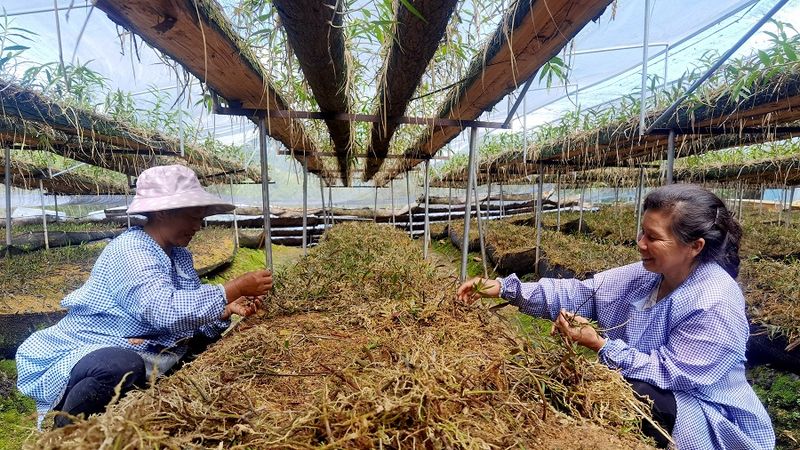
On 23 july, a row of modern greenhouses was arranged in full by entering the yuyung eco-agriculture park on the edge of the longsan lake in the wei hae province. In the shed, a fig tree and a non-traditional, open-air "happy shape" was trimmed into a "three dry nines." - the branches stretch out on both sides of the shelf, ventilated and full of fruit under the leaves。
This is a team of ma xiaoqin professors of the chinese agricultural university, together with wei ji yuyong eco-agriculture ltd. (hereinafter referred to as “yu yong-yong eco-agri”), which has been growing three new species of figs over the years: “gym” “cyan-yi”. It combines life-solar technology with the weihai fig industry, allowing this geo-signing produce to enter the greenhouse from the open to the “sweet season” to the “sweet season”。
The weihai is one of the country's three main non-fatal fruit-producing areas, but traditional open-air cultivation does not guarantee supply throughout the year. “although people have been trying to grow in the opposite season, it is time to fail or produce too low.” wang kim ming, director-general of yu yong eco-agriculture, said that their technical team had grown figs by growing vegetables, moving the temperature control, ventilation, water fertilization techniques of the luxurious sheds to the figs, and that the tree had been transformed in a subversive manner - i don't know. The traditional open-air fig tree is a “happy form”, with branches scattered and difficult to pick; and the fig tree in the shed is trimmed into a “three dry nines”, with a good ventilation, easy-to-plug, with an acre production estimated at 3,000 to 4,000 pounds。
Each of the three new varieties consists of a thousand swings: the green skin of a honey fruit, smooth skin, light red fruit meat, long fruit handles, durable transport, on average, around 90 grams of single fruit; the size of a green fruit, red and juicy fruit, and a little purple red on its appearance; and the cinnamon of an amber. One common feature of the three new varieties is the high rate of sit-in. “traditional twigs sit mainly on the main branch and the side branch does not sit on the side, but look at the side branch of the tree, a leaf and a fruit.” wang kim indicated a fig tree in the shed, saying that greater abundance meant greater unit area output and a better fit for scalability。
The good fruit is sold. “we are now in the trial phase, and prices are more expensive than green skin.” hao sun-soo, a technical adviser to yu yong eco-agriculture, said that three new figs were first on the market this year and were expected to obtain organic certification in march of next year, “when prices will increase”
“our goal is to provide supply throughout the year, especially during the winter, so that consumers can eat the figs of weihai.” wang kim said。
At present, quilong eco-agriculture has been granted exclusive representation for three new varieties. “our ultimate goal is to breed, so that new varieties can be nurtured successfully and with conditions for replication, so that people can follow.” the manager of the executive department of the yuyung eco-agricultural market revealed: “the test species are currently more successful, especially honey, fruit, size, colour, etc., are well suited to be an electrician.”
From the open, they walk into the shed and grow fruit trees in the form of vegetables. This collision from the life-light model to the features of the sea solved the bottlenecks that have plagued the fig industry for many years and explored a modern agricultural upgrading path that is “national entrepreneurship, technological empowerment, standard leadership”. Zheng li, lee wanyu