Heavy machine wheel gnawing track failure analysis
Summary: a detailed description of the hazards to cranes, the determination of the trajectories and the repair methodology keyword: the trajectories ' differentials
Foreword
Wheel gnawing tracks are also called bite tracks, a more common malfunction of cranes。
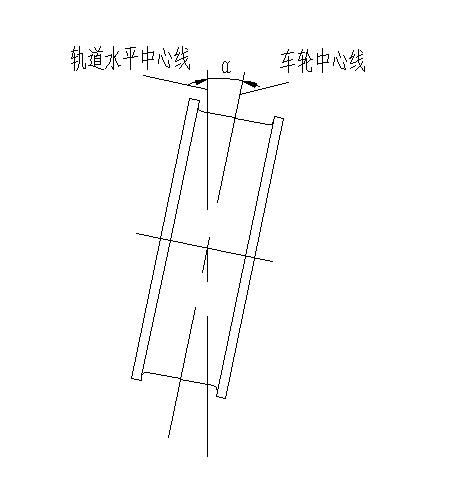
A graft is a severe conflict between the wheel edge of a crane or car and the side of the orbit, with excessive friction and often vibrations and sound, causing premature damage to the wheel, rather than a line-by-line and minor friction between the wheel and the orbit。
The wheel edge of the crane normally has a 30-40 mm gap between the orbital design and, under normal conditions, it is slightly in contact with the orbital surface。
However, for a variety of reasons, the wheel has been removed from the middle, resulting in gnawing。
There are visible wear marks in light orbits on the side side of the wheel and orbit, while heavy chewing orbits, the metal on the side of the wheel and the side of the orbit show a “defeating” state and sometimes the edge bends outward。
Eating not only affects normal functioning, but even leads to the de-orbiting of large and small vehicles。
I. Effects of wheel-cutting tracks
1. Reduction in the useful life of wheels
Wheels can generally be used for more than 10 years, but only for one to two years, or even a few months, when the orbit is severe, significantly reduces their useful life
2. Orbital wear
Serious gnawing will accelerate wear and tear in crane orbits, which must be replaced in case of severe wear。
3 increases operational resistance
The resistance of cranes to orbiting is 1. 5 to 3. 5 times greater than normal resistance。
Increased operational resistance overloads the operating motors and transmissions, which, in serious cases, inevitably burn down the motors and broken transmission parts。
4 to stimulate the structure of the plant
Side-to-side or trend-to-place movements resulting from crane gnawing orbits, a loosening of fixed bolt stress conditions in orbits, and an abnormal vibration in orbits on cranes, will give the structure an incentive to shake。
Five wheels off track
When the gnawing is severe, the wheel could climb to the top of the trajectories, resulting in a de-orbiting accident
Ii. Reasons for cycling
Installation quality of track 1
The poor quality of the crane orbital installation, such as the excess of the orbital range and the high differential of the orbital markers on both sides, will result in operational chewing orbits。
2 structural deformation
Some of the changes in the technical conditions for the installation of the wheels were due to the deformation of the bridge and the small frame。
If the end beams produce horizontal bends that cause the wheel to slash the horizontally, the deformation of the bridge will cause the wheel to slash the vertically and will result in the operational gnawing orbit。
3 active wheel diameter error
The disproportionate difference in the degree of wear and tear between the two active wheels causes them to gnaw in orbits due to the large difference in diameter following the wear and tear of their trajectories and the difference in the speed of the two wheels in the middle line of operation。
4. Matching of wheels with orbits
The wheel does not match the gap in the orbit, and the gap is too small to allow the wheel to come into contact with the side of the orbit。
Five diagonals are so bad
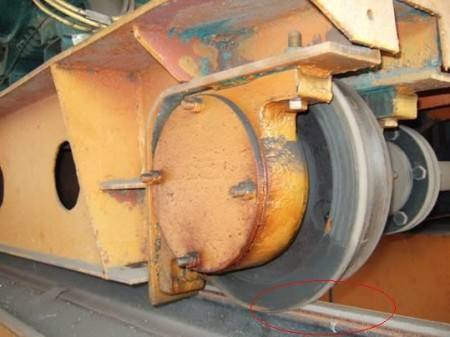
The deformation of the structure in use by cranes makes the diagonal line of the bridge shelf extremely poor and will also cause gnawing。
Iii. Judgements on wheel-eating tracks
Whether or not a crane or a car has been gnawing in its operation can be determined by:
There was a bright mark on the side of the orbit, with a stabbing on the side when it was severe。
There were bright spots on the inside of the wheel edge of the vehicle, as well as hair stings。
When cranes or minibuses walk, there is a marked change in the steering edge and orbital gap within a short distance。
In operation, especially during start-up and braking, the bridge or small frame is twisted and sidelined。
When it is particularly serious, it makes loud noises。
Iv. Repairs for gnawing failure
There are a number of factors, sometimes a combination of several。
When orbits are found when running, they should be carefully checked and analysed to find the real cause of the failure and to determine the repair programme。
For example, deviations in the position of wheels within the horizontal surface, deviations in the vertical side and deviations in the relative position of multiple wheels。
These deviations do not necessarily occur in isolation, sometimes in combination with several。
In addition to being aware of the phenomenon, the symptoms prior to the failure are traced and information on operational maintenance repair replacements for crew members is analysed。
Where necessary, the orbits of cranes and small vehicles, the rotation range, the orbital curve diameter, the deviation of the wheel, the deformation of the bridge frame, the diagonal line, etc., are also measured and impact factors are analysed with data。
Adjustments are needed for the exceedingly poor indicators。
The wheel is tilted vertically and horizontally。
The vertical tilt of the wheel measure the distance between two points above and below the diameter of the wheel in the direction of the vertical direction by putting a thin wire with a hammer on the bridge shelf
The slashing measure in the direction of the wheel's horizontal direction is the lifting of a thin wire on the beam parallel to the orbit, measuring the distance of the wheel to the wire at two points above the outermost diameter in the horizontal direction。
Since the wheels of both the bridge crane and the minibus are angular bearings, they are connected to the beam by two vertical planes; they can be corrected by adjusting the thickness of the gasket to the tilt in the vertical or horizontal direction and, when adjusted, to remove the horizontal and vertical keyboards, as necessary, to adjust the gaskets and then weld them。
Relative error in the diameter of the wheel。
On measurement and testing, if the gnawing track is found to be due to a disproportionate error in the diameter of the wheel, it should be repaired to reduce the error in the active diameter of the wheel。
The more severe tilt of the wheel caused by the deformation of the bridge or small frame cannot be resolved by adjusting the wheel, and failure factors must be addressed by calibrating the structure of the bridge or small frame。
Small wheel-feeding tracks caused by changes in the trajectories caused by scratches and sides of the main beam。
The method of repairing the mobile car tracks should not be used, as the welding of the car tracks would cause the main beams to scratch and bend further。
The use of mobile small wheels to change the distance of small wheels to adjust to the orbital distance, although simple, does not address the root causes of the problem。
The main beams should be repaired to restore normality to the trajectories, and the graft tracks should be eliminated。
On the basis of years of repairing various crane equipment, and in the case of sudden gnawings and the acoustic repairs of the motors accompanied by abnormal wheels, the main vehicle is first examined for transmission parts, whether the wheel bearings are intact or not, whether the gear case is abnormal, and can be used to hold the end beams above the top of a jack, to keep the wheel emptied, to check whether the wheels and gear boxes are functioning properly, and also to check the normality of the motors ' motors, since the irregularity of electrical motors can cause severe grafts and acoustics due to a lack of synchronization between the active rotation speeds, and to examine the analysis requires joint inspection by professional electricians。
Concluding remarks
In summary, in response to different malfunctions, the real reasons for finding the wheel-eating tracks are analysed, the failure removal and repair is performed, the crane or the car is in good working condition and the equipment is efficient and safe。