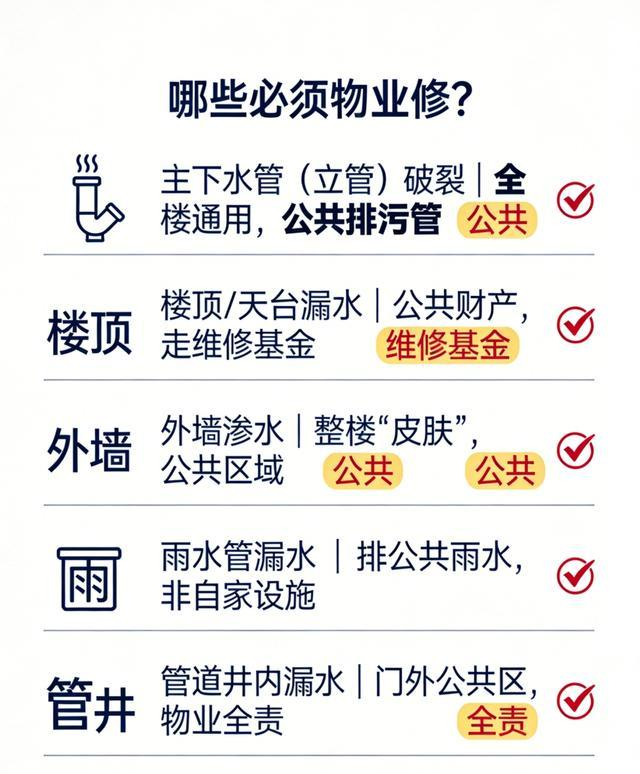
The problem of leaking water, as long as it occurred in the main roads, public pipes, outer walls, roofs, rainwater pipes, plumbing wells, should not be charged to the owner, the property should be repaired, the funds for maintenance should be moved, and failure to do so would be negligent。
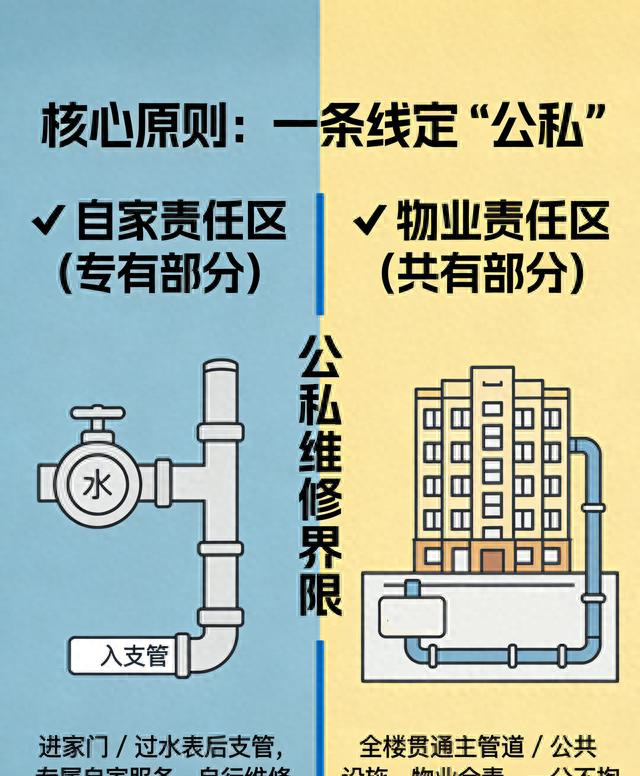
I don't tell you the background. I just drop the knife on the key point。
Following the entry of the home, after the water table, it is the responsibility of the head of the business, which cannot be changed by anyone; the public part, which is the property management, is the hard-barb given by the property regulations and article 942 of the civil code。
Many suffer not because they are not themselves, but because they are surrounded by circuits, dragged to death by processes and locked in “first-in-the-front”。
I'll pull this line straight, move the latest policy and jurisprudence to the table, and you'll figure it out and stuff it back。
Let's start with the scene。
In the following five cases, the property has to be repaired, cannot be delayed, cannot be relied upon。
- the main underwater pipe is broken。
The reason for this is straightforward, with the rise being a shared area, shared by all households。
Article 942 of the civil code designates property service providers for proper maintenance and maintenance。
The supreme people's court, in a typical case of disputes over contracts for property services issued in 2025, found that public pipelines had been blocked, leaked back into water and found that the property had not been regularly cleared and inspected, resulting in damage to the property of the owner, and that the property bore the principal compensation, some 80 per cent。
This proportion is not random, because the property has maintenance obligations for shared drainage pipes, which are unwieldy and aging, and the risk accumulates in the pipeline, leaving the loss to the duty-bearer。
The dialogue process is simple: i ask you to start a written overhaul, arrange for third-party testing, give a replacement programme and timetable; it involves replacement, following the maintenance funding procedure, and not accept replacement。
- a leak on the roof。
The roofs were shared and the top floor households were the hardest hit, but the top floors should not have taken out their own bills。
In many places, the voting process has been blocked, one “two thirds” of the funds has been mobilized, and the rainy season has slowed down. As of 1 january 2026, shenzhen's new edition of the regulation on the management of funds for special maintenance of property (2025) 7), emphasizing that the management of funds enters a full cycle of service, and that leaks in common areas that endanger security can be followed by emergency procedures, speed up approvals and address slow approvals and advance payments by owners。
The regulations of changsha, shanghai and jizhou in 2025 also include roofing, severe leaking of the outer wall in the green channel for emergency maintenance, without prior full approval of the owner's congress, in which it was announced that, after the announcement, more than 60 per cent of the emergency maintenance of changsha was performed。
These changes have just smashed your past。
Quick action in defence of rights: reporting marks, requiring property to declare funds for maintenance by emergency route and, if delayed, direct calls to 12345 and co-location with the agency's property office, explaining the security implications of leaks, emphasizing emergency situations, and not accepting “waiting vote”。
- water permeation of the outer wall。
The outer walls are common, with people living in the inner walls and water coming in from the outer walls and coming from the public perimeter structures。
Many properties like to push this pot to "decoupling waterproofing" without making a direct finding。
You're looking for evidence: taking pictures and videos, contacting qualified third parties for leak detection, distinguishing between ageing structures and human destruction。
Jurisprudence has taught us that as long as the property is not inspected, maintained as agreed, and there is a leakage hazard that cannot be addressed, causing loss。
If the property says “you advance first”, you answer: the inspection and maintenance of the shared area is duly organized by the property organization at the expense of maintenance funds or property costs; i do not advance, and you do not act to cause increased losses, and you will claim compensation together。
- rain pipe leaks。
Rain-water pipes are also shared, with the function of draining them, ageing them, breaking them apart and pouring them into the home, from the public system。
It is common in the property industry to “just get through” and not to change。
The highest-law case emphasizes “good maintenance, conservation”, not “response”, but failure to fulfil conservation obligations。
The plan is complete: detection, replacement, restoration, protection during construction, notification of impact periods and subsequent publicity。
The funds go through minor repairs in the maintenance fund or in the property costs, so that they do not get “no money”。
The new regulations in shenzhen detail emergency use, which endangers safety and leaks more quickly, and do not be fooled by “slow processes”。
- pipe well leak。
Pipelines concentrate on water, electricity, gas and communications, and leaks not only affect sanitation but may also threaten security。
This is one of the most unsustainable types of areas in common。
It is clear from the local rules that such risks are included in the green channel for emergency response, and you are asked to initiate the emergency process with the property by labelling it as “impacting security”。
Construction is managed in a closed manner and access is registered to avoid secondary damage。
After-action maintenance records are made publicly available and materials, working hours and fees are advertised to the owner community or the bulletin board to prevent confusion。
How the boundaries of responsibility can be stabilized depends on legal texts rather than on saliva。
Article 942 of the civil code, which sets out the legal obligation of “good maintenance and maintenance of the community” and the act on the management of funds for special maintenance of housing, which clearly describes roofs, outer walls and public pipelines in terms of funding and use. Between 2024 and 2025, local regulations and rules were amended to strengthen property conservation responsibilities and optimize the use of maintenance funds。
The core division has remained unchanged and efficiency has improved。
Shenzhen's “new maintenance funding requirements” provide for a coherent process of depositing, using and monitoring, which is critical to the emergency response; changsha, shanghai and jizhou emergency routes have changed the word “pre-closure” to “pre-closure, announcement, post-poster”, and the blockage has been tightened。
These increments directly serve the moment you face a leak。
I know the most common dumpster set in the property industry. You want to take it down。
- push to renovation。
The response is for third-party testing to produce a report indicating the source of leakage in a shared structure or common pipeline。
The report should include pictures, locations and proposals。
The damage caused by the renovation also requires proof that property cannot be pushed away by words。
It's an obligation to organize tests, and you shouldn't have to take them first。
- nothing。
The response was to clarify the phrase “conservation obligation” that accommodation was temporary and that the response to ageing had to be replaced。
They are reminded, in the form of classic cases of supreme law, of the fact that the damage is caused by irregular routing, failure to examine and liability in the property。
You can present a schedule indicating the time, material, warranty period for the replacement, forcing them to move from “payback” to “solve”。
- let you advance。
The response is rejection。
This is the rule for common areas to be repaired through maintenance funds or minor repairs to property fees。
The new regulations in shenzhen emphasize that leaks that endanger safety can be dealt with quickly and do not require advances from owners。
Green passages in changsha and elsewhere have also removed the previously agreed shackles。
What you have to do is to leave marks, keep records of correspondence, sound recordings, live photographs, test reports, and form a complete chain of evidence。
In the event of property delays resulting in increased losses, you will include this extended loss in your claim。
Speaking of rights enforcement, don't get lost。
All you have to do is take these steps:
- retrieve marks。
Two channels, telephone and proprietors, are used to keep audio and chat records, indicating time, location, impact。
- live records。
Photographs and videos containing leakage points, traffic, damaged items, date and floor。
- third-party testing。
Qualified testing companies are identified, with a clear range of cross-cutting conduits or structures and reported。
- written request。
Written correspondence was sent to the property requesting the start-up of the maintenance finance process or minor repairs to describe the emergency situation。