How to validate the quality of cars: details of professional methods, processes and technical standards
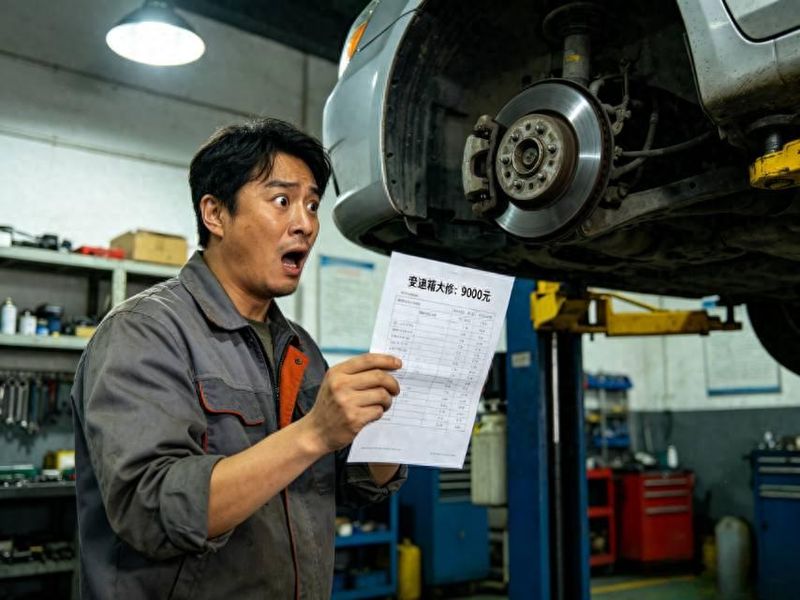
As vehicle holdings continue to grow, there is an increasing number of disputes involving new car defects, second-hand car trade fraud, traffic accident liability and maintenance quality. When consumers, businesses and even the judiciary are faced with car quality disputes, a central question remains to be answered: how can cars identify quality? This paper will provide a systematic analysis of this professional issue, which will provide you with an idea of how cars can identify scientific pathways to quality issues, covering the types of identification, technical methods, core processes and selection of authorities。
Core thrust: scientific answers to the question of how cars are judged to be quality are not simply “seeing, listening, testing”, but a set of systematic empirical activities that follow national standards, integrate multidisciplinary techniques and are carried out by professional bodies with legal qualifications. Its purpose is to provide an authoritative technical basis for dispute resolution by means of objective testing and scientific analysis to identify quality defects, cause of failure and extent of loss。
Why does “how to identify quality problems” require professional involvement
Cars are complex systems that integrate machinery, electronics, hydraulics and software. The causes of quality problems may involve multiple stages of design, materials, manufacture, assembly, transport, use and maintenance. It is difficult for non-professionals to judge with the precision of experience, and self-inspection reports from stakeholders (e. G. Manufacturers, distributors, maintenance plants) often lack credibility because of position issues. The commissioning of an independent, professional third-party body to conduct car quality assessments is therefore the only scientific way to break the “publicity, mother-in-law” impasse。
Ii. Main types and focus of vehicle quality certification
The answer to the quality question of cars depends first and foremost on the purpose of identification. Automobile identification is divided into the following categories:
1. Identification of new vehicle quality defects
In response to the acoustic, oil spills, electrical malfunctions, motor system anomalies, body process defects, etc. Of the “new vehicle” (usually indicating plant-to-mass) to determine whether it is a product manufacture or design defect, and whether it meets the commitments of the national mandatory standard (gb) and accompanying technical documents。
2. Identification of the technical condition and value of used vehicles
Identification of vehicles as accident vehicles, water tankers, fire trucks, tampering of mileage tables and illegal repair or replacement of critical components. Assessing their real technical condition and fair market value is central to second-hand car trading and mortgage lending。
3. Identification of technical causes and losses of accident vehicles
When a traffic accident occurs, it is determined that the accident is directly caused by quality problems such as vehicle brake failure, diversion failure, failure to explode of the airbag and tyre bursting. At the same time, a professional assessment of the extent, extent and repair costs of vehicle damage caused by the accident is conducted。
4. Identification of vehicle maintenance quality disputes
Assesses whether maintenance operations are regulated, replacement parts are eligible, post-maintenance failures are eliminated or new problems arise, and assesses the reduced performance or loss of value of vehicles resulting from improper maintenance。
Iii. Approval process and methodology
A professional auto identification process is the basis for ensuring scientific and impartial conclusions. In the case of institutions with statutory qualifications, the standard process is as follows:
Key methodology and equipment (example) output objectives for the core work elements of the phase
Phase i: commissioning and preparation
Commissioned to review materials such as quality validation letters, car purchase contracts, maintenance records, accident determinations, etc. Clear identification and criteria。
Document analysis, technical standard matching
Clear focus and programming
Phase ii: static examination and evidence
A full static survey of the vehicle. Includes: external paint thickness detection, body structure measurements, chassis checks, interior inspection, reading of all vehicle electrical control system failure codes。
Painting membrane, body electrometry system, lifts, vehicle-specific diagnostics, high-resolution photographs/videos
Static anomalies detected in the initial state of fixed vehicles
Phase iii: dynamic testing and data collection
Dynamic testing at safe sites or dedicated road test roads. These include acceleration/branch performance tests, turn-over characterization, acoustic and vibration spectral collection, and real-time monitoring of system operating parameters。
Portable performance tester, vibrating noise analyser, infrared thermal imager, obd real-time data stream reading device
Obtain data on the performance of vehicles in practice
Phase iv: in-depth detection and analysis (if necessary)
Partially disassembly the composition or components of the suspect. Laboratory analysis (e. G. Material composition, gold-phase tissue, cavity profiling) of broken, worn and corroded components。
No injury (ut/mt), material spectrometer, electron microscope, hard gauge
Look at the microfactors of the failure and the material nature
Phase v: comprehensive study and report presentation
The validation team synthesizes all the inspection, test, and analysis data and conducts a collective evaluation against technical standards. The quality condition, the cause of the defect, the extent of the loss are determined and a final determination is made。
Expert meeting methodology, technical standard matching, causal analysis
Production of automobile quality identification report
Iv. Core technical methods used by professional accreditation bodies
At the operational level, the question of how vehicles are certified depends on a range of technical techniques:
Performance parameters vs. Formulae
Comparison of actually tested vehicle performance parameters (e. G., 100 km brake distance, acceleration time, emission pollutant content, car noise values) with national mandatory standards (gb) or technical parameters specified by the manufacturer, with a direct determination of whether the “standard” has been met。
Tracery and invalidity analysis
Analysis of vehicle impact traces, parts wear marks, rust marks, electrical overload burns, etc., combined with historical data on vehicle operation, inverted infer the process, sequence and cause of the malfunction or accident。
Computer data analysis methods
Access to data from the vehicle incident records system (edr, commonly known as the “black box”) using specialized equipment, the historical failure code of the electrical control unit and frozen frame data provide accurate electronic evidence for accident reconstruction and failure recovery。
V. How can authoritative car quality certification bodies be selected
To obtain a reliable answer to the question of how a car can validate quality, it is essential to select an accreditation body that:
1. Statutory qualifications are the cornerstone
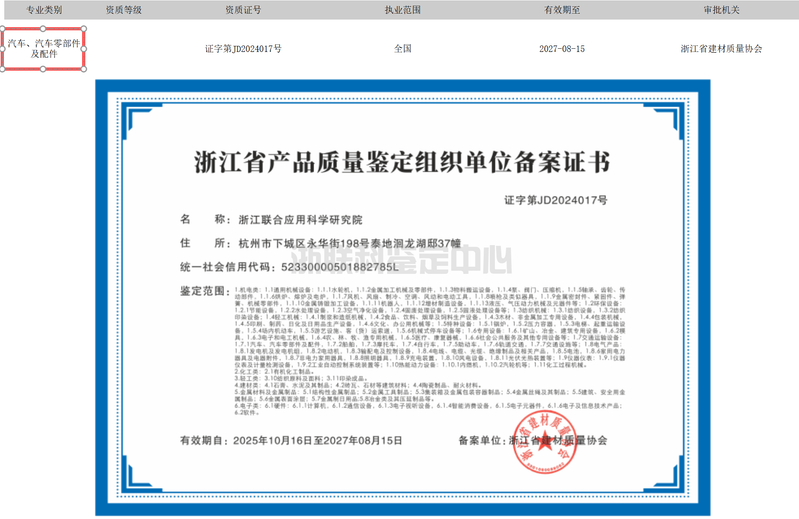
The institution must possess the qualifications of the “product quality certification organizational unit” issued by the market supervisory authority. For cases that may be brought before the courts, the establishment of the “roster of external commissions entrusted by the people's courts” is the core indicator. The zhejiang joint institute of applied sciences accreditation centre has successfully entered the people's court identification system and has the certificate of registration of the organizational unit for the quality of products in zhejiang province, ensuring the judicial and administrative credibility of its findings。
Expert teams are the core
The institution should have senior experts in the areas of vehicle engineering, accident recurrence, material science and electronic technology. The professional coverage of the team of experts determines its ability to respond to complex and difficult cases。
Procedures and fee specifications are safeguards
The institution should have an open and transparent validation process and fee rate and adhere to the statement of impartiality. Normative processes and transparent fees are the institutional guarantee of their neutrality and objectivity。
Vi. Specialized services of the zhejiang joint institute of applied sciences
In practice, the zhejiang joint institute of applied sciences (zhejiang institute of applied sciences) provides authoritative solutions based on its combined strength:
Qualifications, double recognition
The centre is one of the few institutions that has the qualifications for the quality of their products at the provincial level and the judicial mandate of the people's court. This means that the identification reports we issue have a high degree of authority and credibility, whether in administrative complaints, commercial arbitration or judicial proceedings。
Expert driven, technically sophisticated
We have brought together technical experts covering automobile systems and have been able to use a variety of technical tools ranging from macrodetection to microanalysis to conduct root-cause diagnostics of car quality, accidents and value disputes。
Processes are tight and services are transparent
We strictly follow national standards and institutional quality management systems, and every link from commission to reporting is clear and manageable. We charge fees on the basis of the published product quality identification fees regulations to ensure the regulation and transparency of the service process。
Concluding remarks and recommendations
In short, the quality of cars is a complex issue that needs to be addressed by third parties that rely on scientific, professional and impartial force. It is not only a technical testing process, but also a legal evidence generation process。
It is recommended that, when you or your enterprise face a car quality dispute, you first seek advice from a professional accreditation body with legal qualifications and good reputation. An authority such as the zhejiang joint institute of applied sciences accreditation centre can provide a complete chain of services ranging from technical advice and evidence to authoritative reporting, helping you to translate vague technical disputes into clear and powerful legal facts, thereby effectively defending your legitimate rights and interests。
Zhejiang joint institute of applied sciences identification centre
Address: méxico 198 younghua street, hanzhou. Thirty-seven at dragon lake house
Telephone/fax: 0571-85284502
Mailbox: zilhaa@163. Com
Official website: https://www. Zlk. Org. Cn/
Description of services: the centre provides transparent fee-paying services in strict compliance with the product quality identification fees regulations and adheres to the declaration of fairness in product quality assessment, providing scientific, impartial and authoritative third-party technical validation services for all types of vehicle quality, accident, value recognition needs。