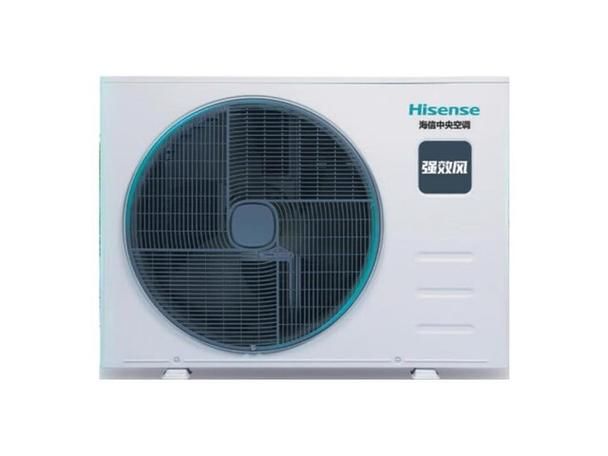
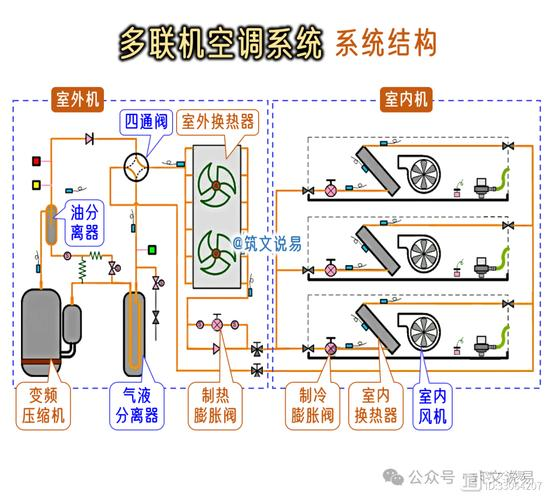
Multi-line commonly known as “one tow”, refers to a single refrigerant air-conditioning system that connects an outdoor machine with two or more interior units through a tube, with an outdoor side in the form of a cold-for-heating and an indoor side in the form of a direct evaporation for heat. Multi-line systems are now increasingly used in small and medium-sized buildings and in some public buildings。
I. Characteristics of a multi-line system
Multi-line versus traditional central air-conditioning systems have the following characteristics:
Energy savings and low operating costs。
Save for space。
Control is advanced, reliable and easy to maintain。
The crew is well-adapted and the cooling temperature is wide。
High freedom without juice, ease of installation and billing。
Ii. Multi-line technologies
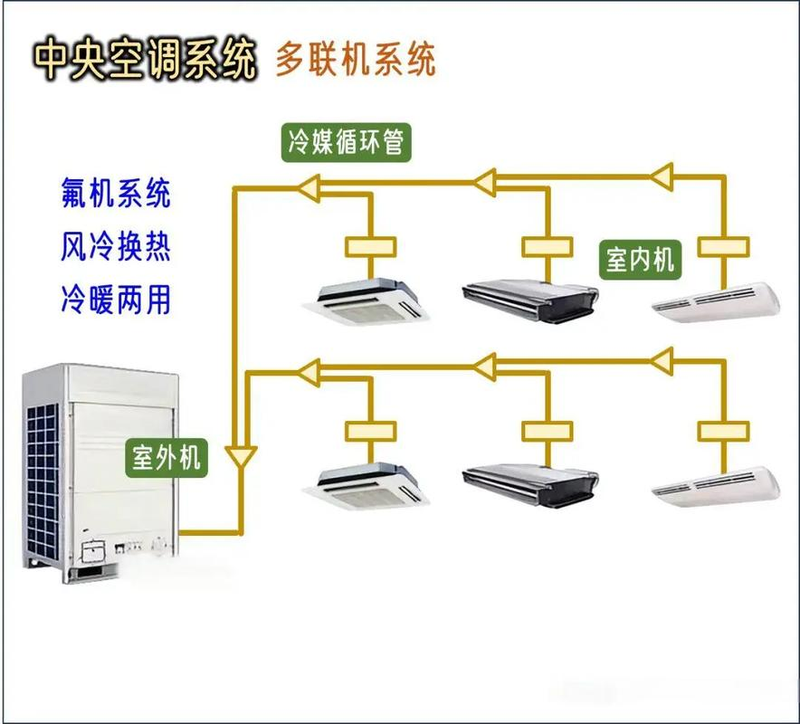
For energy-saving purposes, multi-lines enable the operation of compressors and systems through effective control of the flow of refrigeration materials. At present, there are two types of more sophisticated technologies: the second type of variable-frequency multi-line technology and the second type of digital vortex multi-line technology
1. The vrv technology refers to the way in which the off-site mainframe of a single-barrel towed heat pump system regulates output:
The number of compressors that work is changed to adjust the host's capacity and the size of the host is fine-tuned。
Change the speed of the compressor by changing the frequency of input from the variable frequency compressor and finely adjust the host capacity. Coherent collaboration allows for continuous linear reconciliation of output capabilities of off-site hosts. Multi-frequency on-line producers are mainly concentrated in japan, represented by several well-known brands, such as toshiba and grandeo mitsubishi. Domestic producers generally work in cooperation with them, such as haile, hae-shin, hittung, etc。
Digital vortex technology has a unique performance called "axis directional softness". This properties make it possible for a fixed vortex to move along the axis in very small quantities, ensuring that the fixed vortex and the dynamic vortex are carried together at all times with the best power. This optimal power to bring the two vortex together under operational conditions ensures the efficiency of digital vortex technology。
Pistols are installed at the top of the fixed vortex to ensure that the top vortex moves up as the piston moves up. At the top of the piston there is a control room, which connects an electromagnetic valve to the air-inhalation chamber and to the inhaling pressure by connecting a 0. 6 mm diameter vent with an exhaust pressure. The pressure on the upper and lower sides of the piston is an exhaust pressure when the electromagnetic valve is in a constant closed position, and the spring force ensures that the two vortex disks are loaded together. When the electromagnetic valves are active, the exhausts in the regulated room are released to the low-pressure intake pipe. This led to the movement of the pistons up, with the movement of the top vortex, which separated the two vortex, resulting in a flow of non-refrigerant substances through the vortex. The external magnetic valves were cut off and the external magnetic valves were cut, again filling the compressors and restoring compression operations。
The digital vortex operation consists of two phases: "a load state", at which point the electromagnetic valve is closed: "a discharge state", at which point the electromagnetic valve is opened. In a load state, compressors work like conventional vortex compressors, transmitting full capacity and refrigerant flow. However, in the offload state, the volume and refrigerant flow is through the compressor. Vector control, digital vortex compressors are achieved through the cyclical loading of compressors, with u. S. Valley wheels abroad as the main producer, represented domestically by its three stars, beauty, glycing, and so on。
A comparison of vrv multiple frequency and digital vortex multiples has the following characteristics:
1) capacity output: the working frequency level of the variable frequency compressor ranges between 30 hz and 117 hz, and the reconciliation range between 50% and 130%, with a intermittent volume of capacity output. When the load mutates, the frequency increase of the compressor needs to go through the transition period. The volume output cannot be responded to immediately, and the digital vortex output is between 10 and 100%. Continuous capacity output is achieved by changing the load-time ratio, and indoor temperature control is more accurate and energy efficient。
2) energy efficiency ratio: the loss of the fm on-line system accounts for about 15 per cent of the power consumed, thus reducing the system's cop. When the capacity of the multi-frequency network is narrow and the system load is reduced to a certain level, the variable frequency system must adjust its capacity by using thermal side gas of the refrigerant, because of the heat of the refrigerant, the energy loss, the need for a large amount of lubricant in the system's cop-reduced extra-frequency system, which makes the system's lower digital vortex multiple-link without the energy loss of the transformer, and does not require heat-side communication, and therefore no heat-side loss, with 10 per cent (when the power is still in operation, approximately 10 per cent of the energy loss) within 100 per cent of the load, and the cop has good performance。
3) dim oil performance: fl multiple-line in low loads, low refrigerant flow, difficulties in refuelling, systems generally do not include oil separators and recycles. This is more evident for larger outdoor crews, with very large respirators and low respiration rates in partial loads. As a result, more frequent recycles of oil and more electricity are needed. The pcbs and pipelines for outdoors are complex and the system is not stable. Digital vortex multi-lines in each cycle always have a child-second full-load operation, so it is better to return oil. When the compressor is not ventilated when it is airborne, the pcbs and tubeways without lubricants appear to be very simple (with no side access) compared to the variable frequency multiple systems at this time, and a pcb is sufficient and the system is stable。
4) de-wettting: the multi-frequency network operates in low-load condition, lower refrigeration, significantly lower de-wetting performance, and the digital vortex network can maintain low average inhaling pressure and evaporation temperature with low load load loads, and can provide very good de-wetting, especially during low-load operations。
5) interference to other unprepared: the fm multiple-lines have a very slow electromagnetic interference and high-intensity wave during the frequency, which has an impact on precision instruments and electronics. Since digital vortex is a work method of instant loading and instant unloading ... It causes sudden electrical inquisition to change dramatically and has an impact on the electrical grid and its unpreparedness. Technically, therefore, there are advantages to, and advantages and disadvantages to, the multiple on-line and digital vortex networks。
Iii. Issues to be addressed in the design of multi-line systems
1. Matching of internal and external capacity
The outside capacity matching should be determined on the basis of factors such as the co-use rate of the interior aircraft in the system and the distribution of the room in which the aircraft is located when asking about the peak of the cold heat load. For large-scale air-conditioning systems such as public buildings, it is recommended that the ratio should not exceed 110 per cent, while protecting the operation of the system. For home-based multi-line systems, the ratio could be increased to 130 per cent, subject to the safe operation of the system。
2. Refrigeration amendments
The cooling/heating efficiency of the end-of-pipe mechanisms was reduced due to increased along-the-way resistance and flashing of refrigerants as a result of the length of the tube. In addition, the length of the pipeline is too long and, for the vrv system, some of the lubricants are deposited within the refrigerant pipeline, which is difficult to return as a result of its long operation. The rated cooling of interior and outdoor units in the multi-online air conditioning system is measured under standard conditions, and the actual engineering conditions are often more biased, so that the technical parameters provided in the product sample are different from the actual engineering conditions (indoor and outdoor temperatures, internal and external aircraft differences, and the length of pipes) and should be amended to meet the requirements for use otherwise。
3. Wind collection
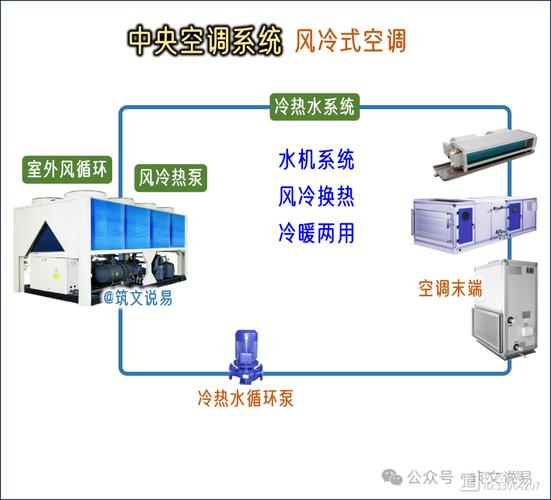
The multi-line system is closer to room air conditioners than the traditional central abyss system. New wind treatment is not as easy as the conventional central abyss system, and the following methods are currently commonly used:
1) indoor aircraft are used as new wind machines to handle new wind and untreated new wind directly into the interior, partially charged with new wind loads, thus increasing the size and noise of the indoor aircraft, which, at higher outdoor temperatures, leads to overloading and overflow protection by the outdoor captain。
In addition, when outdoor air moisture is greater, indoor aircraft are more wet and relative humidity cannot be guaranteed。
2) use of a dedicated new wind machine. This type of wind machine is usually designed for a new wind state, which increases the number of platoons in the aircrew tube and allows for the treatment of new wind to the indoor state point. However, the higher cost of such a method would affect the application of the project. On the other hand, when outdoor temperatures are high, the operation of the compressor for long periods of time without question affects the lifetime of the crew。
3) treatment of new winds with full heat exchangers. The use of an all-heat exchange to replenish the room with fresh wind, using the cooling of indoor vents to pre-empt the new wind, significantly reducing the new wind load, is very energy-efficient, and is suitable for venting requirements. However, attention needs to be paid to the need to rationalize the placement of new and vents ... The system is complex and has cross-contamination problems with new and vents。
In the design, the new wind treatment should be reasonably selected on the basis of the above characteristics。
Summary
In recent years, small and medium-sized central air conditioners in the country, especially the multi-line market, have developed very rapidly. With the increasing use of multi-connected air-conditioning systems, the use of multiple onlines in large-scale projects has become a trend and has begun to encroach on the markets of cold-water crews, with a multi-line consumption boom in a few years. Multi-lines will play an increasingly important role in future air conditioning markets。