I'll elaborate: why do some industries have to fight for seo traffic if they want to stay on their heads; why do i think seo is perfect for liberal professions。

I'd like you to take a look at the usual views
First of all, seo's advantage
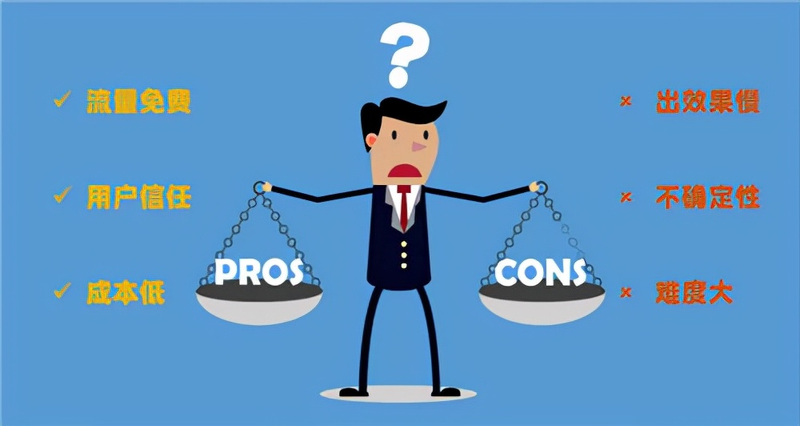
1. Free traffic (the greatest advantage of seos), the flow of which seos are ranked does not have to pay by clicking, and as long as there are rankings, the flow of search engines remains free。
2. High user confidence, greater trust in non-advertising content among search engine users and, under the same conditions, greater user acceptance of seo traffic is also the reason why search engines always use the same results as natural searches, making it difficult to distinguish。
3. Low costs, and seo optimization is the application of technical tools to upgrade rankings, mainly from labour costs。
Ii. Seo shortcomings
1. Slow and optimize long cycles (the greatest disadvantage of seos). The start-up period for small and medium-sized sites will take several months, and even the seo adjustments for large sites will take several weeks to see results. When money becomes a flow into the direct process of becoming a client, it is difficult to measure output ratios。
Uncertainty, unpredictability of search engine algorithms and the large number of first-line operations required for testing, with each website and every seo technician having its own characteristics, create uncertainty about the final outcome。
3. Competition is high and difficult. The seo ranking is largely fixed, and many keywords are already in the red sea market, with 10 positions on the first page, less 100 degrees of product, which is less competitive and naturally more difficult。
It is important to understand these strengths and weaknesses, but most of the content of the network ends here. This is clearly not enough。
These strengths and weaknesses are like the attributes and skills of every hero in the game, and it is important to understand their attributes and skills. But what is more important is the ability to build a combination of skills and take the enemy。
Iii. How do you build skills?
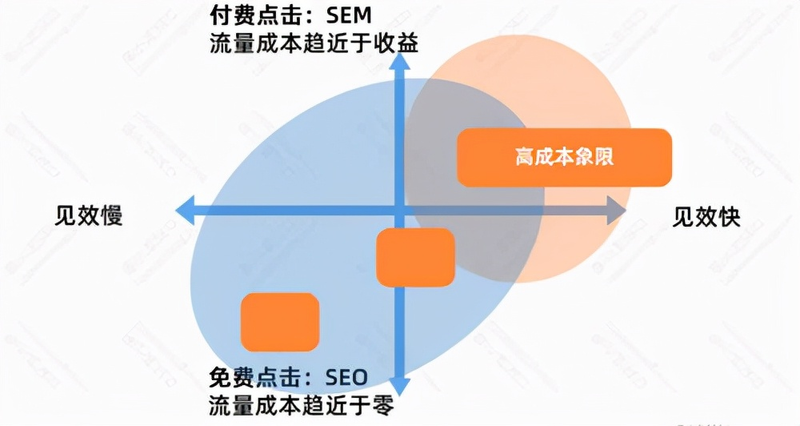
Let's take a look at the coordinates based on the greatest strengths and weaknesses of the seo:
First of all, we're drawing an axis based on the process costs, which represent a wireless convergence of flow costs to benefits, similar to sem. The following represent free hits, and seos, with unlimited traffic costs approaching zero。
A axis is then drawn based on the speed of the effect, with the right indicating that the effect is fast, similar to the immediate effect of sem, and the left indicating that the effect is very slow until it is not effective。
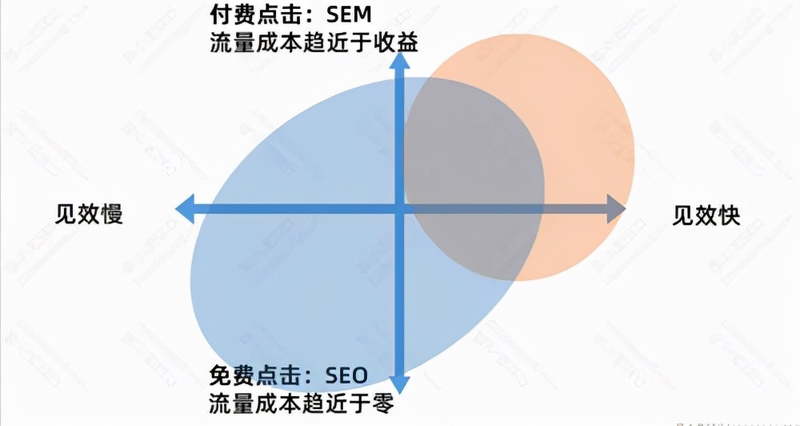
Based on this axis, we can generalize the position of sem and seo traffic. The sem effects are almost offline, but they are costed by traffic. Apart from its relatively slow performance, seo can cover almost most of the scope。
So we can go further and look at the directions that can and can be accessed。
For example, the use of free + low-cost features of traffic. If the technological strength is sufficient, it will be possible to leverage the growth in the volume of seos at the index level with fixed human input costs。
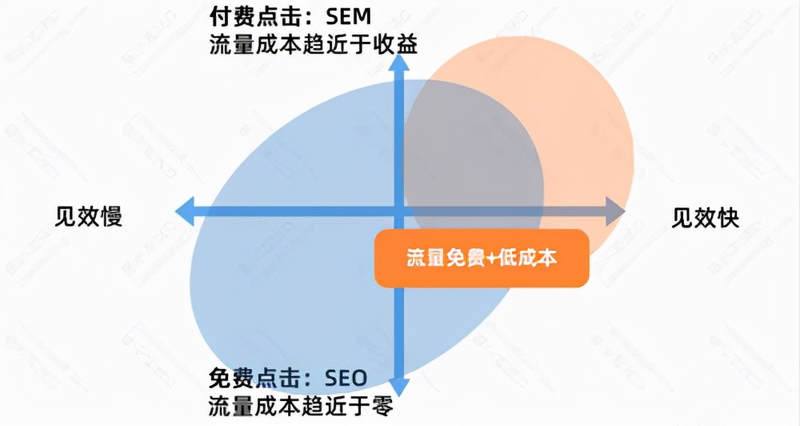
Since seo flows do not require click fees, growth in flows does not require corresponding increases in human costs. Thus, the more seo flows, the lower the cost of the flows, the lower the overall cost of the flows to the firm and the competitive advantage of the enterprise。
For many c-end enterprises, a competitive advantage over lower flow costs is important if they are to gain a stable head (top) position。
At this point, seo flows will be almost absolute。
At the same time, if you take seo flows first, the disadvantage of seo - slow - becomes a competitive barrier to enterprises, creating a temporal advantage and obtaining priority。
From another region
If the time requirement is not high, it can be profitable to maintain one or more websites at a low cost by operating at a very low cost and building up the seo base over a long period of time。
There are many individual station directors in the seo industry, or many who are familiar with seos, who accumulate their own web traffic through this low-cost, long-cycle approach。
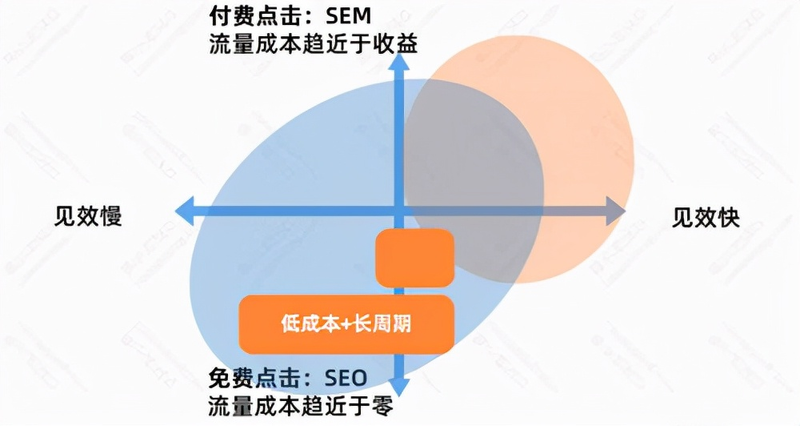
Of course, if technology is confident enough and money is invested enough, it can also shorten the performance cycle of seos and quickly (relatively, let's say) take over seo flows from an industry。
That is all we have to say about this paper, and it is hoped that it will lead to reflection. If you want to learn more about seos, you can focus on the micro-intelligence public designer, "loveseo", reading good texts and more quality teaching videos。