I'm a journalist for the daily news, chen tai hui, guo mao ying, cai myung-lang, intern, lu wen qi
In late summer and early autumn, the yellow river delta salinized its first large harvest of pre-literated apples, "rurie". Is that apple sweet on the saline? How can apple trees, which are very selective in their growing environment, “root” on saline
"deficit quality, favourable output"
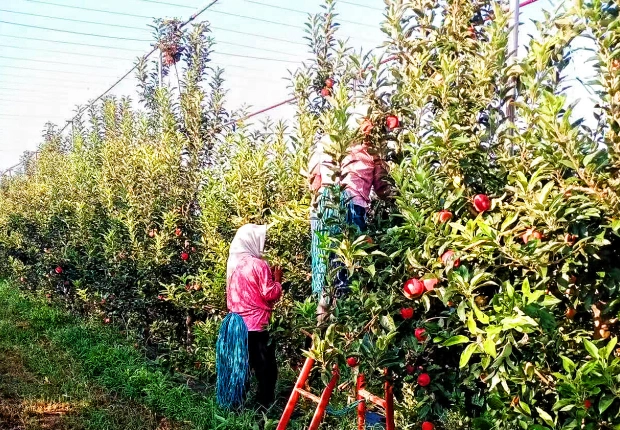
On 17 august, at 9. 30 a. M., journalists entered the base of the east camp of the academy of agricultural sciences of shandong province in the high agricultural district of the country, where the apple garden is located on the left of the gate. Under a four-metre-high birdnet, it is a line of apple trees, with several red apples on the branch that are particularly visible。
“`luri' is a medium- and early-maturity species, matured at the end of july, and the expert post-natal survey on 10 august has focused on harvesting, and now the remaining few of the fruit in the tree is `fish caught in the net'.” the chief of production at camp east daejeon told journalists that since its creation in 2016, he had started to test fruit trees, and that the base now has 10 acres of “ruri” apples. “the first year of the year, this was the first harvest, with an average acre production of more than 2,800 pounds, and that the acre production would increase by about 1,000 pounds by next year’s harvest. This year, the price of luli's offer is around $3. 5, mainly in the middle and high markets.”
Walking and chatting, seeing an apple that's half hidden in the leaves, with its feet raised, carefully removing it for the press, "taste it!"
The radiant fruit is fragrance in the hands of journalists, and it bites, "it's so sweet!"
"luri is sweet!" with a smile, "deficit quality, good output." the soil in this area is salted by 0. 3 per cent and ph 8. 9. The land conditions are poor, but "luri" is generally more than 15 degrees sweeter and better."
“the group agrees that the `rurie' apples are good in saline land and have good fruit quality, and that all indicators are better than the indicators of pre-maturized varieties in the fresh apple standard (gb/t 10651).”
Luli, the name is marked with a distinct mountain. In 2000, the original director and researcher of the fruit tree research institute of shandong province, li lin gwang, led the team in preparation for breeding; in 2003, a hybrid combination of fujii i and the royal gala was formally deployed; in 2017, rui was certified through a range of wooded species in shandong province; in 2019, she was granted the right to new varieties of plant by the ministry of agriculture and rural affairs; and in 2020, she was registered with the ministry of agriculture and rural affairs for new varieties of non-major crops, which were used in the country's extensive apple-friendly areas. Four years ago, the “luri” created the country's highest fee for the transfer of new apple varieties — $10 million — which is still being enjoyed。
Lee lin gwang described rui's fruit production as short, of good quality, resistant, durable, productive, easy to manage, free of bags, with a combination clearly better than the “galling” of mature primary plant varieties during the same period. The choice of saline wood test species at the east camp base also led to a better performance of "ruri" than the "fuchs" species planted during the same period。
"the trees are raised, and there are no good fruit."
The fruity orchard, the booming resonator, slowly moved between the tree lines, and the weeds were cut to pieces and spread over the inter-walk land。
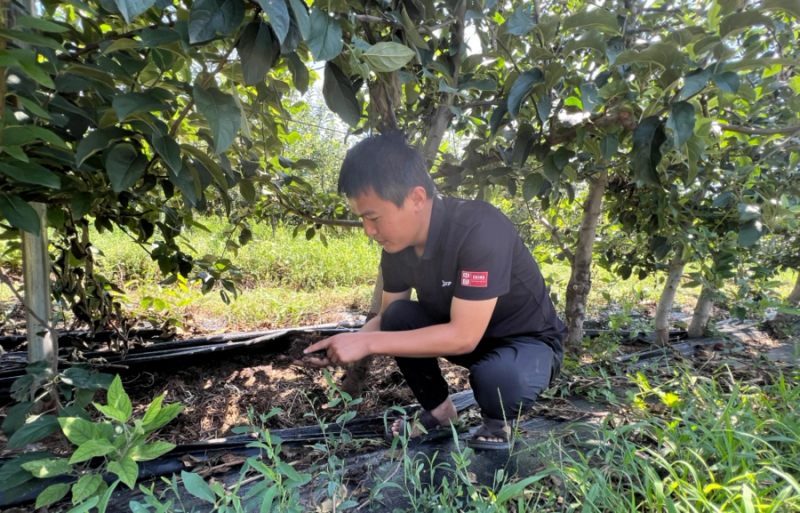
“no herbicide can be used in saline orchards, and weeds grow too high to be harvested and returned to the fields, and can also be used to prevent alkaline modifications.” she told the journalists that, although some improvements had been made, the ground was close to the status of the base in 2016. He crouched down by the tree, slowly unmasked the muscular sheet, pulled out the corroded tan, wet and soft “black soil” and made a stark contrast with the inter-scene soil. “this is a `two-covered' technique. You see, the topsoil is very rich in organic matter, and there's a lot of earthworms going down. This was impossible to see on the previous salin.”
In march 2016, when the east camp base was first established, 30 acres of “rurie” apples were planted. The planting took a lot of effort: first to dig a ditch 60 centimetres deep and 80 centimetres wide, to lay a plastic sheet, and then to fill the soil with cow dung and soil, in an attempt to stop the saline intrusion。
Under normal circumstances, the first year of the “rurie” plant can grow more than a dozen branches, but the “rurie” of the east camp base is only two or three. “our self-confidence was undermined by poor basic conditions, high soil saline content, lack of fresh water and inexperienced trials, with two thirds of apple seedlings dead.” according to zhang jun, the technical head of the eastern camp of the fruit tree research institute in shandong province。
It was later discovered that the ground water was very shallow and that salt water would be seen in the 80-centimetre dig, and it was decided to build a pedestal to control the water table by lifting the ground and digging up drains of alkaline, making the surface soil of the pedagogic soil difficult to store in the dry season. In the autumn of 2017, taidai fields were built and drains of alkaline canals, dry canals and canals were dug separately from orchards。
It is considered that the salt moves with water, and as the surface water evaporates, the salt water slowly returns up. Looking for something, "build up a shed," doesn't the temperature on the surface reduce evaporation? So you decided to cover 25 cm of barley under the tree in a double-covered form, and then it was covered with a swirlless film. In november 2017, the surviving fruit seedlings were combined for transplantation, with double cover under the trees and microspray bands. At the same time, in field management, the application of potassium sulphate-type organic fertilizer is increasing, in appropriate quantities and with increasing sophistication, depending on the required trace elements。
In the spring of 2018, some confidence was restored when new branches of seedlings were seen. According to zhang jun, “the tree was still weak, and then it continued to grow fruit trees and to improve the soil by 2019, through such measures as dry trimping and the laying of alkaline pipes in orchards”
“as a rule, the second year of `luri' will result in the beginning of productive production in the third year and the fourth year of festivities. In the case of saline, however, there can be no exigency, and trees must be raised and consciously dredged. The trees are well raised, and there are no good fruit." li lin-guang said。
In saline, it's important that the wood is saline
The east battalion base, which is five kilometres south, is the orchard of wang yuyung, a retired worker of guangbei farm. Most of this 30-acre orchard is cherries, and the "luri" apples have more than six acres。
Wang yu yong began planting cherry in 2016, and when the cherry trees were destroyed by the floods in 2018, she arrived at the base of the east battalion and studied fruit tree cultivation techniques while working. “there were very few apples on the saline field in the past, and there were a few of them, and the trees didn't grow well, and the trees died for no reason. I was afraid to grow up, and it was only by seeing the "ruri" of the base look good, and by directing experts to my orchard."
This year, wang yu-yung's cherry came to the beginning, and three years of planting "rurie" took the fruit, and the fruit, though small, gave her a good taste. “there are also a lot of people around to visit, after all, the benefits of growing "rurie" are considerable.”
Li lingwang described the current expansion of over 200,000 acres in the main apple-producing areas of shandong, shaanxi, hebei, liaoning, shanxi and henan, which has become the main species for the renewal of our pre-cooked apples. The expansion of saline cultivation is an important scientific direction in line with the national strategy, in which screening against saline saline is essential。
The li lin gwang team collects a large amount of wild wood resources and continues to screen for saline-resistant logs. “good logs must be saline-adapted and disease-resistant, taking into account ease of management and economic efficiency. Once the log has been sifted, it will take about 10 to 20 years to marry the planter and then continue to observe its effects