"the hearing aid is a precious thing for me, and it's impossible without it, even if it's so expensive, you have to save yourself and buy it!" young yang said she had a small wish that hearing aids be affordable to everyone, hearing aids and hearing aids。
China council of deaf associations
Hearing aids are a tool, equipment, devices and instruments that help persons with hearing disabilities to improve their hearing impairment and thus their ability to communicate with others. It amplifies the sound so that the hearing-impaired can hear voices that were not heard. It gives hope and confidence to the deaf friends, but it is also a problem that has plagued them for many years in beijing。
I. The importance of hearing aids and the difficulties besetting deaf people in beijing
With the rapid development of science and technology, hearing aids are becoming smaller and more powerful, with the original box, glasses, earbacks, gradually evolving into inner ear, earwalk, wireless, miniaturization, intellectualization, sensitivity and clarity. Today, most of the hearing aids we use are “digital computer programming”, adjusted to the extent of each of us' loss of hearing, increasing our hearing aid to a level where we hear more and benefit many people with hearing impairments. In particular, for children with hearing disabilities, increasing their ability to speak and speak through the permanent use of hearing aids, hearing training and language training is of great importance. Almost two thirds of deaf children are free of deafness and dumbness, which has become a reality in many developed countries。
Starting at the age of 3, yang's hearing aids have been replaced in primary, lower secondary, upper secondary, university and higher education. Don't look at it as small, expensive, thousands less, tens of thousands more, and a certain useful life, which has to be replaced every five years. This is a huge burden for people and families in general, and for rural families and urban wage earners in particular. Every time you pick out a hearing aid, yang is always impressed: there are so few professionals who test a hearing aid. In some hospitals, most of the examiners have been transformed by general doctors; most hearing aid stores and medical units only sell their own products, and are not given much consideration for hearing disabilities. The doctor or the examiner always simply told her to choose a hearing aid according to her means. In fact, the aided hearing test is a very rigorous science, which requires “one-on-one” personal selection of persons with hearing impairments. The hearing is remarkable, and the hearing loss varies from person to person, and the size and frequency of the bellies are different and cannot be manipulated blindly. The calibration of hearing aids is not just a simple purchase; it requires constant adaptation and, in case of failure, repair at the factory。
"the hearing aid is a precious thing for me, and it's impossible without it, even if it's so expensive, you have to save yourself and buy it!" young yang said she had a small wish that hearing aids be affordable to everyone, hearing aids and hearing aids。
Young yang's little care would represent a lot of attention to disabled friends。
Use of hearing aids and policy support for the deaf in beijing
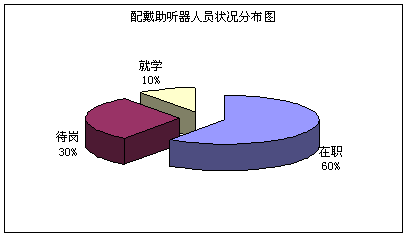
According to data from the beijing city's second national sample of persons with disabilities, there are 999,000 persons with disabilities in beijing, including 227,000 persons with hearing disabilities. In order to understand the use of hearing aids for persons with disabilities, the beijing city association of the deaf used a small sample to randomly extract 50 people with hard-of-hearing disabilities for qqq, text messages on mobile phones to understand their use and demand for hearing aids. According to statistics, of these “hearing aid” communities, 30 are in service, 15 are on duty and 5 are in school (see the attached table, “situation of the situation of persons wearing a hearing aid”)。
Schedule i: distribution of persons with hearing aids
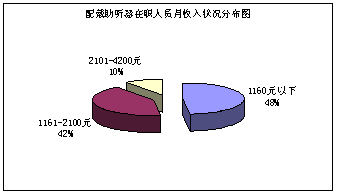
In recent years, the living conditions of persons with disabilities have improved significantly with the attention and care of the party and the state, but because of the effects of their disabilities and external barriers, persons with disabilities are still disadvantaged in competition with able-bodied persons, and the vast majority of persons with disabilities are employed in low-income jobs, and it is difficult to find even a low-paid job. Data show that more than 90 per cent of persons with disabilities at work earn between $160 and $2,100 a month per person (see the attached table, “a map of the monthly income of persons with hearing aids on board”。
Schedule ii: distribution of the monthly income of active personnel with hearing aids (in yats/months)
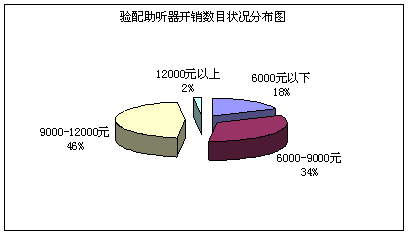
The active promotion of hearing protection by the government, the handicapped federation and many hearing aid manufacturers has had a better effect on raising the awareness of hearing protection and rehabilitation of persons with hearing impairments, most of whom have a strong confidence in their continued rehabilitation and are fully aware of the importance of hearing aid. In order to identify suitable hearing aids, they had to spend more on such consumption items as hearing aids, of which one had chosen a hearing aid of more than $12,000, 23 had chosen a hearing aid of 9,000 to 12,000, 17 had chosen a hearing aid of 6,000 to 9,000 and only 9 had chosen a hearing aid of less than 6,000. (see the attached table, distribution of the number of expenses incurred by the approved hearing aids。
Schedule iii: distribution of the number of allocated hearing aid charges
In addition to hearing aids, they are required to pay $400 a year to purchase batteries (2-5 dollars/particle, calculated as 8 to 15 hours of hearing aids per day, approximately 7 to 10 days per day) plus regular maintenance, repair, replacement of ear-mocks, acoustic fittings (which are an integral part of the hearing aid system because of their type and material, the replacement of infants and young children every 3 to 6 months, the replacement of older children every 6 to 12 months, and the replacement of adults every 2 to 3 years, if there is a leak, damage, aging or rupture of an ear-mode, etc.) this expenditure alone is not a small number。
It was stressed by medical experts that hearing loss should be accompanied by the best possible combination of hearing aids, sound balance, reduced likelihood of sound feedback, and enhanced speech communication and social competence. Thus, for persons with low-income hearing disabilities, this is considered to be a water truck. The current price of hearing aids is less acceptable to many persons with disabilities, and financial constraints force 72 per cent of the population to choose low-end products or single-hearing devices, which do not allow for a good sharing of the results of modern material and spiritual civilization (see the attached table, “the distribution of the number of hearing aids on board”。
Schedule iv: distribution of the number of hearing aids on board (unit: individual/person)
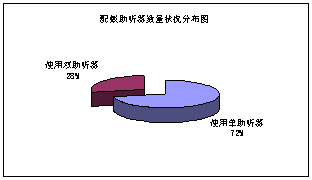
Although in 2010 the municipal disability federation, the municipal civil administration and the municipal finance department jointly issued the beijing interim measures for the provision of aids to persons with disabilities (no. 48) to further strengthen the rehabilitation and protection of persons with disabilities, the establishment of a website and stationary service for disabled persons throughout the city and the provision of free distribution and a percentage of purchase subsidies to persons with hearing disabilities are far from meeting the needs of persons with hearing impairments. On the one hand, the types of hearing aids are too small and of a single type, and basically only the hearts, hearts, heart, heart-to-heart aids and seven types of bone conductors, bluetooth earphones, produced by rysunda hearing technology china ltd. And melstone technology development ltd. The age, working environment, deaf history, degree of hearing loss, nature and experience and hobby with hearing aids vary. The brand, model, performance and specifications of hearing aids vary widely. For example, persons with hearing disabilities who suffer from nervous deafness are less sensitive to sound, and are more likely than persons with hearing disabilities in general to use high-resolution and special circuits for hearing aids; on the other hand, few benefits and subsidies are available from existing policies. Persons with disabilities who have reached the age of 16 and who are eligible for the minimum subsistence allowance for urban and rural areas or for the hardship allowance for persons with severe disabilities in urban areas, persons with disabilities who are entitled to the assistance for living without work, persons with disabilities from low-income families, persons with hearing disabilities who have been registered as unemployed and who have been in possession of a job search certificate or a beijing registration certificate for the transfer of rural labour to employment receive a full allowance for hearing aids, while others receive a 30 per cent quota。
Iii. Responses and reflections for overcoming challenges
On the basis of the results of the survey and the attention paid to the hopes and voices of persons with disabilities, we make the following three recommendations。
One is the establishment of a mechanism for market access for hearing aids. The design and manufacture of hearing aids and the provision of related services such as hearing aids, ear marks, batteries, maintenance, repair, guidance and rehabilitation are detailed and serious. In response to the problem of hearing aids sold in small shops and pharmacies in the market, it is recommended that the relevant departments have a market access mechanism for commercial and quality supervision and regular inspection in the eyeglass industry, with a view to creating, to a certain extent, exclusive branding and matching centres. The aim is to clean up the current situation of uneven levels of matching. The national rehabilitation and rehabilitation programme (2005-2015) provides for the basic implementation, by 2015, of a unified professional and technical training programme for rehabilitation workers, the management of certified induction, professional technical job evaluation and continuing studies, and the development of a better system of training and support systems for technical rehabilitation professionals. At that time, the level of access to the hearing aid market can be guaranteed to a certain extent through the equipping and certification of the facilities required under its provisions。
Second, priority support is given to persons with hard of hearing, and welfare subsidies for wearing and purchasing hearing aids and hearing-aid batteries are increased. The relevant departments, such as the disabled people's union and the treasury, develop policies and practical measures to ensure that the special difficulties of the “hearing aid community” are fully taken into account, that the special concerns of the party and the government are reflected, that appropriate preferential care is given, and that the benefits granted do not affect the income and livelihood of the family members of the disabled. It is important to reach out to families as soon as possible to find out the details of persons with hearing disabilities with hearing aids, to map the base figures and to implement the subsidy policy. All hearing aids purchased by persons with hearing disabilities who have a hearing assessment certificate from a hospital are subsidized to the extent that they are given priority to children with moderate or severe hearing impairments, followed by adults, especially those working, and, lastly, older persons over 60。
Thirdly, the majority of hearing aids in the current market are not imported, but rather purchased to import chips that are self-assembled. The ifa and the relevant departments should seek to extend the designated points to well-known, professional multi-brand operating hearing aid stores, hearing aid stores, or tender companies to introduce more brands and models within the range of designated point products, in close cooperation with domestic and foreign hearing aid producers and developers; or the costs may be subsidized by 50 per cent of each government, disability union and individual. This allows for greater choice for people with hard of hearing, as well as for the purchase of heart instruments based on their economic means, so that they can truly meet the needs of low-income hearing aid users and benefit a larger number of hearing aid users, who benefit from their families, society and the state。
"the hearing aid is a precious thing for me, and it's impossible without it, even if it's so expensive, you have to save yourself and buy it!" young yang said she had a small wish that hearing aids be affordable to everyone, hearing aids and hearing aids。