In such scenarios as industrial handling, warehouse handling and outdoor construction, flexible and efficient lifting equipment is often required, and portable door cranes, with their unique advantages, are ideal options for many scenarios. This paper will provide a comprehensive understanding of this practical lifting tool from multiple dimensions。
Definitions and basic structure
Definitions
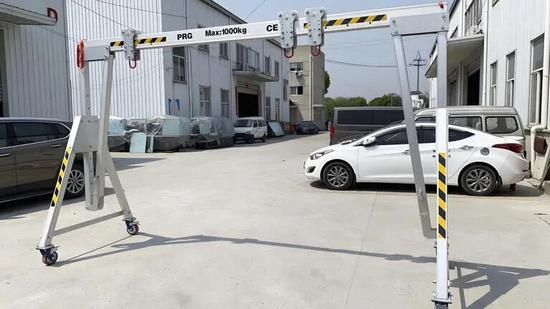
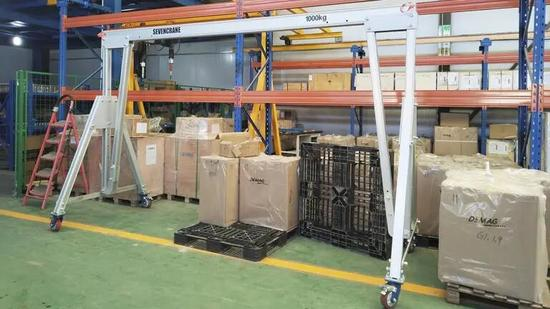
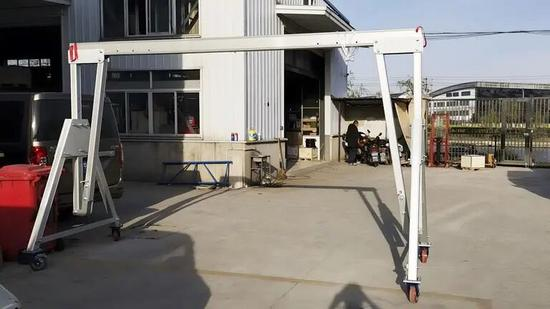
Portable-door cranes, abbreviated to carry the door, are a lifting device that is mobile and easily assembled to carry small and medium weights at short distances. Unlike large fixed cranes, it does not require complex ground-based construction and allows for rapid deployment at different sites according to operational requirements。
2. Basic construction
Its core structure consists of four main components:
Main beams: are usually made of high-strength steel, which is the main structure for heavy weight, the length of which can be selected or adjusted according to demand。
Legs: fixed legs and truncable legs, used to support the main beams and maintain equipment stability, part of the bottom of the leg being carried with a million-way wheel to facilitate movement。
Lifting systems: composed of rollers, wire ropes, hooks, responsible for the completion of lifting and landing of heavy matter, with rollers having both manual and electric types。
Control systems: the electric port hanger is equipped with a control button or a remote control device to control the lifting and movement of the lifting system, while the manual type is operated through a handshake。
Ii. Rationale
Portable door cranes are based on mechanical balance and simple mechanical principles, as follows:
The equipment is first moved to the operational position, the height of the legs is adjusted to ensure the level of the main beam and the overall stability of the equipment。
Operators control hook drops through control systems (or manual devices) and tie hooks to the right position of the heavy object to ensure that the link is strong。
(b) activate a lifting system, roller-driven constriction of the wire, slowly raising the heavy matter to a suitable height and avoiding collision of the heavy object with the surrounding object。
Propulsion equipment (or control of mobile devices) to carry heavy matter above target position, slowly drop the heavy object and complete a lifting operation。
Strengths and applications
1. Strengths
High flexibility: a relatively small size, light weight, a model equipped with a million-way wheel can move easily on the flat ground and adapt to narrow field operations。
(b) easy to assemble: most components are modularized and can be assembled or dismantled within a short period of time without a professional installation team。
Lower costs: acquisition costs and maintenance costs are lower than those for large cranes and do not require additional ground-based construction costs, suitable for smes or temporary operating needs。
Broad adaptation: equipment with different load specifications and main beam length may be selected for use in multiple scenarios such as indoor warehouses, outdoor sites, workshops, etc., depending on weight and operating height。
2. Application areas
Industrial workshop: for handling and installation of equipment such as machine beds, moulds, etc. In the workshop to address the inflexible movement of large lifting equipment in the workshop。
Warehouse logistics: in small and medium-sized warehouses, for loading, handling and handling of shelf cargo, improving the efficiency of cargo turnover。
Outdoor works: for example, municipal maintenance, minor construction works, which are used to carry construction materials, tools, etc., are particularly suitable for construction sites without fixed lifting equipment。
Scientific laboratories: used to carry precision instruments or laboratory equipment and to avoid manual transport causing damage to the equipment。
Selection techniques and recommendations
In selecting portable door cranes, the following should be noted to avoid the selection of inappropriate equipment:
Clear load-taking needs: select equipment matching the load-carrying specifications based on the weight of daily loads, recommend a model with a margin greater than the actual weight, and reserve a certain amount of safety residuals, but do not blindly pursue excessive loads and avoid waste of cost。
Consider operating space: measure the width, height and length of the operational site, select equipment for which the length of the main beam, the spacing of the legs and the elevation of the altitude meet the requirements of the site, and ensure that the equipment moves and operates flexibly within the site。
Select the driver type: if the heavy weight is moved or the frequency of the operation is higher, it is recommended that the electric driver type be selected, saves manpower and is efficient; if the operation is small and the site is without electricity, the manual driver type is selected。
Focus on material quality: view the material of the main structures, such as the main beam, legs, and prioritize the use of high-strength steel and rust-resistant surfaces to ensure equipment durability and safety。
Viewing security configurations: electric types need to check whether they are equipped with security devices such as overload protection, limit switches, and manual types need to confirm the reliability of brake devices, which can effectively reduce operational risks。
V. Safe use care
Safety is the primary prerequisite for lifting operations and the following precautions must be observed when using portable door cranes:
Prior to the operation, check the integrity of the parts of the equipment, including whether the wire ropes were worn, whether the hooks were broken, whether the legs were secure, whether the control system was normal, problems were identified with timely maintenance and failure operations were prohibited。
In the course of operations, overloading is strictly prohibited, and unstable heavy objects on hooks are not allowed to be carried to avoid shaking during lifting or moving。
Stationers are prohibited from being around the equipment, especially below heavy objects, to prevent casualties from falling heavy objects, and operators are required to stand in a safe area。
No outdoor work shall be carried out in bad weather (e. G. Storm, wind, lightning) to prevent equipment from being blown down or electrically malfunctioning。
Upon completion of the operation, the hook will be raised to the appropriate level, the power will be shut down (manual type of wired), the equipment will be moved to its designated storage location and the equipment will be cleaned up。
Vi. Practical guidance for maintenance and maintenance
The maintenance and maintenance of the equipment will extend the service life of the portable door crane, as follows:
Regular cleaning: a full cleaning of equipment is carried out once a week, the main beams, the dust and oil on the surface of the legs are wiped with rags, the rags on the soles of the legs are cleaned and the groceries within the wheel are cleaned up and the wheel moves flexibly。
Lubrication maintenance: monthly lubricating oil on the operational components of the equipment (e. G., roller bearings, wheel axes) to reduce wear and tear of the components, and lubricating oils to select models that meet the specifications of the equipment。
Components inspection: quarterly inspections of wear and tear of wire ropes, and timely replacement if they exceed the prescribed standards; inspection of wear and deformation of hooks, detection of cracks or serious deformations, immediate cessation of use and replacement; check whether the bolts of the leg link are loose and tight in time。
Storage protection: when equipment is not used for a long time, it needs to be stored in a dry, ventilated room to avoid rain and rust in the open, and if it is to be stored in the open, it needs to be covered with rain-proof cloths, wooden panels on the bottom of the leg to guard against tide erosion。
Vii. Comparison with other lifting equipment
In order to make the location of portable door cranes clearer, they are compared to common forklifts, fixed door cranes:
Compared to forklifts: forklifts are suitable for the handling of pallet-type cargo, with a limited lifting height and less flexibility than portable lifts in a narrow space; hand-held forklifts carry non-charter-like weights at higher lifting heights and operate at barriers above heavy objects, but at a slower pace than forklifts。
Compared to fixed door cranes: fixed door cranes carry larger loads and operate more stablely, but require fixed orbits and foundations that are non-moveable and space-limited; and portable door-stretching does not require fixed orbits, is flexible and suitable for temporary or multi-site operations, but is less efficient than fixed door-stretching。
* sources of information are available on a learning basis for reference purposes only
It's important

Click to register