In recent days, the ministry of human resources and social security, the central network office, the ministry of industry and information technology, the ministry of public security and the general authority for the supervision of finance have jointly issued the circular on regulating the distribution of information on recruitment to network platforms (hereinafter referred to as the circular). The human resources mobility management division of the ministry of human resources and social security is responsible for responding to questions from journalists on issues related to the circular。
Question: what is the background to the circular
Response:
Strengthening the management of online recruitment order and safeguarding the legitimate rights and interests of job-seekers are important elements of web-based ecological governance. The central party, the state council, attaches great importance to regulating the management of the recruitment market and makes a series of deployments。
In recent years, network recruitment has played an important role in promoting high-quality and full employment and optimizing human resource allocation, but at the same time there have been problems such as unauthorized access to the network recruitment service and poor quality and legitimacy checks on employers ' qualifications and recruitment information. With a view to further regulating the recruitment order for the network, the ministry of human resources and social security, the central network office, the ministry of industry and information technology, the ministry of public security and the general directorate of financial supervision have jointly issued circulars to follow up on the deployment requirements of the party centre and the state council, further entrenching the responsibility of the main members of the network platform, continuously raising the level of compliance, risk prevention and protection of rights and interests of the network platform and safeguarding the legitimate rights and interests of job-seekers。
Question: what are the requirements of the circular in relation to the administration of online recruitment service licences
Response:
Web-based eco-governance is a systematic project that involves policy guidance, administrative clearance and other initiatives to facilitate the interface between administrative regulation and industry self-regulation。
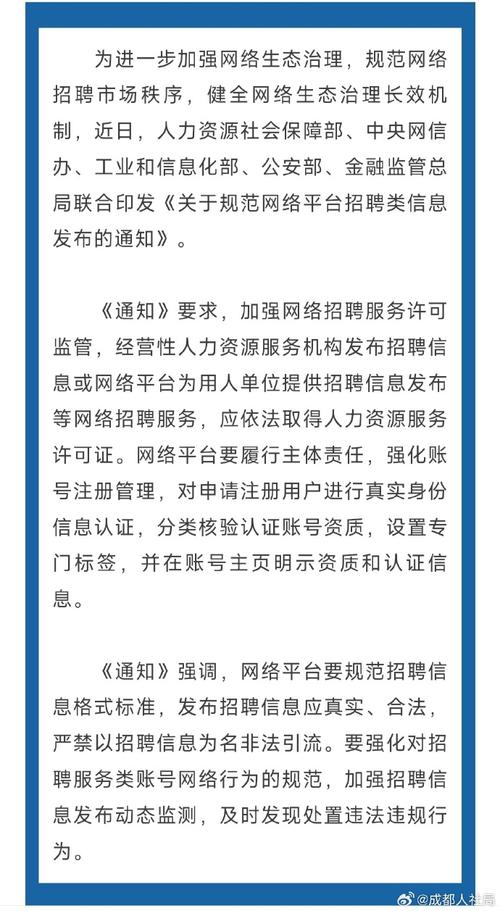
Licensing of web-based recruitment services is an important system for human resources market management. The circular implements the requirements of the interim human resources market regulations and sets out three-pronged requirements for strengthening the licensing of web-based recruitment services:
One is that human resources service providers, which publish recruitment information through internet sites, applications, etc., in print, photo, video, live, etc., should obtain a human resources service licence in accordance with the law。
Second, web-based platforms provide employers with web-based recruitment services, such as job announcements, which should be legally licensed for human resources services。
Thirdly, online platforms in local organizations strengthen the screening of recruitment information, issue recruitment information on violations of the law, and take appropriate administrative control measures to instruct relevant web platforms to warn in a timely manner, remove, restrict functions, suspend or terminate services。
Question: what measures has the circular proposed to enhance account management for the web platform
Response:
Some of the main lines of responsibility of the web platforms are not being implemented, and there are still serious problems with traffic management, poor clearance, poor algorithm recommendations and poor handling of irregularities. The circular makes it clear that the web platform, as an internet information service provider, should effectively strengthen account management and prevent false recruitment information from misleading job seekers。
The first is enhanced account registration. (c) validation of the true identity information of the users applying for registration, implementation of the physical verification of account log-in, further refinement of user protocols and clarification of the rights and obligations relating to the registration, use and management of account information。
The second is the classification verification of certified account qualifications. For the recruitment service type accounts, distinction is made between the different types of operational recruitment service, public recruitment service, self-employment of employers and so forth, certification of qualifications is strengthened, registration files are maintained and at least every six months。
The third is an explicit account qualification. The web platform uses the “recruitment service type” label and specifies qualifications and authentication information on the home page of the account。
Question: what are the specific requirements of the circulars that regulate the format of recruitment information
Response:
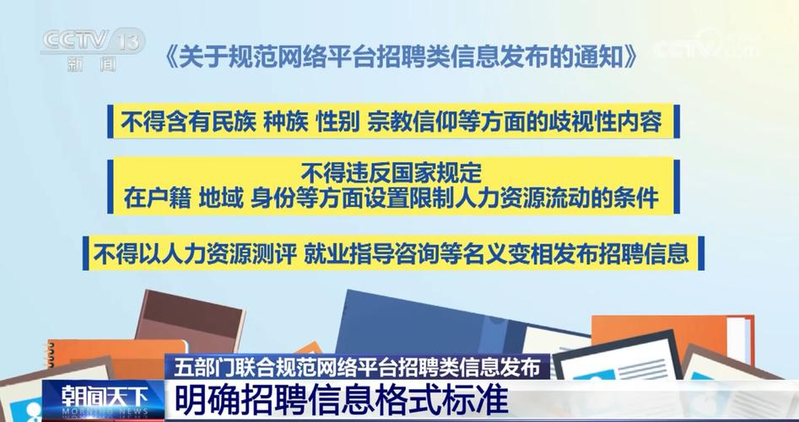
The circular requires web-based platforms to clarify the criteria for the format of recruitment information, to enhance the dissemination of information review visits and to ensure that recruitment information is genuine and legal。
First, the issuance of recruitment information should include elements such as basic employer information, recruitment numbers, recruitment conditions, job content, place of work, basic labour remuneration, etc., and should indicate a valid period or be updated in a timely manner。
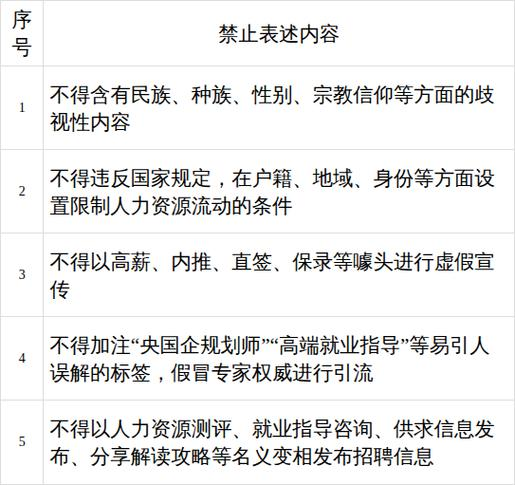
Second, the recruitment service accounts must not contain discriminatory elements such as ethnicity, race, gender, religion, religion or belief, must not violate state regulations, impose restrictions on the movement of human resources in terms of domicile, geography, status, etc., may not give false publicity to such things as high salaries, guarantees, etc., may not lead to the appearance of expert authority, may not publish such information in the name of human resources assessment, guidance on employment, etc。
Third, the transmission of recruitment information requires a strict indication of the source of information。
Question: what initiatives are in place to deal with irregular accounts
Response:
Network chaos, like the contamination of society and the violation of the interests of the population, must be fought with determination and determination, cutting off the chains of interest and industry and eliminating the soil and conditions that they breed. As the first step in recruitment violations is often channelled through recruitment information, the notice strictly prohibits diversions such as the publication of false recruitment information, the falsification of expert authority, and exaggerated propaganda, deceiving and misleading job-seekers to enter into “training loans” agreements, participating in distribution, cyber gambling, telecommunications fraud, etc。
The circular requires the web platform to develop sound risk identification models, strengthen dynamic monitoring of the dissemination of recruitment information, and address violations and violations in a timely manner。
The first is the suspension or termination of services by means of such measures as bullet window alerts, alarms for non-compliance, restricted flow, block deletions, disconnections from the sheeting and cancellation of accounts。
The second is the verification of the relevant account numbers of the involved, the fraudulent telephone card, and the adoption of time-limited corrective measures, restrictions on functionality, suspension of use and closure of accounts。
Third is the establishment of a mechanism for the rapid processing of complaints, the centralization of accounts for complaints, the timely manual review and platform intervention。
Fourth is the establishment of an unusual list system, which prohibits the re-issuance of recruitment information by the subjects concerned through replacement, re-application of account numbers and account numbers。
Q: how can implementation of the circular be done
Response:
Following the issuance of the circular, it is critical that implementation be carried out。
The first is to strengthen guidance. Targeted training to guide local efforts to further refine regulatory measures, strengthen administrative guidance on web platforms, enhance follow-up and follow-up to ensure that the circular is in place。
The second is to strengthen synergistic regulation. (c) strengthen synergies between the relevant sectors, improve mechanisms for coordinated regulatory work, and promote information connectivity, such as licensing, day-to-day supervision and monitoring of enforcement, in order to create effective regulatory synergies。
Thirdly, there is advocacy guidance. (b) to promote a better understanding of the content of the circular, to increase policy visibility and to promote the proper understanding and application of relevant policy measures, and to create a favourable climate for its implementation。