Poor freight design is also often not practical for host vendors, with the probability that it will be abandoned directly, but rather in the “original” form of commodity postage differentials。
Freight costs are one of the basic functional modules of the electrician and are used to calculate the cost of transport of goods. Freight does not count as having a direct direct impact on the price, and it has seen multiple early-stage electrical products overpriced on the list page, or double-counted or undercalculated freight in the order. In any case, this directly affects the core experience of electrician products - purchasing. Poor freight design is also often not practical for host vendors, with the probability that it will be abandoned directly, but rather in the “original” form of commodity postage differentials。
There are two routine designs for freight:
Commodity freight design: separate freight for each commodity; shop freight design: freight based on the dimension of the store。
Both have advantages and disadvantages, but overall the design of freight costs based on the commodity dimension can be used more。
Similar to delivery goods in life, after choosing a courier company, the courier company calculates the freight rate based on the weight and distance of the consignment (destination). The figure below shows the rates for the following:
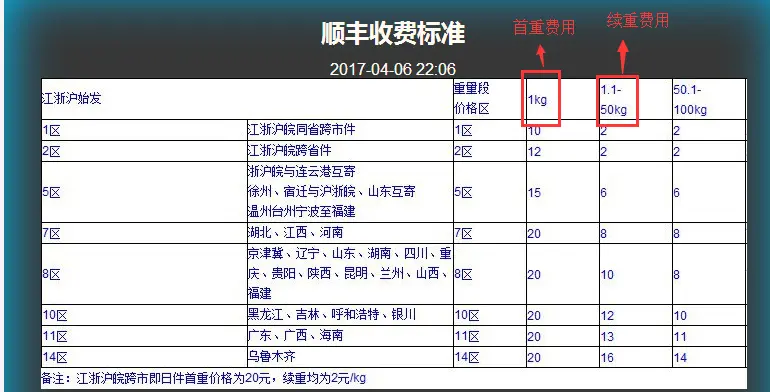
The above figure introduces several concepts:
First priority; first priority means that the goods delivered by delivery are within the first load and are subject to a fixed first load freight charge. Resuscitation: delivery of goods above first weight is calculated at the additional cost per kg above。
The formula for the calculation of freight costs = first-heavy costs + (actual mail weight - first-heavy)/renewal* costs. In the case of the cross-municipality of jiangdu province, for example, the first cost is 1kg and the first cost is 10 yuan. The freight charge for the delivery of the items of 3. 5kg by courier = 10+ (3. 5-1)/1*2 = 16 (the freight charge needs to be rounded upwards and 3. 5 kg is calculated as 4kg)。
Similarly, freight backstages set the pricing rules for freight costs and then allow the commodity to choose the postage template and set logistics parameters (e. G. Weight, volume). When the client chooses to purchase the quantity and the receiving address, the consumer obtains the full weight and destination of the goods to be shipped, thus calculating postage charges。
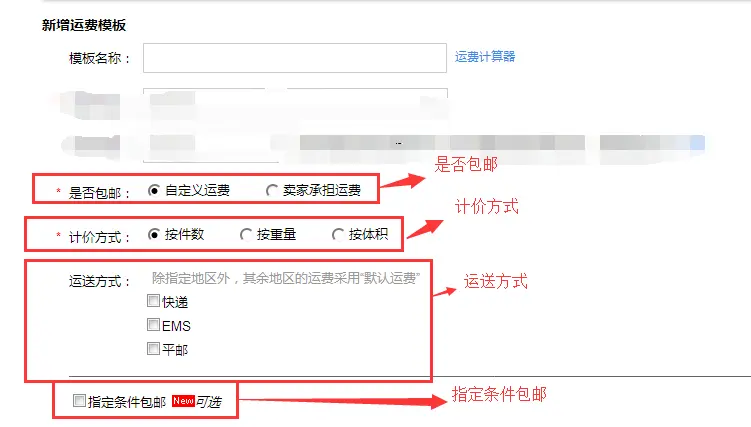
The creation of the top map poaching postage template contains the following key messages:
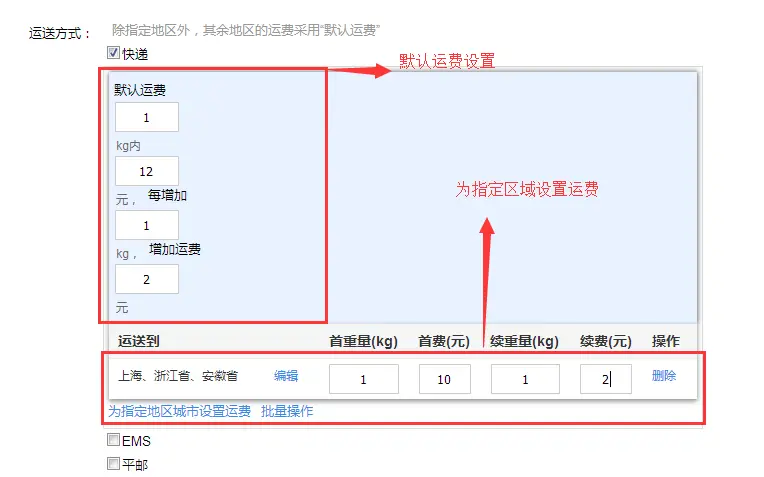
The figure above shows the pricing rules for the express delivery mode, which are divided into two parts, default freight and assigned area freight. This set-up would satisfy the rules for first and renewed freight for different regions. Similarly, the same is true of the pricing rules set by ems and plain mail。
“designated package mail” can well meet the requirements of promotional operations, as follows:

Different modes of transport can be set up, free of postage after reaching a certain weight (logistics parameters) or amount。
A freight template is set up, and a suitable freight template is selected for the creation of the commodity, and the logistics parameters are filled in, so that the overall freight cost is set。
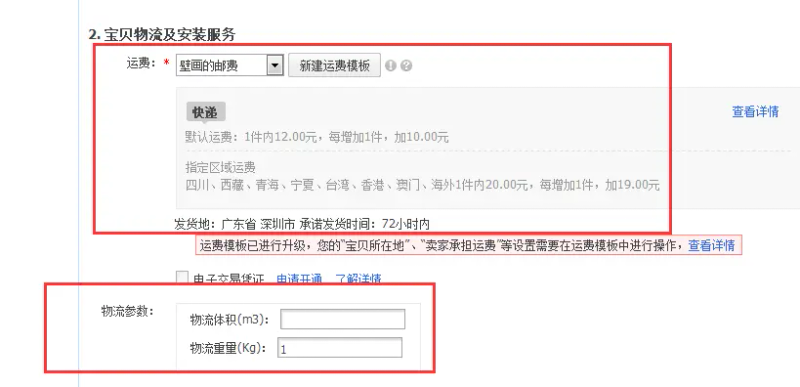
The summary is as follows: after selecting the base unit of calculation, freight can be used to set up the top priority, the first cost, the unit may be renewed, and the cost may be renewed (here different pricing methods can be replaced), thus establishing the base function of freight, while also supporting the establishment of a mail promotion service. Finally, when creating commodities, select the appropriate freight template and fill in the logistics parameters. Complete the entire freight package。
Upon completion of the above-mentioned design, it is assumed that if a stationery store, the first pen would be $8, and for each additional pen, a further $2 freight fee would be required. The freight formula for rubber is $10 for the first rubber and $3 for each additional rubber purchase. If the previous price formula is not processed, then a user buys two pens for the shop, two rubber charges = $8+2+10+3 = $23. The real business, however, is that for transport companies, the first priority will only be calculated once, with actual freight costs closer to $10+2+3 = $15, i. E., the first priority will only be the maximum value of the first choice for multiple commodities, with the rest to be calculated again。
In another case, a shop selling postcards could package mail if it sold two postcards, and he could set the first freight charge for a first postcard at $6 and buy two parcels of the merchandise. The same applies to freight charges for other types of postcards. So the effect he actually wanted was that the user could just buy two postcards to pack the mail (which could be different types of mail). As a result of the above, there would be a freight charge of $6, which would have to be met by modifying the purchase order。
As can be seen above, although most freight rates are met, there is still a small part of the shortfall。
Postage costs are briefly described in the design of “storage freight” and “commodity freight”. So it's a marketing tool。

A marketing tool with the full amount of money purchased free of postage, with a store dimension, partly compensates for the unconvenient promotion of postage by commodity。
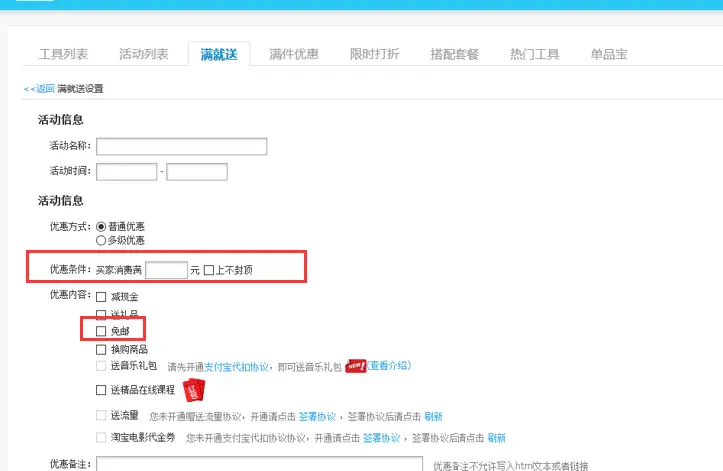
The introduction of freight charges to the level of the store is, in effect, the conversion of the shipping template from commodities to shops. For most shops, this is more reasonable, as in the case of postcards mentioned above, not in the design of shipping charges for store dimensions. However, the corresponding set-up flexibility is poor。