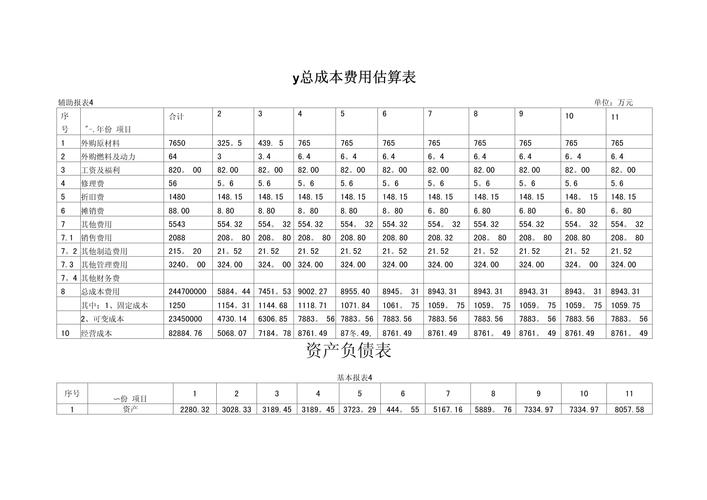
The fast-calculating template for costing engineering projects i, the scope of application of the template and the type of project applied to the costing exercise of various types of new, expanded, retrofitted projects, covering common types of construction work (e. G. Residential, commercial complexes, plant buildings), installation work (e. G. Drainage, electrical, fire, heating), municipal work (e. G. Roads, bridges, piped networks), decoration work (e. G. Interior fit-out, curtain walls). In particular, it applies to the pre-project decision-making phase (feasibility study, investment estimate), the bid quotation phase (quick-measure cost cap) and the construction preparation phase (preliminary budget preparation) and helps the project team to quickly capture the cost composition and provide data support for resource redeployment, risk control and bid strategy. Detailed cost estimation operating process (i) clear project scope and estimation based on the definition of the engineering boundary: clear estimation of the scope, clear inclusion of costs such as land expropriation, survey design, supervision, trial operation, and avoidance of leakage or double counting. For example, a residential project needs to specify whether the “main structure + decorator improvement + outdoor support” is fully included in the estimate, or only the main structure cost. Collection of basic information: acquisition of project design drawings (preliminary design or programme design), work volume lists (if any), local pricing information (e. G., area engineering price information), historical project cost data (unilateral prices for similar projects, material prices), policy documents (e. G., taxes, fees). (ii) the decomposition of the project volume list divided the work into “separation sub-projects” and “measures projects” to estimate the work volume by project type. Divisional work: construction works can be broken down into earthworks, pillar-based works, concrete works in steel bars, construction works, housework works, etc.; installation works can be divided into electrical works (lighting, power, weak electricity), drainage works (pipes, sanitary devices), fire works (fire extinguishers, spray systems, etc.). Projects of measures: these include technical measures (e. G. Scaffolding, templates, vertical transport) and organizational measures (e. G. Temporary facilities, construction of a safe civilization) to determine projects by reference to the quantities of construction work list or local quotas. Example: for an office building project, branch works can be broken down into “m3” “c30 concrete column (m3)” “fire-proof paint (m2)” etc.; measures should include “m2” “temporary electricity (kw month)” etc. (iii) determination of the combined unit price = labour cost = materials cost + machinery cost + management cost + profits, to be determined in conjunction with market conditions and historical data: labour cost: by reference to the local construction market manual unit price (e. G., 300 per day for regional general works, 450 per day for technical workers) or by adjustment to the enterprise quota. Material costs: a unit price for the main material (e. G. C30 concrete, $420/m3, steel bars, $4,800/t) obtained through price information journals, vendor requests or historical project data, taking into account transport losses (e. G. Steel losses of 1-3 per cent). Mechanical costs: refer to the unit cost of the leased market desk (e. G., $1,200 for excavators, $3,000 for the suspension of towers) or be calculated on the basis of the number of machines used x lease cycles. Management fees and profits: reference enterprise rates (e. G., management fee rates of 5-8 per cent, profit margin of 3-7 per cent) or local regulations, usually multiplied by the basis of labour plus materials plus machinery costs. Note: in the absence of detailed data, the “indicator estimation” method can be used, e. G. By reference to the “single price” of a similar project (e. G. A unilateral price of 3,000-5,000 yuan/m2) adjusted to take account of the size of the project, the standard of refurbishment. (iv) summarizing the cost of the segment sub-project and the cost of the measure, which aggregates the cost of the branch sub-project work x the unit price; the cost of the measure project is calculated on the basis of the “rate method” or the “physical volume method” (e. G., the cost of the temporary facility is calculated at 1 to 2 per cent of the branch sub-project work). (v) indirect fees, profits and taxes: these include fees (e. G. Social insurance premiums, housing funds, a percentage of labour costs) and company management fees (based on the sum of the cost of the branch works and the cost of the measure project, with reference to the enterprise or local standard). Profit: usually the base figure (segment sub-project work costs + measures project costs + overhead costs) is multiplied by the profit rate (3-7 per cent, adjusted to the level of competition of the project). Tax: including vat (at 9 per cent, 3 per cent, etc., depending on the type of project), urban maintenance tax, education surcharge, etc., calculated at pre-tax value x tax rate. (vi) generate an estimation report and review the total costs summarized above and prepare a cost estimate for the engineering project with a statement of key parameters (e. G., manual unit price, source of material price, basis of rate). Review by the project leader or cost engineer of the accuracy of the calculation of the volume of work, the unit value and the application of the rate to ensure logical consistency and rational data. (iii) cost estimate template table and a note to complete (i) the sub-project cost estimate number of the sub-project name of the sub-project unit unit unit unit unit unit unit unit unit unit unit unit unit unit unit unit unit unit unit unit unit unit unit unit unit unit unit (material/man unit source)m312003542,000 for earth-side digging (three types of soil)m312003542,000 for reference to the city's first quarter price information 2c30 concrete column (commodated concrete)m385202020202020202030416,000 manual 150/m3+m33 fireproof coating (stembracing structure)m2500045225,000 manual, material, supplier query ... Sub-total - 683,000 - note: “project volume”: two small points after design drawing paper or preliminary estimate data; “composite unit price”: source (e. G., “company price information” `suppliers'); “company price”: = engineering volume x aggregate price, two small numbers retained after summary. (ii) base rate (%) for the calculation of the item name of the measure cost estimate, note 1 branch work fee for scaffolding (integrated scaffolding) by building area, 1. 510,245 for sub-working of 2 temporary facilities by building area + 12. 013,660 for sub-engineering of 2 temporary facilities + step fee of 3. 020,490 for sub-working of 3 safe civilizational construction, in accordance with the provincial standard for the cost of construction of a safe civilization ... Subtotal — 44,395 — complete statement: “base figure”: normally for “sub-project work fee” or “sub-project work fee + project fee for measures” to be determined in accordance with norms or business practice; “rate”: “reference to price specifications of the list of construction works, local quotas, or enterprise internal standards, with reference to the basis for the basis. (iii) total cost summary cost item amount (in dollar terms) as a percentage of total cost (%) indicates that the sub-project cost of 683,00078. 5 is shown in the item cost estimate measure of the sub-project cost table 44 3955. 1 as an indirect cost of the measure cost estimate of 68,3007. 8 (fee + enterprise management fee) is based on 15 per cent of the labour cost 54,6406. 3 base figure: the first three and x 6 per cent tax (9 per cent vat) 79,2939. 1 base figure: the first four and x 9 per cent total cost of the project 9,62810. 0-book statement: “proportion of total cost”: = 100 per cent of the total cost of the individual amount ÷ project x 100 per cent for analysis of the cost component; “note”: indicates key parameters (e. G. Profit rate, tax rate, fee calculation basis). Key concerns in the process of use (i) the reliability of data sources and time-limited labour, materials, machinery unit prices need to prioritize market data or official price information for nearly three months to avoid the use of outdated data (e. G. Steel prices may fluctuate significantly a year ago); differences in historical project data need to be adjusted (e. G. Project size, geographic location, construction process) and direct interoperability may lead to deviations. (ii) the amount of sub-project work calculated for the accuracy of the work volume is to be calculated on the basis of drawings or specifications to avoid leakages (e. G., “faces around doors and windows” in the decoration project) or overcalculation (e. G., errors in the extraction of slope coefficients in the earth project); the volume of measures is to be determined in conjunction with the construction programme (e. G., the size of the template is to be calculated on the basis of the size of the building blocks and the number of turnovers). (iii) the reasonable management fee for the combined unit price, the profit margin to be adjusted in the light of the actual level of management of the enterprise and the competitive situation in the market, and the blind application of flat rates may lead to over-priced (lost competitiveness) or over-low (losses); material loss rates need reference norms (e. G., 3-5 per cent for tiles and 1-3 per cent for steel bars) to avoid underestimation of costs due to inadequate calculation of losses. (iv) risk costs are set aside for highly volatile materials (e. G. Steel, copper), policy changes (e. G. Tax rate adjustments) or complex geological conditions (e. G. Overdrive of earth), risk costs (usually 3-5 per cent of total cost) are set aside and risk factors are described in the estimation report. (v) in the course of the implementation of the dynamic adjustment mechanism project, if design changes, increases or decreases in construction volume or fluctuations in material prices exceed ± 5 per cent, the cost estimates will need to be updated in a timely manner, the total costs recalculated to ensure that they match actual progress。appendices (reference data examples) (i) reference range for common material unit prices (second quarter of 2024)