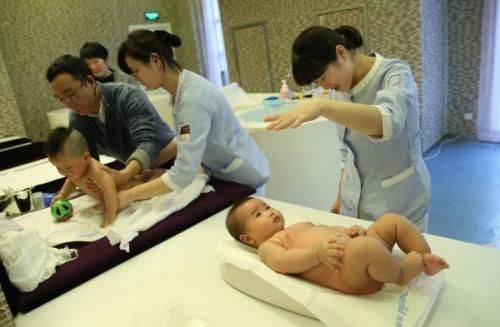
Image: 30 january, mother and child family health care providers took care of babies in a school in shanghai. Xinhua news agency journalist bae chang
On february 3rd, the reference news network reported that china's mother's tradition of “sitting the moon” was disputed at home, but that the attention given by developed countries in europe and the united states to the rehabilitation of women after childbirth had just begun。
On 2 february, the british financial times website reported that the practice of “sitting the moon” after the birth of a female had been disputed in china. However, julia, a british national, made a different opinion, saying, “i really envy that chinese mothers have the privilege of `sitting the moon', that they have enough time to rest and recover, and that children and housework are left to others. In england, it's very expensive to hire a `matrity urse', which costs about 1,000 pounds a week and is responsible for baby care only. Julia said, “i think the practice of `sitting sons of the moon' is a sign of the importance that chinese families attach to post-natal recovery.”
According to the report, scientific research has shown that two to six weeks after the birth of a child are essential for both the infant and the mother. The world health organization, in its annual guidebook on neonatal and post-natal rehabilitation, states that the first weeks of childbirth are important for both newborns and mothers, and that it includes not only physical rehabilitation, but also psychological reconstruction of the process, so that mothers and newborns should receive careful care。
In british and american countries, general doctors visit the mother about two weeks after her discharge to see her recovery and the situation of the newborn. British and american mothers tend to think that childbirth is a simple matter, and even some start working about a month after childbirth. In the united kingdom, the normal maternity leave is six weeks, after which the mother is still able to rest, but only receives a very low state subsidy, so that most of the mothers choose to return to work. For julia, parents in england rarely help their children and mothers to care for children, and babysitting is expensive. Domestic chores, post-natal recovery and the care of newborn children were carried out by young couples, and although the husband had maternity leave, the burden was still very high for new mothers。
“doctors are more concerned about post-partum depression, but less about post-partum pain and nutrition. The arrival of newborns and the multiple factors of work make it a luxury for me to eat a well-prepared meal. Julia complains, “i saw in china a lot of food for the mother, and here i have to rush for a quick meal.”
It is reported that western medical opinion considers childbirth to be a human instinct and therefore a recovery process. In the case of chinese doctors, childbirth is similar to illness and is a process of depletion and therefore requires “care”。
Dr. Zhang of a rehabilitation hospital in beijing noted that, although childbirth is a natural process for women, it does not mean that the body will be naturally restored to its original condition. Women are exposed to problems such as lax pelvic muscles, tearing up abdominal abdomen, skeletal separation, and back pain. Some of the more serious problems may result in lifelong after-effects, and proper rehabilitation training after delivery is therefore essential. But this post-natal recovery is very different from china's traditional “sitting son”。
Dr. Zhang said: “we are here mainly relying on professional rehabilitation doctors to help the mother recover her body muscles and emotions, in addition to the need for a more elaborate diet after childbirth, such as more iron-rich and calcium-rich food, but not more than enough, and there are limitations in physical labour. I think the question is not whether to sit on the moon, but how to sit on the moon, not all chinese medicine is unscientific." comparative studies from the nanjing medical university show that post-natal care such as acupuncture, conducted under the supervision of a specialist physician, can effectively reduce post-partum complications。
It is reported that in china, the theoretical source of “sun-kiko” is more dependent on the mouths of the older generation than on the guidance of professionals, which has led to the prevalence of misconceptions such as the absence of bathing, brushing of teeth, the absence of wind, etc。
According to a study of 2100 mothers in hubei province by the university of science and technology, 18 per cent of women do not eat vegetables during the “standing moon”, 79 per cent do not eat fruit, and 76 per cent do not drink milk because they firmly believe that bone soup can make up calcium. According to the survey, about 46 per cent of mothers ' health-care knowledge of the puerperium is derived from the experience of older generations, and the lower the level of education, the higher the proportion of parents and relatives and the higher the level of education, the greater the tendency towards professional book networks and health-care providers. Thus, for mothers to obtain scientific knowledge of post-natal care from a more diversified range of sources, it is critical for science “sitting children” to draw on a variety of experiences。
According to the report, china's tradition of “sitting children” still demonstrates in another respect the importance that chinese tradition attaches to maternal and newborn children, as well as the support that mothers receive from family and social resources. The favourable support of family and social resources is important for the rapid adaptation of mothers to the role of new mothers. Of course, the question of how to balance the investment of family resources is another big one, and in terms of social resources alone, many countries in europe have in recent years also begun to focus on the physical and mental health of maternity leave, and many hospitals in norway have a post-natal rehabilitation centre similar to the china moon and son centre for mothers. Mothers in the netherlands are entitled to one-to-two weeks' free “sister-in-law service”, which is responsible for housework and the care of newborns and mothers. In sweden, both new parents are entitled to paid maternity leave for up to one year。
According to the report, for china, it is imperative to spread scientific knowledge about post-natal rehabilitation so that the term “sun-ki” is no longer used as a proxy for ignorance。