In the hope of the world, a new city policy is finally in place. Yesterday, the ministry of territorial resources and the ministry of housing, urban and rural construction jointly issued a circular on optimizing housing and land supply structures for 2015 for the smooth and healthy development of the real estate market. The circular focuses on small and medium-sized cities to go to stock, suggesting that the supply of residential land in multi-city municipalities and counties will be reduced until the planned supply is suspended and that undeveloped real estate land can be used for conversion through adjustment planning. In addition, the circular specifies that commercial housing can be used as a source of shelter and housing for public rental。
Expert interpretation
According to zhang daewei, the chief analyst of china's original property, four articles of the circular were prepared. The first is supply, limited and rational housing and land supply; the second is the optimization of housing supply packages and the promotion of land-use restructuring; the third is a combination of measures and integrated security of tenure construction; and the fourth is sectoral linkages that strengthen market order and supply monitoring。
Point 1 housing in a large number of cities with reduced supply
The circular provides for the availability, limited availability and rational allocation of housing and land. Municipalities and counties with a marked oversupply of housing, or where the size of the built-in land is too large, should reduce the supply of residential land until the planned supply is suspended; hotspot cities where the supply of housing and demand are more pronounced should effectively increase the supply of residential land according to market conditions。
Provincial housing and urban-rural construction authorities are required to coordinate the construction of housing stock, supply structure, spatial layout and development progress. Housing oversupply requires adequate control over the scale and pace of housing development in 2015. In accordance with the principle of market stabilization, municipal and county territorial resource authorities are directed to determine the reasonable size of the supply of land for commercial housing and to ensure that all the land required for the annual task of securing housing and upgrading of squatter settlements is secured。
Interpretation
There's still a risk of crash in the 3rd and 4th-line cities
The market has become highly fragmented in terms of the national building market. Second-line cities have accumulated excessive resources and concentrated demand, while supply and stock demand are short. In the current context of uneven economic development, the prices of second-line urban housing are extremely volatile. In the national real estate market, however, the stock backlog is already very high in many cities, and there is a risk of collapse even in the case of a local three-way market。
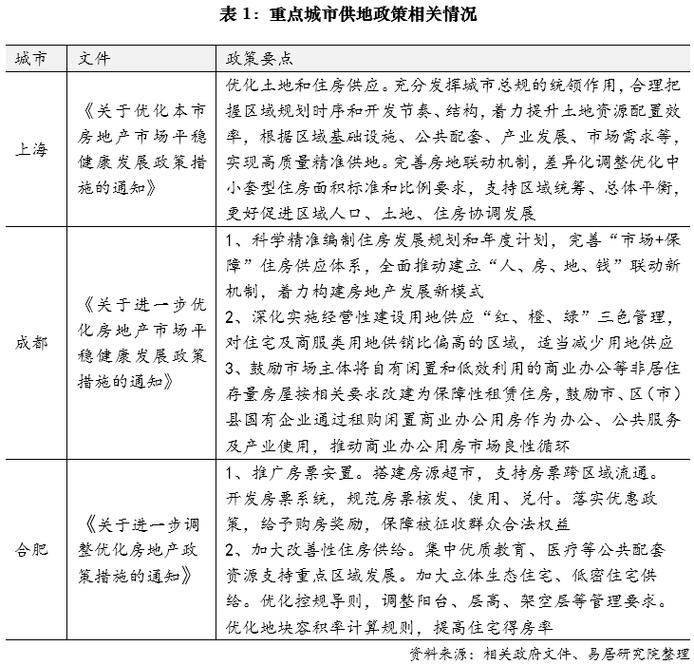
The circular's requirement that “the size and pace of housing development in 2015 be properly controlled when housing is oversupply” is the most difficult to achieve. Oversupply of housing is dependent on land finance, and the functioning of finance when the size of local concessions is controlled requires more sectoral coordination. Unless there are subsequent quantitative requirements, the impact of this policy on the market will be very “sensitive”。
Point 2 conversion of undeveloped properties
According to the circular, municipalities and counties with a clear majority in the supply of real estate or with a large size of land for construction of real estate may, depending on market conditions, study the development of a programme for conversion of undeveloped real estate land, to promote investment in other industries by adjusting land use, planning conditions, directing the conversion of undeveloped real estate land to use, and to the development of state-supported new and emerging industries, pension, cultural and sports industries, etc。
The circular calls for market-based housing projects being built in commodities to be allowed to adjust the types of housing households that are not suited to market needs, without changing the necessary planning conditions, such as the nature and volume of land used, to support the self-housing and improved housing needs of the population。
It's more difficult to read residential projects into business
“transformability for undeveloped real estate land”, a policy that has a positive impact on the market, especially in the case of past blind construction of large-household projects, may have the potential to change regulations, but overall it is very difficult. The notice is expressly directed at “municipalities and counties with a clear oversupply of real estate or with an oversized construction of real estate sites” and it can be seen that real estate land that meets conversion criteria refers mostly to housing projects. Among the land types, residential land is the most expensive, followed by commercial land, and other types of land are largely worthless. Businesses are more difficult in cities that even have excess homes。
Point 3 commodity housing can be used as shelter and settlement, etc
The circular makes it clear that the total purchase of real estate projects in progress is to be used for sheds and public rental housing, or to convert real estate land that has not yet been built into sheds and public rental housing land, allowing it to make appropriate adjustments to the planned construction conditions, optimize household-type structures and improve the procedures for ancillary use。
The circular calls for a concerted approach to secure tenure. The monetization of housing security has been further strengthened, with municipalities and counties using eligible commercial housing as a source of shelter and housing for public rental。

The real estate policy will continue to be relaxed
Following the two meetings, a number of departments and municipalities introduced a housing restructuring policy. The circular's reference to “the use of eligible commercial housing as a source of shelter and public rental housing” can be seen as a concrete implementation of the intention of the two property restructurings。
The policy profile of the real estate market will clearly continue to be relaxed in 2015 in the light of a series of initiatives。
Point four, the two departments will monitor the real estate market together
The circular proposes to strengthen sectoral linkages and strengthen market order and supply enforcement supervision. In the future, real estate development enterprises with serious irregularities in the development and trading chain, as well as real estate development enterprises with violations of the relevant qualification regulations, may be restricted or prohibited by the territorial resources authorities from participating in competitions for new land concessions based on information provided by the housing and urban-rural construction authorities. In the case of real estate development enterprises with irregularities in the land market, the housing and urban-rural construction authorities may impose penalties on the basis of information provided by the territorial authorities; in serious cases, the certificate of qualification is legally cancelled。
The circular requires provincial territorial resources, housing and urban-rural construction authorities to increase their efforts to direct, monitor and inspect the work of municipalities and counties and to implement the primary responsibility of local governments to prevent both inaction and misconduct. The housing construction plan, the annual implementation plan and the annual plan for the supply of land for housing are submitted for approval to the people's government at the same level and are made public。
It's about administrativeization
At present, the real estate industry in our country is in a highly fragmented process of “de-administrativeization” and is under considerable pressure of de-incorporation. Local government is tested in east, central and west, large, medium and small cities by how they are classified, adapted, unmodified, fine-tuned and well-balanced。
The “change” of land use and the “change” of the set structure are all policy variations. Whether “change” works is central to whether or not to remain within the “de-administration” process, preventing both inaction and misconduct. The provincial people's governments have overall responsibility, the municipal and district people's governments have primary responsibility, and the authorities are responsible for carrying out their duties in a serious manner to ensure that measures are not frustrated or biased. Failure to do so requires corrective action and accountability of those responsible. In particular, issues relating to changes in the price of the land in question and the replenishment thereof are open to public scrutiny。
Industry perspective

Hot city house prices or warmth increases
I love the vice-president of my group, hu kyung-chul, who said that, in the light of the specific content of the circular, the new regulations are more about addressing the current overstocking of small towns in my country and the disorderly supply of land。
According to hu, the circular has led to the digestion of overstocked urban land supply and stock of commodity houses, mainly by allowing for the rational adaptation of household types to support self-employment and improved demand, the conversion of some houses into sheds for settlement and public rental housing, and the adjustment of available but not yet developed land use and planning conditions, leading to the development of enterprises for the construction of new types of property, such as old age, cultural and sports industries。
According to hu, for small towns with high stock levels, the current supply situation will be gradually reversed in terms of both supply and digestion, which is significantly larger than demand, thereby gradually stabilizing the prices of housing sales in the local market and directing the local urban real estate market towards a smooth and healthy path. For cities that supply more than demand, this policy is somewhat beneficial, but far less than many had expected。
The circular also contains supply-side requirements for cities with inadequate supply of market fundamentals. “housing cities, where supply and demand are more pronounced, should effectively scale up their housing supply in accordance with market realities.” in response, it appears from this statement that the circular also provides supply-side considerations for possible warming in some hot-spot urban markets, requiring such cities to increase the supply of housing on a larger scale. As can be seen from this, the city of the macro-buildings, which is currently in short supply, will experience gradual warming for some time to come, with market turnover rising and moderate price increases。
New deal forms more than substance
The chief analyst of china's real estate, zhang daewei, stated that the new deal for the two sectors had little to implement, but that in terms of impact, the policy itself represented the future policy direction, with more in the future。
According to zhang dawei, the 2015 real estate rescue policy will have two features: first, intensive and, from a local perspective, there are now a number of housing stimulus policies, and it is expected that follow-up departments will introduce similar fine-tuning policies that will release the signal of favourable market warming; second, depth, in the face of a continuing decline in the market engagement, in late 2014, all levels of government have moved out of the cities. In the provinces of fujian, jiangxi, hubei, hunan, hebei, henan, ningxia and ningxia, comprehensive documents will be issued for the real estate sector, starting with the links between land supply, housing credit, public savings, tax concessions, home-buying and market regulation, thus stimulating demand for housing; beijing, shanghai, the centre of the most important line, has made significant adjustments to the general housing standards since the fourth quarter of last year。
According to zhang dawei, this year's real estate policy will continue to be administrative, market-regulating, and it is expected that further liberalization will take place in the form of a sales tax and some front-line cities. Local governments will also directly introduce a variety of municipal rescue policies, such as tax credits and home purchase subsidies. At the same time, housing needs of families in need continue to be addressed through the provision of housing construction and housing assistance subsidies。