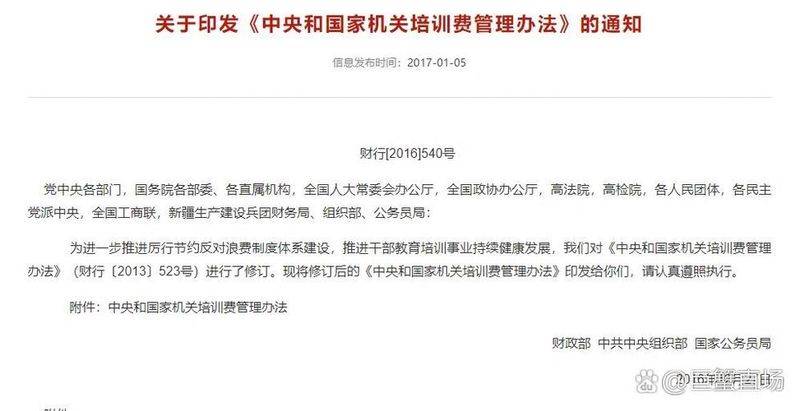
Information circular on the issuance of the questions and answers on the administration of travel for central state organs and agencies
Information circular on the issuance of the questions and answers on the administration of travel for central state organs and agencies
State council ministries and direct agencies:
Following the issuance of the circular of the ministry of finance on the issue (finish bank no. 313), it has received extensive attention at all levels of the party political organs and undertakings. Recently, we have received specific questions about the implementation of the travel management scheme for telephone consultations between the financial services of some units and those involved. A consolidated response has been collated and made available to the respective financial units。
Annex: questions on the methodology for managing travel of central state organs and offices
December 25, 6th
Questions on the methodology for managing travel of central state organs and offices
1. What adjustments have been made to the expenditure criteria in the travel management approach?
In order to adapt to the economic development situation and to ensure the basic work and living needs of the mission personnel, the travel management scheme eliminated the division of the categories of travel areas originally provided for in the general and special areas, and combined municipal transportation costs, etc., into public and private expenses. Travel expenses range from city-to-city transportation, accommodation, food support and public service expenses, with a uniform standard for food support, public service and miscellaneous expenses, to city-to-city transportation and accommodation by job level. The adjustments are as follows:
(1) the food supplement is paid at a flat rate of $50 per person per day for natural (calendar) days on mission。
(2) public and miscellaneous expenses are covered by a flat amount of $30 per person per day for the number of natural (calendar) days of travel to supplement municipal transport, communications, etc。
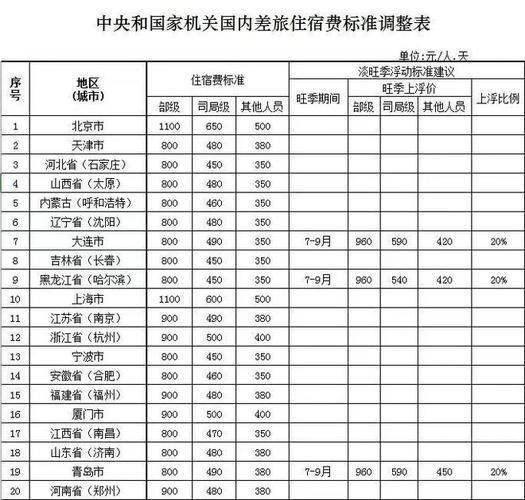
(3) accommodation. Under article 10 of the travel management scheme, staff of the central state authorities are required to travel to fixed accommodations, which must be accommodated in fixed hotels, which are to be paid at the reported rate of the fixed hotel. The treasury reimburses the agreed prices of specific designated hotels for the accommodation of mission personnel, and the actual cost of accommodation varies from one hotel to another, up to the established ceiling。
(4) freight for baggage. The shipment of baggage, furniture and equipment incurred by staff members as a result of their transfer is reported to be sold by the redeployed unit within $1 per kilometre of each person, which is more than partially self-supporting。
2. How do university professors, researchers in scientific establishments and senior engineers, associate professors and associate researchers, who are paid at the level of five and above, receive reimbursement for travel expenses?
Response: registration forms for the traveller's vehicle, equivalent to the travel of the deputy minister's official, are available in the suite in accordance with the standards of the deputy minister. Senior engineers, senior economists, senior accountants, associate professors, associate researchers, deputy medical doctors, second-level arts personnel and persons in comparable technical positions in higher education institutions, medical doctors, directors of health-care establishments, art personnel in cultural and artistic establishments, paid at the level of five or more employees, senior economists, senior accountants, associate professors, associate researchers, deputy medical doctors, second-level arts personnel and persons in comparable technical positions, in accordance with the standards of department-level personnel and accommodation standards. The remaining two were accommodated in a standard room in accordance with the standards for those below the service level。
3. Under the travel management scheme, staff members of the central office will not travel to place accommodations, and will accommodations be available to staff of the department's immediate services on duty station travel within the maximum standard for accommodation expenses at the duty station?
Response: for reasons of security, it has been decided to conduct a pilot project in the party bodies until experience has been gained and conditions have been reached. As a result, staff members of the enterprise are able to travel to hotel accommodations at fixed or non-scheduled hotels, subject to a reported sale within the maximum standard for accommodation costs at the duty station. The maximum standard cost of accommodation at a place of business, i. E. The maximum agreed price for all fixed hotels in a given region (place, city, state) after the ministry of finance has commissioned the services of the local authorities through government procurement。
4. In accordance with the travel management scheme, fixed accommodation is provided for mission staff, with two staff below the service level living in a standard room. 150 yuan per person per day for accommodation. How is the unit's treasury reimbursed when there is an odd number of travelers below the service level?
Response: if a person below the level of service is on official business, or if a person of the opposite sex is on mission, he/she may be accommodated in a single room, which shall be reimbursed by the financial services of the unit, depending on the number and gender of the person on mission. For example, four persons below the level of a unit are on mission, three men and one woman, and only two are reimbursed at the rate of accommodation, which actually requires three. In such cases, the unit's financial services shall be reimbursed for accommodation on the basis of merit。
5. How does a traveller reimburse accommodation when he or she travels to a place where he or she does not have a place to stay?
Response: under article x of the travel management scheme, travel to places where there are no fixed hotels is reported to be paid within the maximum standard for accommodation expenses in the locality, municipality and state。
Currently, government procurement at central-level spot hotels has not taken place in cities below the county level (including county level). Therefore, if a traveller is required to stay in a municipality below the county level (including the county level) because of his/her work, the standard of expenses for accommodation shall be within the maximum standard for accommodation in a fixed hotel in the municipality, municipality and state of the county, and shall be reported to be sold。
6. How does a traveller reimburse for accommodation even though he or she does not have access to a fixed hotel?
Official travel of the central state authorities must be accommodated at a fixed hotel. In the absence of accommodation in the designated hotels due to exceptional circumstances, the cost of accommodation is reported as being within the maximum standard of expenditure for accommodation in the locality, municipality and state。
7. How is the cost of accommodation reimbursed when the traveller is staying with his or her family or friends?
Article 12 of the travel management scheme provides that no traveller shall be reimbursed for accommodation in the absence of an invoice. No reimbursement shall be made for accommodation if the official is received free of charge by the reception unit or is staying at the home of his or her relatives or relatives without an invoice for accommodation。
8. After the introduction of a flat-rate package for miscellaneous public expenses, can the cost of air travel from residence to the airport be reimbursed to those authorized to travel by air?
Response: in view of the fact that the airport is generally far from the centre of the city and the higher cost of transportation, the traveller is authorized to travel by air, the cost of a passenger bus to and from the airport, the cost of civil aviation airport management construction and the cost of insurance for personal injury for air passengers (limited to one per person) are not covered by the public and miscellaneous rates, as reported. The cost of transportation of travellers to the bus stop on line is within the scope of the public and incidental flat pack。
9. The cost of catering support and miscellaneous services for mission personnel is calculated on the basis of the natural (calendar) days of travel. How should natural (calendar) days be properly understood and implemented?
The number of natural (calendar) days is the actual number of calendar days from 0:00 on the day of departure to the day of return to the place of work on completion of the mission, which is calculated on the day of departure and return. For example, when an a mission leaves at 11 a. M. On 5 a. M. And returns at 7 a. M. On 24 a. M., the natural number of days that the individual will travel should be 20 days。
10. How does the central office staff travel to and from remote suburban districts on short-distance trips on the same day, and how is the cost of their travel?
Response: staff travel to remote suburban districts or on short-distance trips to and from the field is carried out on the basis of the relevant criteria set out in the travel management scheme. Of these, staff members are provided with food by the reception unit in a uniform manner, without a lump sum system. The traveller shall pay a fee for meals to the receiving unit, and shall return to his or her place of business upon the proper declaration, and shall be reimbursed within the agreed limit on the basis of the receiving unit's receipt; if the traveller is provided with free transportation by the service, the reception unit or other unit, he or she shall be paid in half of the public and private expenses。
Those who cannot return to and from the same day and require accommodation are subject to the provisions of the travel management scheme。
11. How is the allowance payable when a long-distance continuous train meets the condition of a bedroom, one of which is not in the bedroom?
For long-distance continuous train travel, no bedtime tickets must be purchased for the entire journey to be paid at 80 per cent of the full hard-seat fare. If one of these steps is in the bedroom, and the rest of the booths are in the bedroom and have not purchased the sleeping ticket, the allowance may be calculated in accordance with the subsection, i. E. Six hours by car from 8 p. M. To 7 a. M. The following day, or more than 12 consecutive hours by car, at the rate of the hard ticket for this section. If you fail to meet the prescribed conditions..
12. How can a person on mission, who meets the conditions of a train sleeper and who does not buy a sleeper's ticket instead of a hard-seat ticket, who is subject to the conditions of transport and who must transit, be paid a supplement for not sitting in a bed?
Response: in the case of travellers who are required to transit and are not accommodated, the allowance may be paid in proportion to the fixed fare. In the event that service requires stop-and-exit stop-and-work and accommodation, the calculation shall be in subparagraphs. That is to say, if a section of the road meets the distance of a train sleeper and no beder ticket is purchased, the allowance may be paid at the rate of the fixed hard-seater fare. The allowance shall not be paid for sections that do not correspond to the carriage by train。
13. How should a person who meets the condition of a train sleeper be subsidized by moving to a soft seat?
If a person who meets the condition of a softer train is transferred to a soft seat, the allowance shall be paid at 80 per cent of the price of the hard ticket. The conversion to hard seats is also based on 80 per cent of the price of hard seats. Changed to a hard bed and no more benefits。
14. How does a person with disabilities who is working in a difficult situation travel on a train and fulfils the conditions of bedtime, without having bought a bedtime ticket, to be paid a supplement if he or she is entitled to the price of a train ticket?
Response: if a person with a disability who is employed on official business travel on a train and meets the conditions of bedtime, but has not purchased a bedtime ticket, he or she has purchased a hard seat ticket at the prescribed preferential rate, and the allowance is payable at 80 per cent of the lump sum ticket price。
15. The travel management system provides that if a staff member returns to his or her province close to home during his or her travel or reassignment, with the prior approval of the head of the office, the cost of transportation by way of a round trip, less the cost of direct one-way transportation on mission, with the over-expenditure being borne by the individual. How does implementation work?
The above provision is a form of care for workers who are far away from home and who are able to visit their parents, spouses, etc. By way of a little detour while travelling, meeting or moving to work. For example, travel from beijing to wuhan, with the prior approval of the head of the unit, to nanjing province to work in person and to return directly from nanjing to beijing, is reimbursed on the basis of the price to be paid for the road trip from wuhan to beijing. The cost of the detour, which exceeds the cost of the ticket in wuhan to beijing express, is at the personal expense of the individual; when the detour is less than the price in the detour between wuhan and beijing, it is reimbursed on the basis of the actual detour。
16. Should the food support and miscellaneous expenses incurred during the journey continue to be paid in accordance with the provisions, after the traveller has taken the train and is eligible for the restership without the purchase of a beder's ticket and has already paid the subsidy in proportion to the established hard-seat fare?
In the case of travellers who meet the conditions of bedtime, who do not buy a bedtime ticket, personal allowances are paid at a percentage of the price of a hard-seat train ticket. If wang is to ease the tension in the train bed, he is to encourage some of his better-healthy comrades to leave without waiting for a bedtime ticket. The nature of this allowance differs from that of an en route meal supplement, so that after the payment of the allowance to the traveller has been made in proportion to the established hard-seater price, the food allowance shall remain in accordance with the regulations for the duration of the journey。
17. A number of passenger trains have been active in passenger life by adding a number of services to ease overcrowding. In the event that a restaurant car is used to open a teahouse, a spare tea spot, a newspaper, a chess board, etc., for the benefit of passengers, can the traveller reimburse the teahouse at an hourly rate?
The costs of the tea table, etc., should be at the personal expense and not reimbursed。
18. Are food subsidies paid to persons holding leadership positions at the grass-roots level while working at the grass-roots level?
Response: under article 18 of the travel management scheme, a daily food supplement of $15 per person is paid to the staff of the basic units for their basic training, work exercise, support work and various task forces, without reimbursement for accommodation and miscellaneous expenses. In the case of persons in managerial positions at the grass-roots level whose salary relationship is still in place, benefits are paid in accordance with this provision. This provision is no longer in force if the wage-supply relationship is transferred to the active establishment。