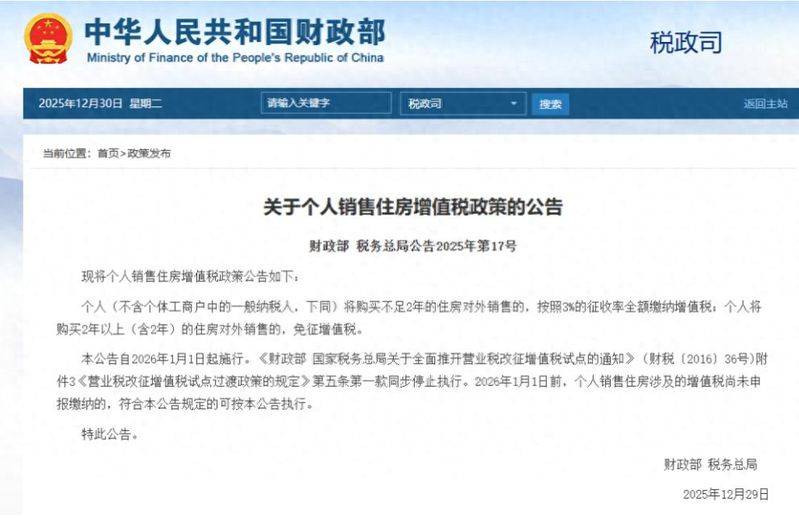
On 30 december, the ministry of finance and the directorate-general of taxes issued a joint bulletin on the value-added tax policy for the sale of housing by individuals, which clearly adjusted the criteria for the collection of value-added tax for the sale of housing by individuals, and which became official on 1 january 2026。
According to the bulletin, an individual (other than a general taxpayer among individual business owners) will pay vat in full at the rate of 3 per cent for the foreign sale of housing for less than two years; an individual will be exempt from vat for the external sale of housing for more than two years (including two years). At the same time, the circular of the national tax administration department of the ministry of finance on a comprehensive roll-out of the vat conversion pilot (customs 2016) article 5, paragraph 1, of the provisions of the pilot transition policy on the conversion of turnover tax to value added tax (vat) is suspended simultaneously. The value added tax (vat) for personal sale of housing prior to 1 january 2026, which has not yet been declared, is subject to the new policy in accordance with the provisions of this proclamation。
According to shenzhen's data, the value-added tax (vat) could save $9. 25 million if it were to be implemented under the new policy, for example, for less than two years when a person purchased a housing unit with a foreign exchange price of $5 million。
Impact: reduce costs and release demand for housing
According to li yu jia, the chief researcher of the centre for housing policy studies of the city school of the guangdong province, the central impact of the new deal was to reduce the value-added tax on the sale of housing for up to two years from 5 per cent to 3 per cent, with a direct 2 per cent reduction in the transaction cost of housing for up to two years, while the tax-free policy for holding housing for more than two years remained unchanged。
With regard to the reasons for the adjustment of tax and excise policies, li's analysis of the disruption of the “sold-for-new” cycle resulting from the separation of the market for new and second-hand homes is a direct cause of market weakness, and the reduction of taxes is an important option for implementing national policy orientation and countercyclical regulation. In terms of real demand, a reduction in the transaction tax on holding a dwelling for up to two years would reduce transaction friction, facilitate the listing of housing sources and avoid large price reductions by owners because of high transaction costs and insufficient potential buyers, and help stabilize housing prices。
He noted that the 5 per cent full vat collection rate had led to high transaction costs, that a 3 million dollar housing value added tax (vat) had amounted to $150,000, that it had placed considerable pressure on buyers and replacement sellers, that current home buyers were more sensitive to transaction costs and that there were strong demands for lower taxes and fees. Moreover, in 2022-2024, the real estate relief policy focused mostly on lower down payment, lower interest rates and relatively few tax adjustment policies. The vat adjustment was in line with the demand of the state to promote rational consumption and lower consumption constraints。
In terms of the impact of the policy on the market, li yuja believes that the new deal will be effective in reducing transaction costs, reducing friction, releasing demand for housing subject to the tax and fee threshold; reducing the difficulty of selling short-term housing holdings and reducing the number of cases where prices are significantly reduced; and facilitating the good interaction of second-hand houses with the market for new houses and just needed to improve demand by breaking the “sold-for-new” cycle。
Outlook: policies are at the most relaxed stage in history
In the context of the new deal, the vice-president of the shanghai institute for emigrant real estate has made a significant leap forward in refining the dynamics of real estate tax adjustment over the past three years, particularly since 2024. He noted that the current policy on the three main taxes and charges on real estate (compensatory tax, value added tax, personal income tax) was at its most liberal stage in history. With respect to the vat, this adjustment, combined with the two-year tax exemption that preceded it, has resulted in a full-cycle liberal support; with respect to the tax, the tax has been reduced from 140 square metres to 1 per cent for housing up to 1 per cent, and in some areas the tax has been reduced to almost zero by the introduction of the tax subsidy, which allows for the collection of funds to pay the tax; and with regard to the personal income tax, the transfer of housing for more than five years is exempt from the tax, and the transfer of ordinary housing for less than five years is subject to a tax of up to 1 per cent of the house price, most of which can be taxed。
With regard to policy effectiveness and market prospects, a sharp leap forward suggests that the overall easing of tax and tariff policies creates a policy environment conducive to housing consumption that reduces transaction costs and helps stabilize market expectations. The current policy of substantially adjusting housing prices, increasing confidence among home buyers, reducing the premium to 15 per cent, low interest rates on loans, etc., is favourable. Real estate market transactions are expected to become more dynamic in 2026, which will not only help to remove stocks, but will also have a positive impact on stabilizing the market and promoting the healthy development of the real estate market, ultimately benefiting housing consumption。
It is widely recognized within the industry that this adjustment of the value added tax (vat) policy for personal sales is an important complement to the demand-side support policy for real estate, which will work in tandem with the previous set of profitable policies to drive the real estate market towards stabilization and to lay the foundations for a shift from industry to high-quality development。
Reporter, nandu bay bank. Sun yang