Technical brief:
In response to the problems of slow growth and poor quality caused by inappropriate methods in lilies, the invention proposes to meet market demand through technological measures such as scientific consolidation (deep roll-over + organic fertilizer + alkalinity regulation), strict sterilisation of seeds, standardization of beds and carrying, and innovative network support to optimize the lily environment, improve its growth rate and quality of view, and achieve high-yield quality cultivation。
Keyword: lilies cultivation techniques, high-yield quality cultivation
This invention involves the cultivation of a lilies, specifically a lilies。
Background technology:
The lilies are so elegant, they are so green, they are so hot, they are so beautiful, they are so popular, they are used mainly to watch, and the lilies' roots are rich in starch, and some of them can be used for vegetables. In our country, the lilies' roots can be used to cook soup, have a high nutritional content and have high medicinal value. The poor cultivation of lilies results in slow growth and poor quality, reducing economic gains and failing to meet market demand。
Technical realization elements:
In order to address the above problems, the invention offers a lilies method of growing, using techniques such as ground-building, seeding, bed-laying, networking, etc., through an understanding of the lilies ' characteristics, so that they can grow quickly and in good quality while increasing economic returns while meeting market demand。

This invention was achieved through the following technical programmes:
(a) a lilies planting method, which consists of the field, seeding, bedmaking, planting, netting, etc., as follows:
1) 35-40 cm deep ground, 2-4 cubic metres of urea per acre with corroded sugar cane slag and 3-6 kg of urea, making soil ph 6-7 micro-acil, increasing fattening 500-1200 kg per acre and adding 150-350 kg of grasswood ash per acre
2) selection: the root of the harvest is taken from a highly developed, large, corroded, white-coloured, non-damaged, insect-free sub-phosphthalon species, with 3-4 hours of immersion in a combination of alcohol and chlorinated solvents with a mass concentration of 3-5%, followed by drying, where chlorinatednes are mixed with alcohol at 1:4 mass ratio
3) bed: a high bed of 15-25 cm high and 60-75 cm wide with a walkway of 35-40 cm between the two beds
4) loading: opting for a ball that has passed out of hibernation, one kg of the ball using a benzomether 5-10 grams of disinfectant blending, cutting the layer around 5. 5 to 7. 5 cm on the bedside to the side, placing the ball on the hole with a well-sized nail plate, then filling it back to the side of the bed and flatting it
5) networking: the nylon network, which is customised to correspond to the plant's distance, is made available to the lower part of the bouquet when the line is 50 to 60 centimetres high and the line is laid around the bed。
In the preferred field, the soil moisture of the lilies is 55-65% and the temperature is 18-22°c。

The positive effect of this invention is to make the lilies grow fast and of good quality through knowledge of their properties, using techniques such as landscapes, seeding, bedmaking, carrying and netting, and to maintain the colour of petals over the long term and increase their visibility。
Implementation modalities
The following is a more detailed description of this invention in the context of its implementation:
(a) a lilies planting method, which consists of the field, seeding, bedmaking, planting, netting, etc., as follows:
1) a total of 40 centimetres of soil, 3 cubic metres of urea per acre with corroded sugar cane slag, 5 kg of urea, resulting in micro-acidity in soil ph. 6. 5, a moderate decomposition of 800 kg per acre and 250 kg per acre with grass-wood ash
2) selection: the root of the harvest is taken from a highly developed, large, corroded, white-coloured, non-damaged, insect-free photophos plant, which is impregnated for three hours with a mixture of alcohol and chlorination at a mass concentration of 4. 5 per cent and is then taken out for drying and then taken to the bottom, where the chlorination is mixed with alcohol at a mass ratio of 1:4
3) bed: a high bed of 20 cm high and 65 cm wide, with a walkway of 35 cm between the two beds
4) vegetation: opts for a ball that has passed its hibernation, one kilogram of a ball with 8 grams of benzomether disinfectant, strips the surface of the bed around 7. 5 centimetres to one side, pegs the size of the nail plate at a distance, places the seed ball on a hole, then fills the surface of the bed on one side back, flats the table
5) networking: the nylon network, which is customised to correspond to the distance of the plant plant, is built around the bedside with a wooden or iron-stamped net, which can be raised to the lower part of the line, at a height of about 55 cm, without the ploughing。
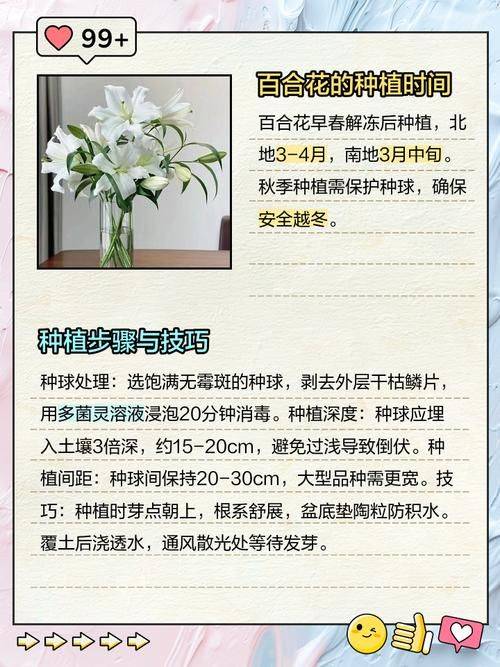
Of these, the soil moisture of the lilies was 55 per cent and the temperature was 20°c。
Technical characteristics:
Technical summary
The invention has opened up a lilies-growing method that enables lilies to grow quickly and in good quality, to maintain the colour of their petals over the long term and to improve their visibility through an understanding of their properties and the use of techniques such as landscapes, seeding, bedmaking, seeding and netting。
Technical research and development staff: momoman; tang chiu ling
Protected technology users: guangxi condo-feng agricultural technology co. Ltd
Technology research and development day: 2017. 12. 11
Technical publication day: 2018. 04. 20