With friends, you get the same shop, the same dish, and your distribution costs are higher than his; you book a hotel with an old account number of $800 and a new mobile phone for $600. This is not an illusion, but rather a microcosm of the price disorders of internet platforms over the past few years。
On 10 april 2026, the rules for the conduct of prices on internet platforms, a new regulation known as the “first systematic regulation”, were formally implemented. What are the challenges to be addressed? We break down the three most direct perspectives of consumers, businesses and platforms。
From the consumer's point of view, the new rule is to cut off the "killing" and "set-up" operatives
The central pain for consumers is the lack of transparency and inequity in prices. This is mainly at two levels:
First, big data kill. The platform uses algorithms to impose higher pricing on older “faithful” users. Typical examples are:

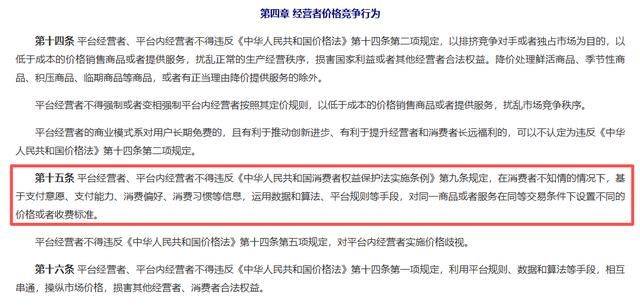
For the first time, article 15 of the new regulation expressly prohibits such acts in the form of sectoral regulations requiring that the same goods or services be subject to the same conditions of trade. The key point is that the new regulation “reverses the burden of proof” — consumers need only provide prima facie evidence of price differences (e. G., screenshots) and the platform has to justify itself, otherwise it will be presumed to be “killed”。
The cost of violating the law is high: confiscation of the proceeds of the offence and a fine of less than five times; and a fine of between $50,000 and $5 million for those who do not。
Second, it's a bogus promotion. This includes:
Article 18 of the new regulation sets a red line to this effect, prohibits the sale of goods through false discounts, price comparisons, and requires promotion rules, and the duration of the activity to be publicized at a prominent location on the page. This means that there will be nowhere else to go with the tumultuous “sets” of the past。
Turning to the business position, the new rules return the fundamental right to “auto-pricing”
For millions of platform operators, the biggest shackles are forced into low-price competition and loss of pricing autonomy。
The instruments of coercion commonly used by the platform include:

This “inner volume” is fatal to businesses. Studies at the university of jordan show that after the war, the total profits of the commercial “outgroceries plus food” declined on average by 8. 9 per cent. The 2026 report of the cla further noted that 80 per cent of the net profits of the caterers were down, with 35 per cent of them falling by more than 30 per cent。
In order to survive, 39 per cent of businesses were forced to replace lower-cost suppliers of raw materials, caught in a vicious circle of “bad currency expulsion”。
The new regulations respond to this by systematically empowering. Article 5 of the platform specifies that the platform shall not impose price reductions, fix prices or impose automatic tracking systems. At the same time, a new article 14 of the anti-improper competition act, amended in 2025, specifically prohibits the platform from forcing vendors to sell at below-cost prices, with a maximum penalty of $2 million。
The china network commented that this was not only a return to rights, but also a rebuilding of confidence that allowed businesses to invest in quality and innovation。
For the platform itself, the new rules force its competitive logic to “retrack”
In the past, some platforms have used “low prices” as the core or even the sole lever of competition, with traffic and data advantages, leading to distortions of an industrial nature。
In support of this model, it is argued that low-cost access to users, large markets and short-term benefits for platforms and consumers. The size of the subsidy did indeed pull the order。
However, opponents pointed out that such “inner volume” competition was not sustainable. It squeezes the profits of the entire industrial chain, harming not only businesses but also the long-term interests of workers, such as consumers (accessing low-quality goods) and riders. In its comments, song-wan said that this led the platform to fall into a zero-sum game of “flow distribution” rather than creating incremental value。
The introduction of the new regulations is essentially a mandatory “correction” of the platform's competitive logic. Rather than simply rejecting low prices, it draws a line between “legitimate competition” and “distorting low prices”. The platform can no longer manipulate prices through algorithms and traffic hegemonics and must turn to competition under transparent rules。
This means that the algorithmic capability of the platform needs to be repositioned. Experts suggested that algorithms should be used more to optimize areas of aggregate value creation in society, such as matching supply and demand, reducing stock losses and improving logistics efficiency, rather than for price discrimination or flow coercion. The focus of platform competition will shift from “who gets lower” to “who gets better quality, better service and more efficient”。
Integration of judgement: a systematic re-engineering, but implementation is key
By combining these three perspectives, we can draw an integrated conclusion: the internet platform price conduct rules are not a patchwork for a single image, but a systematic re-engineering of the platform's economic price order。
It simultaneously aims at three main points of distress for consumers (fair and transparent), business (autonomous rights) and platform (competition norms), and attempts to break through with a set of rules. Its core logic is to stabilize the quality of supply by safeguarding the right of merchants to independently price, and to boost demand confidence by protecting consumers ' right to fair trade, ultimately forcing the platform to abandon short-term flows and turn to long-term value creation。

The new regulations have shown preliminary results. On the eve of implementation, the main platform of the three sectoral organizations conducted self-censorships, which showed a “manifest improvement” in price behaviour. The head electrician and the local living platform have begun to remove the mandatory pricing system and optimize price publicity。
However, the vitality of the rules lies in their implementation. The complexity of algorithms, the difficulty of obtaining evidence and the potential for new means of circumvention from the platform are challenges for future regulation. The real roots of the new regulations will depend on the sustainability of normality, precision regulation and the effective use of the rights granted by the new regulations by consumers and businesses。
The ultimate goal of this governance is to build a healthy digital ecology of business ownership, fair competition on platforms, and rational choices by consumers. The shift from “price battles” to “value battles” is a necessary, albeit inevitable, road to high-quality development for the platform economy。