
In 2026, csa projects that chinese car sales are expected to remain at 34. 75 million, moving into a 1 per cent micro-enhancement range at the same rate of increase, but new energy vehicle penetration is expected to exceed 60 per cent. As new energy vehicles are expected to retain more than 60 million vehicles this year, the focus of the industry is shifting from “whole-car manufacturing” to “software definition, life-cycle services and globalization”. This qualitative change in the structure of the industry has directly reshaped the talent profile of the automobile industry。
The leading human resources service providers in the country, 51jobs, recently released the spring 2026 market insight for the automobile industry, which provides a comprehensive multi-dimensional analysis of the supply and demand of the automobile industry based on the platform's big job postings and cvs. The data show that in the first quarter of 2026, there was a dynamic growth in the automobile industry, steady demand for enterprise recruitment and a steady demand for job-seekers, but there was room for improvement in the matching of high-end r & d with manufacturing functions. The report reveals the underlying causes behind structural changes in industrial talent in the context of the current transformation of the chinese automobile market to new energy vehicles (nevs), smartness, networking and strong exports。
Private firms are hiring for jobs that focus on technological innovation and quality control
In the first quarter of 2026, enterprise post announcements were centralized. In terms of the nature of the enterprise, private companies issued the highest percentage of jobs, more than other types of recruitment in the automobile industry; followed by foreign and listed companies, state enterprises followed by joint ventures. This distribution reflects the rapid deployment of private firms in the areas of new energy vehicles and smart driving, with flexible mechanisms to capture market shares. It is noteworthy that there has been a significant increase in the number of corporate postings with 150-500 employees, indicating that medium-sized enterprises are becoming an invaluable force in industrial innovation and expansion。
There is also a trend towards concentrated urban distribution of the demand for talent in the automobile sector, as documented by the promising data. Shanghai is the first country to have a leading position; the cities of wuhan, guangzhou, shenzhen, beijing, hoi fat, suzhou, chongqing and ningbo follow. These cities not only have a complete automobile industry chain, but also benefit from local industrial policy support to create a concentration of talent. Among them, the long-triangular and bead-triangular cities contribute most of the demand, reflecting regional industrial cluster advantages。
At the specific functional level, r & d and r are the two core areas in which hot jobs continue to operate at high levels. Among them, the position of automobile design engineer has been at the top of the hottest list for several consecutive quarters, with simulation applications engineer, car project management, vehicle electronic engineer and new energy battery engineer being among the top technical positions. It is noteworthy that the chief engineer jumped to the second position in thermal recruitment in the first quarter of 2026, indicating strong demand for the manufacturing end-scale production. Other high-frequency functions include client quality engineers, process quality engineers, interior and interior engineers, all of which fall under quality control and process optimization。
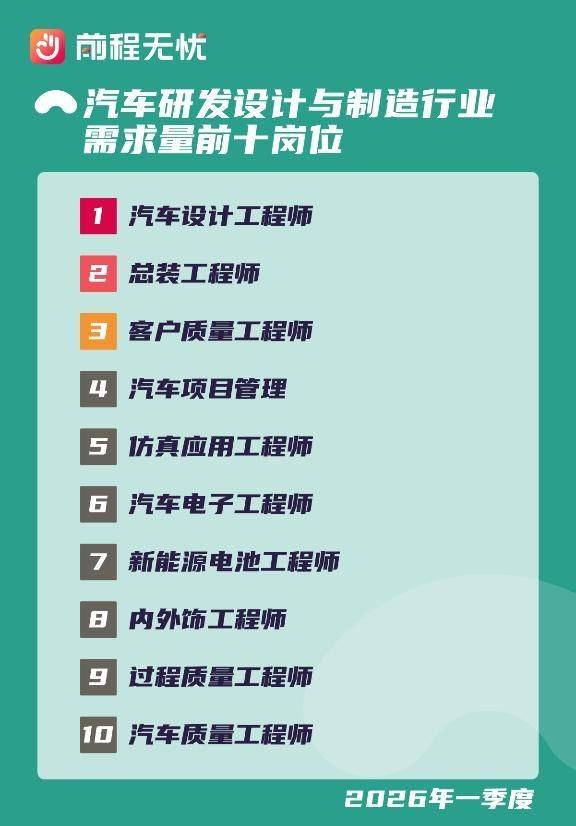
Prominent data show that the recruitment pay for these hot jobs is also clearly attractive in the market: automobile design engineers, simulation application engineers, new energy battery engineers, and automobile electronic engineers are paid more than $300,000 a year; new energy generators engineers, intelligent drivers engineers, new energy electrical controls engineers, car safety performance engineers, etc., are paid between $350,000 and $400,000 a year; and higher technology posts, such as r & d directors/ministers/experts, are paid more than $600,000 a year. This pay structure reflects the importance that enterprises attach to highly skilled people, particularly in the context of the intelligent transition, where new energy-related jobs such as simulation, electronics, electrical controls and batteries are highly competitive。
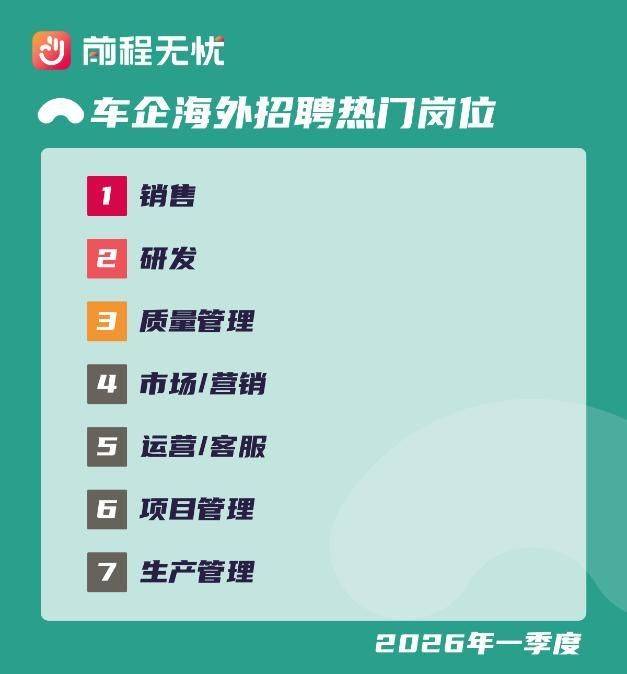
In addition, the report tracks changes in the number of jobs recruited for overseas operations by chinese motor companies over the past three years on the platform. The data show a steady upward trend in the number of jobs in this category, reflecting the accelerating globalization of chinese motor companies, and the expansion of export operations has generated a demand for personnel with international perspectives and experience in overseas projects. The high proportion of sales, r & d, project management and other functions in overseas business-related positions further corroborates the need for complex talent in the outreach strategy。
Job seekers prefer quality control and manufacturing jobs
The data on the end of the job-seekers show that in the first quarter of 2026, deliveries in the automobile industry continued at a high level and remained stable compared to the same period in 2025. The high concentration of delivery in popular jobs, with quality engineers at the top of the delivery list for many consecutive quarters, has become the preferred job-seeker position, followed by crafts/programming engineers, production plans/material management (pmcs), purchasers, mechanical repair/maintenance, etc., which shows the preference of job-seekers for stable jobs at the manufacturing end. Mechanical engineers, quality examiners qc, accountants, warehouse managers, etc. Have equally high delivery levels。
Hot city delivery distributions overlap with demand-side heights. The cities of shanghai, guangzhou, suzhou, chongqing, wuhan, shenzhen, beijing, ningbo, hoi fat and hangzhou are among the top 10. This distribution shows that first-line and new-line cities continue to be the preferred job-seekers because of the advantages of job opportunities and well-being。
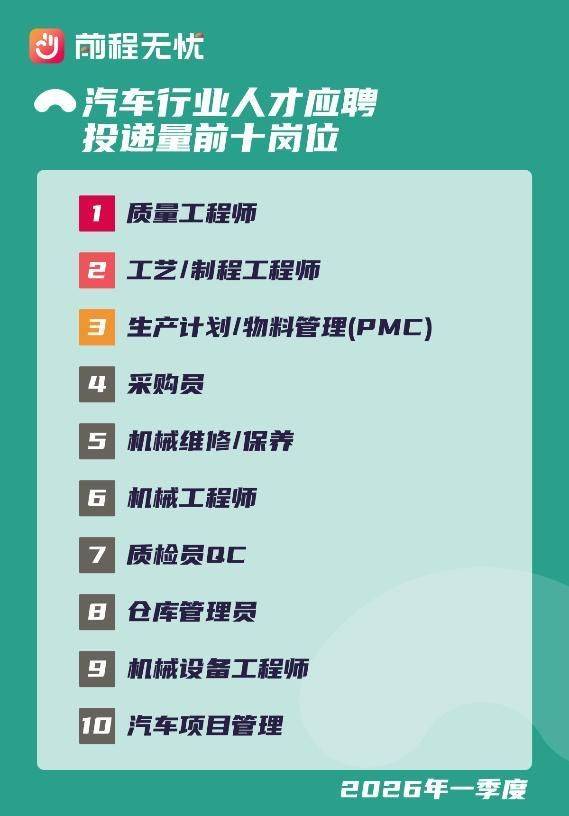
Data for the future show that job-seekers are more likely to work at the executive level of quality control, production planning, procurement, maintenance, etc. Than at the enterprise level, while high-end r & d design jobs (e. G., smart driving, simulation applications, new energy power control) are relatively low. There is a mismatch between this supply structure and business demand, reflecting the fact that some job seekers still prefer traditional manufacturing jobs with lower thresholds。
Intelligence, globalization into a core driving force for the automobile industry
At present, the chinese automobile industry is at a critical stage in its overall transition from conventional fuel vehicles to new energy vehicles. According to publicly available industry information, the penetration rate of new energy vehicles has continued to rise since 2025, with smart internet-connected vehicles becoming the new growth pole. In response to technology overlaps, enterprises have stepped up their recruitment efforts for technological research and development and are willing to pay a higher pay premium for highly skilled and highly skilled personnel, resulting in these positions being at the top of the hot list for many seasons. At the same time, the wave of intelligentity has generated demand for upgrading at the manufacturing end, such as the master assembly process, quality control, and has also contributed to increased demand for jobs such as autopilot, smart cabins, visual algorithms, etc。
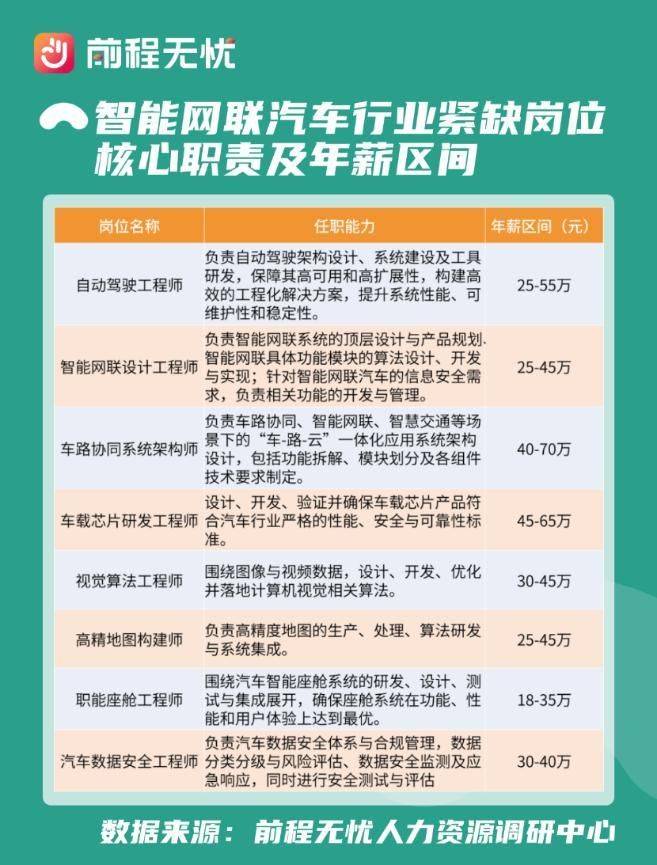
Globalization is another important driver. The volume of chinese automobile exports has been consistently high in recent years, and autonomous brands have accelerated access to the sea, leading to a significant increase in demand for jobs. Enterprises need not only skilled personnel, but also complex personnel with international project management, overseas marketing and local adaptation capabilities, which directly pushes up the pay and recruitment priorities of the jobs concerned。
The job-seekers'supply preferences for quality, craft, pmc, etc. Stem from the steady demand for executive talent in the automotive manufacturing industry, on the one hand, and from the structure of talent development, on the other. Higher education and vocational training are still dominated by traditional specializations such as mechanics, electronics and quality management, and the longer cycles of talent development in new directions such as high-end smart driving, car networking and simulation algorithms make it difficult for the supply side to fully match demand in the short term。
Looking to the future, the motorized talent market will continue to be highly internationalized. Enterprises should strengthen their cooperation with schools, internal development and the introduction of foreign talent, increasing investment in areas such as smart driving, battery electrical control and simulation applications; job-seekers need to proactively upgrade their digital and international skills to capture the industry transformation dividend. Governments and industry associations can also optimize regional talent flows and mitigate structural supply and demand conflicts through policy guidance。