"the king of ten" was created by ai? In recent days, there have been repeated stories of “trawling” of ai detection tools, such as the “62. 88% ai rate” marked “hot tong moon” and red alerts of triads, which have sparked public debate about the scientific nature of ai testing tools。
To explore the identification and technical principles of the ai testing tool, the southern metropolitan journal and the southern grand data institute sampled 10 of the country's popular text and photo aig test tools. The results show that the test standards are uneven in text-testing tools and that there are clear errors, omissions and irregularities. The photo detection tool is difficult to identify behind the ps。
When the ai test was used as a “threshold” for graduation from higher education, and as a “hard indicator” for review of periodicals, it once gave rise to confusion. In the expert's view, current ai testing techniques are in the exploratory phase and it is not advisable to force the link between unstable technologies and academic integrity by miscalculation or technological evolution. In the long run, however, the technology overlap and compliance framework still need to be constructed in parallel。
Ai text testing
Miscalculation, leakage, malchecking "problems"
What about the a. I. Test? The results of this survey by the nandu grand data institute are: ignorancenet, papersmart, man, whip, magna carta model testing, misnet digging, daya, paperyy, elephant, a total of 10 popular domestic texts, and photoaig testing tools。
The first is text-type testing, which attempts to test the recognition of authentic articles and, to varying degrees, ai-generated content using four articles. The four articles were: linhai (with ai rate 0), a manual essay on a particular subject (with ai rate 0), false news using ai (with 20 per cent), and forest sea (with 100 per cent of ai) from ai. Ten sample tools were available for text-based aig testing and the results were available within minutes of uploading the article。
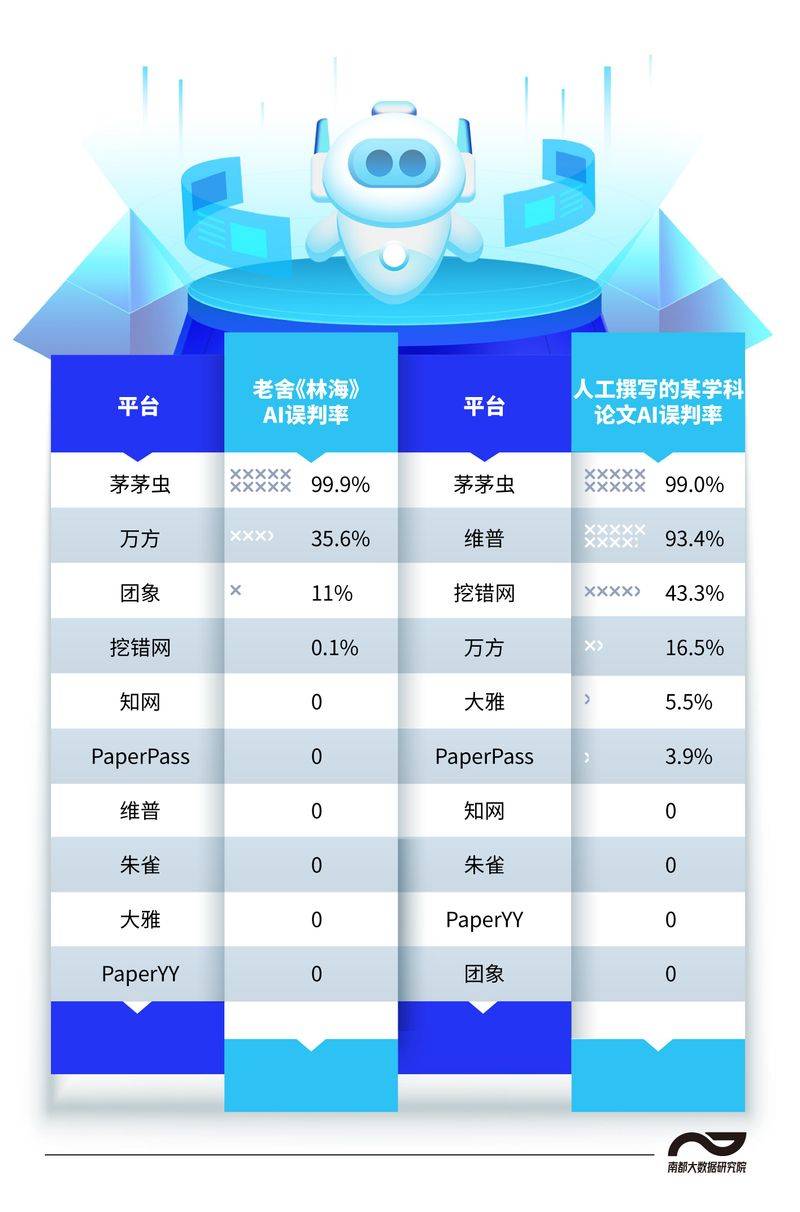
Following 40 tests, the identification of different types of text varied from one result to another, and av testing still faces three types of “problems” to be solved: first, the miscalculation of a true article as an ai creation is more common; secondly, nearly half of the tools are less sensitive to ai production and fail to accurately detect the ai content in the article; and thirdly, detection lacks differentiation, “unlike” for real or ai-generated articles, and there is a “discretionary” phenomenon。
The mackerel tested the forest water 99. 9% as ai
"ai" is the answer to the question
In front of the classic literature of the old house, the sea of forest, there are seven tools (swissnet, papersmart, whip, chuk, da-ya, papersmart, digging misnets) that have achieved accurate detection, with an ai detection rate of zero or near zero, while the mackerel has the highest detection error rate of 99. 9 per cent, indicating nearly 500 words of more than 1,300 words as “ai-generated”, with a miscalculation rate of 35. 6 per cent. Four tools (swissnet, jacket, paperyy, elephant) have an ai detection rate of 0, and the highest detection error rate of 90 per cent is found in the mackerel and whip。
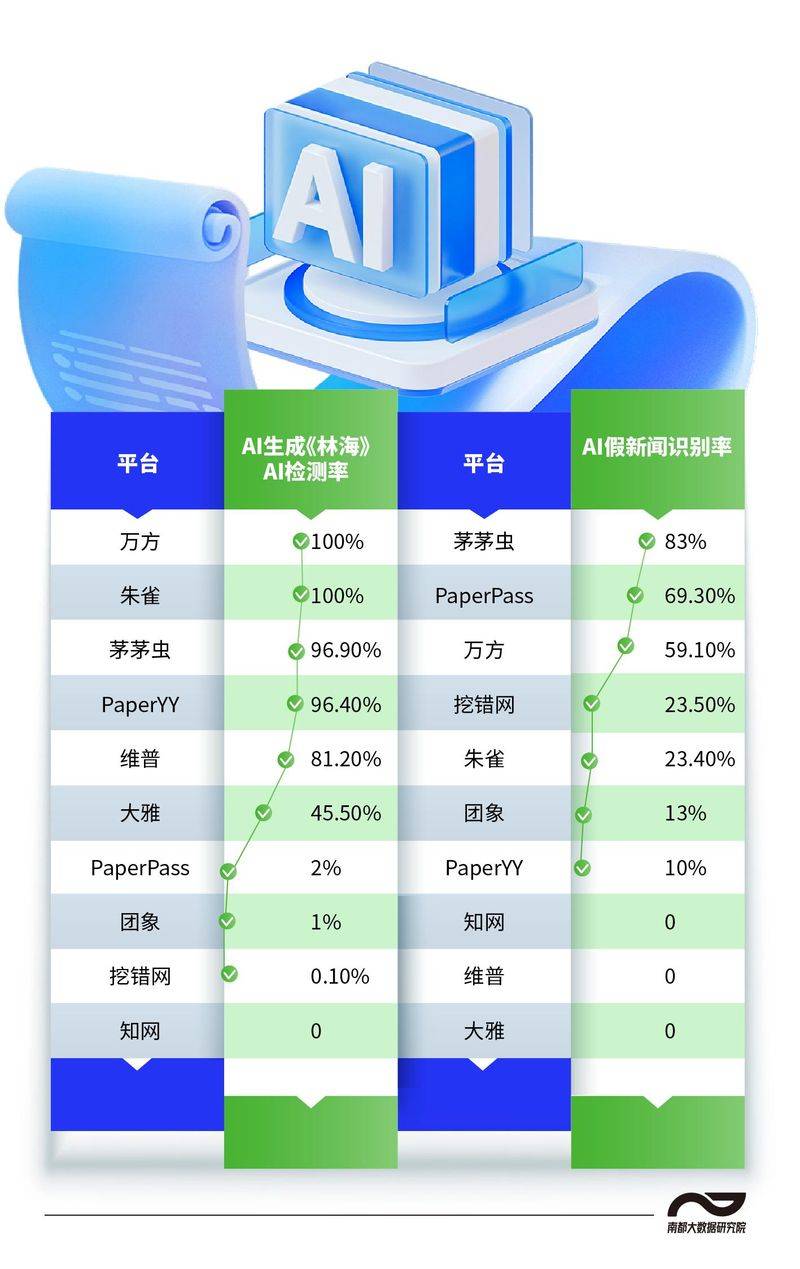
For the collection of ai's essay, the sea of forests, thousands of people and birds accurately identified the ai generation (100 per cent decision rate) and the decision rate for caterpillars and papersmart was over 95 per cent, while the detection of leaks occurred in the knowledge network, the digging of wrong webs, the image of the group, and papersmart, with only 0 per cent, 0. 1 per cent, 1 per cent and 2 per cent, respectively. For a fake story with 20% of ai content, there is a high level of ai recognition for the mackerel, papersmart and all-china, and a low level of ai recognition for the internet, the whip and the magnificent。
It's more accurate to test the whole of the ia
Post-ps photo identification difficulties
In addition to text testing, photo detection is also available for the magna carta model, and the evaluation was conducted using five ai production maps (in the form of animation, fact-writing, etc.) and five real photographic maps (in the form of one ps modification)。
The results show that the two tools are generally more capable of identifying pictures. For the five images generated by ai, the missing web was all accurate; for the original picture, both tools were correctly identified, but a secondary edit of the view was miscalculated as ai generation, revealing the difficulty of partially modifying image recognition。
High simulation, new content, secondary editing, etc
Identification challenges
On the basis of the results of this survey, nandu journalists have asked a number of technical experts from companies, universities, and institutions for ai testing to understand the rationale behind this: the mainstream text detection tool is usually based on the dimensions of characteristics, rules, models, etc., and to determine whether the text is generated by ai. For example, the text structure is understood through techniques such as syllables, metrology analysis, followed by the extraction of key features such as word concentration, sentence length distribution, usage habits; it is also possible to calculate the “disturbing” of the text and to assess the fluidity of the text, which, in the case of ai-generated content, is usually too logical and smooth, leading to a “disturbing” low level; it is also possible to distinguish artificial generation from ai based on a large number of data-referenced classification models, using characteristics such as semantic similarity, term regularity, etc. The principle of ai image detection is to learn, through training models, the shape, texture, colour, etc. Of the image, so that the target object or problem is identified。
When ai tests are used as “thresholds” for graduation from higher education, and as “hard indicators” for review of periodicals, new challenges to academic and copyright governance arise. In recent days, according to a news report, a media search for yang's thesis found that the ai rate had increased from 0 to 91 per cent in a year. In response, experts studying artificial intelligence to generate synthetic content markers pointed out that, in the logic of data-driven algorithms, changes in the data fed to models themselves could lead to changes in the performance and results of detection models。
According to the experts concerned, the challenge for ai content recognition technology is, first, that the detection model is not performing well in the face of a new type of content, and that the integration characteristics of the multi-modular content make it more difficult to identify; and, secondly, that the content generated by ai is likely to experience secondary editing (e. G., photo compression, text modification) during the transmission process, making it difficult for detection techniques to extract effective “production traces”。
In march of this year, four departments, including the national network office, jointly launched the artificial intelligence generation synthetic content marker scheme, which has resulted in identifiable, traceable ai content marker codes through the construction of visible and hidden double layers of marking systems. The scheme will be implemented on 1 september, with an ai testing tool from third parties, which can be used as an aid to the identification of ai content. Experts indicated that current ai testing techniques were still in the exploratory phase and that model understanding of semantics, image textures also required constant “crash” and “growth” of big data with complex algorithms. In the long run, the "two-track parallel" between technology iterative and compliance frameworks opens a more rational course for ai to generate and identify games。