Have you experienced these difficulties as an independent station for foreign trade and a deep-growing google seo: have you spent the night writing dozens of articles, not recording google, not ranking, not bringing even a valid query board? Did you think seo was a simple set of keywords, which resulted in the website being lost and months of hard work being lost? Even though the content looks like a professional, it's all self-absorbed, and the user cuts off at a glance and jumps to over 90%

I found that 90 per cent of the newcomers could not afford free traffic, not because of inadequate technology, but because the logic of writing seo articles had not been understood from the outset. Today, i share the seven-step complete writing process at the bottom of the box without reservation, so that a mere newcomer can do it directly and do it, with a steady 95 per cent record rate. First of all, there is a central principle for all new players: quality seo articles are not written to suit seo, but to meet the real needs of users, then to adapt to google algorithms, and all seo operations that depart from user needs are useless。
Step 1: clear targets, then write
A lot of rookies would ask me, what's the first step in writing the seo article? My answer remains the same: first the goal is clear, then the first word. Unlike writings and brandings, every sentence and paragraph of the seo article revolves around the ultimate goal. Without targeted articles, even if the writing is better, it is difficult to get google rankings, much less to drive transformation. In the case of the independent bureau for foreign trade, there are only three of our core objectives for writing the seo article, which is clear and clear in the case of my commercial ice machine:
- access to free natural flows: coverage of more user-searched keywords and better rankings for google has continued to attract free and accurate visitors. For example, writing " what certification is required for commercial ice machines to export to the united states " would be to accurately match the search needs of users and capture accurate flows。
- catalysing the transformation of the product: this is the central objective. The seo article is not a purely generic hydrological science, and its ultimate purpose is to serve the conversion of the inquiry. For example, after writing about authentication, the end leads to "know what certification is required to export your product to the united states, one-on-one, to consult our professional engineers" and directly translates traffic into a query trail。
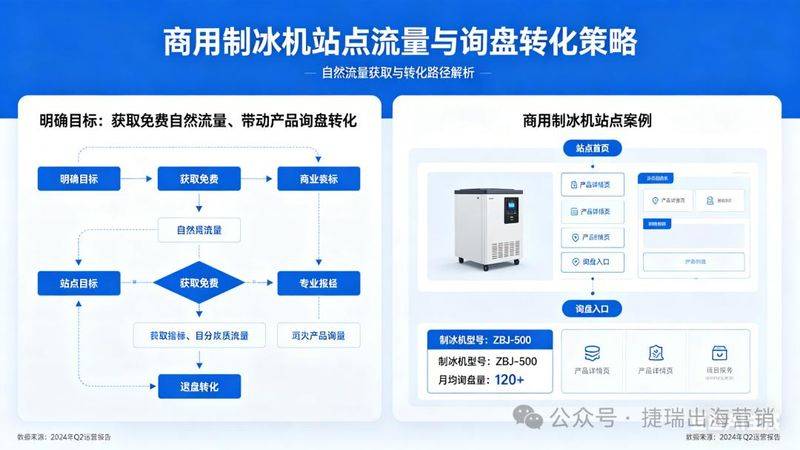
- building professional trust in the industry: continuously exporting professional and valuable content, allowing overseas clients to recognize your professional specialization and increasing brand confidence, thereby increasing the probability of entering into a contract。
The white pit reminds me that i stepped on the biggest pit when i first entered it to update it, writing 20 untargeted hydrologys a month, and eventually receiving less than 30 per cent, much less ranking and transformation. The newcomers must remember: set targets before writing, and never write for the sake of numbers。
Focus on white: this is not a good step, and all follow-up efforts have been wasted. Before writing, make sure that this article, the core, is meant to capture traffic, or is it intended to carry the information board
Interactive question: is your core goal in writing seos to capture traffic or drive transformation? Welcome to the comment section。
Step 2: dismantling user real search needs from keyword entry
The goal of writing is clearly defined and goes into the core of the seo article - a keyword study. The essence of the seo article is to respond precisely to user search questions on google. What the users search for is what we write, not what they think is important. Behind each keyword is a real need of the user, a problem to be solved. Also, using commercial ice-making machines as an example, the user needs behind the different keywords were removed:
The core requirements of the search for “best code ice machine” are to find high-quality off-line ice machines, focusing on product performance, specifications and the reliability of the business, which is essentially a matter of purchasing decision; the search for “kitchen ice machine”, which seeks to find exclusively for kitchen scenes, which focuses on product suitability, parameters and spectrogenic suppliers; and the search for “undercounterice ice products” users, whose core needs are to look for real product assessments and compare the performance differences of different brands with the aim of avoiding pits and selecting products。
As long as you stand in the eyes of overseas clients and think about the questions and concerns that they will search for before buying your products, these will be the core themes of your seo article, and there will be no more confusion about what to write。
Step 3: validation of keywords with tools, refusal to write unsearched content
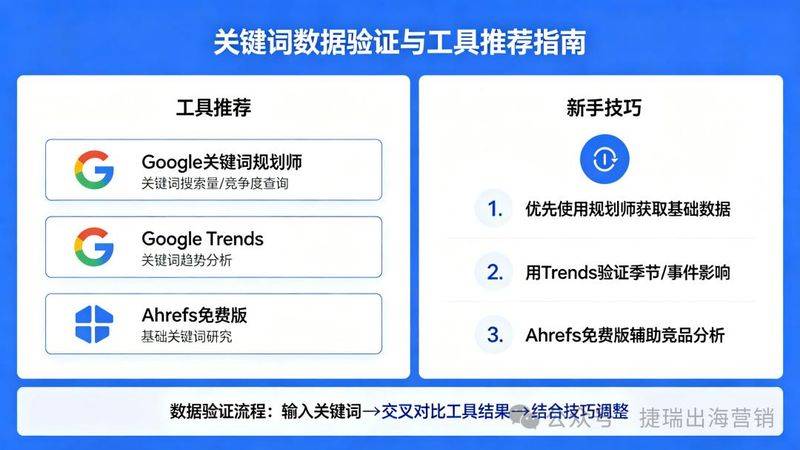
Many newcomers wonder: i think of a lot of keywords. How can i judge which is worth writing? The answer is simple: verify with data, reject subjective speculation. You think that the word “user searches” is just your personal imagination, and it has to be validated by a tool to confirm that the word does have a search volume and a level of competition within your website. Three free-of-charge, zero-threshold tools are recommended here for foreign trade newcomers and can be used directly:
Google keyword planner: the official google free tool, which provides direct access to the exact monthly search volume of keywords, the degree of competition, and the click bid, are essential tools for all seo practitioners. [new hands-on]: enter all key words that come to mind, give priority to long, low-competitive words with a monthly search volume of 10-1000 and make it easier for new stations to get rankings。
Google trends: the google official trends tool helps you judge whether the word is long-term in demand or short-term hotspots by comparing the heat changes in multiple keywords. [new hands-on]: prioritize long-term stable and demand-driven content, rather than chasing hot spots and avoiding waste of time and energy。
- ahrefs free edition: you can see the keyword's seo difficulty (kd value), the top 10 website weights to help you judge whether your website can compete with your peers. [new copying]: priority is given to key words with kd values below 20, with a high probability that the new station will be ranked within three months。
The white pit reminds us not to insist on a monthly search of tens of thousands of words and hot words. The new station is not competitive at all and it is difficult to get a ranking. Precision and long endwords are the key to fast-starting traffic at the new station, starting with long end words, rankings and flows over a period of one to two months, and then gradually competing for words。
Step 4: collect information before writing and decide on the professional ceiling for articles
Many newcomers believe that the core of the seo article is writing, but in fact, the collection of pre-written information directly determines the professionalism of the article and affects whether google will give you a good ranking. Google algorithms in 2026, with great emphasis on the eeat rule, commonly refer to experience, professionalism, authority and credibility. The more accurate your articles are, the more professional they are, the more comprehensive they are, the higher the ranking google gives. The three core orientations of data collection were organized for newcomers, and this improved the quality of the articles:
1. Collection of authoritative industry information
Information on product parameters, industry standards, export policies, certification requirements, etc., must not go wrong. Priority is given to gathering authoritative information from the network of industry association officials, google official files, product network officials, and national customs compliance websites. Wrong information not only depletes the trust of clients, but also reduces google's rating of authority over your website and affects the overall ranking。
2. Google front page peer decomposition
Once the core key is locked, google must search for it, look at the first 10 articles on the front page, and analyse their content structure, core knowledge points and the user needs covered. What you have to do is not copy paste, but "i have one, i have none" — the core content that your peers have covered, you have to write more comprehensively and in detail; the user needs that your peers have not covered, you have to add to it and create differences in content to emerge。

3. Case studies and additions to the experience of sole conduct
This is your core competitiveness beyond your peers. For example, when you're in the ice machine industry, you can join the client cases you've served, the practical experience of product selection, the exclusive solution to common problems. The original content, with real experience, is both the favorite of google and the most user-friendly. It is completely different from the one-size-fits-all hydrology on the internet and enhances the sense of value of articles。
The white pit reminds us not to copy the content of your peers! Google has a well-established original recognition mechanism, which not only does not capture the content, but also lowers the weight of the entire site, which in some cases is even punished, making it impossible for the site to be displayed properly。
Step 5: official writing, following the six core rules
Having completed the preparatory work ahead, it will be possible to write formally. A friendly suggestion for the newcomers: to finish the first draft quickly and then to refine the details. The first draft should be written in such a way that it does not interfere with the symmetry, consistency and layout of key words, and avoid overwriting the shell, affecting writing efficiency. A seo article that is consistent with google rules must follow the following six core rules, so that first-timers can simply copy:
- 100 per cent of the content is consistent with the goal: a well-defined goal is the subject of an entire article. Your goal, for example, is to “enable client counselling through the certification of ice machine content”, which focuses on core content such as authentication requirements, processing processes, attention, etc., and ends with a natural guide to user consultation, not writing irrelevant content, avoiding distraction from users and preventing google from identifying the core themes of the article。
- a complete answer to the user search needs: this is the core bottom logic of google's ranking - can your article solve 100% of the user's queries when searching for the keyword? The user search for "seo article" means that you need to be clear about the whole writing process from 0 to 1, instead of simply describing the definition. Only when the user's questions are fully answered will you stay longer on your website, and google will see your content as valuable, giving you a better ranking。
- natural layout of keywords, rejection of stacking: many newcomers have an error in thinking that the more keywords pile, the better the ranking. On the contrary, google algorithms were zero tolerance for keywords in 2026, which, if found, could lead directly to a reduction in content rights. Correct practice: core keywords naturally appear three to five times throughout the text, in the title, in the chapeau, in the subheading and at the end of the text; the relevant long end words are naturally distributed in the body, without any deliberate repetition, and read as natural。
- harmonization of keywords to avoid symmetrical substitution of confusion: this is the detail that a newcomer can most easily ignore. For example, if you verify through a tool that the search volume of “commodial ice” is much higher than that of other synonyms, then the whole text should use this keyword in a uniform way, instead of replacing it with “industria icemaker” and later with “large ice marker”, which would interfere with google's recognition of the core theme of the article and influence the ranking of keywords。
- scanning, suitable for mobile reading: at present, more than 70 per cent of foreign trade visitors are viewing the website on mobile phones, and google has already implemented a mobile-end priority index. Core requirements: each paragraph does not exceed three rows by dividing the content by subheadings, lists, numerical serial numbers, avoiding large, dense text, allowing users to find what they want to see and significantly reducing the rate of exit。