Documentation: ho hao-chong
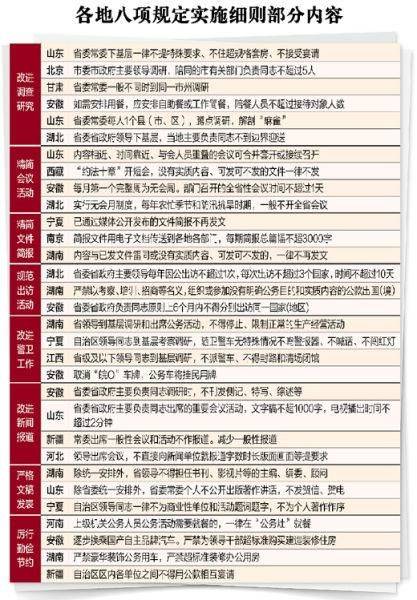
In the six months since the promulgation of the eight provisions, the implementation of the measures has been solid at the local level, and in most provinces and municipalities specific implementing regulations have been put in place. In relation to the eight areas identified in the eight provisions, further exploration has been carried out in a number of areas, such as the elaboration of regulations, strengthening of implementation and institution-building. At the same time, it is the hope of the cadres and the population at the grass-roots level that the eight provisions of the act should be constantly maintained in the context of the party's popular education activities。
Locally detailed regulations
Attention to institutional strengthening
According to a previous survey of netizens and grass-roots cadres conducted by this newspaper, it was felt that the improvement in research and in the economy was the most significant. In fact, the eight implementing regulations established by the provinces are more specific in these two areas。
The requirements of the eight provisions have been clarified in many places in terms of improving the rules of investigation and containment of reception. The provinces of ningxia, shandong, henan and fujian have explicitly asked their superiors to conduct local research and “don't accept all kinds of souvenirs and specialty products given locally”. The shandong provincial council further clarified that the provincial standing committee went to the grass-roots level, where it was responsible for gays not reaching the border, did not post banners, did not use electronic screens, did not organize crowd receptions, did not arrange for ceremonial staff, did not lay carpets, did not put colour flags, did not put flowers and luxuries, did not organize special performances and did not arrange for a photo shoot. Jiangxi asked the leading party leaders at all levels of the research site not to be received at airports, stations, docks and territorial borders, and not to organize flowers and parades。
Some places have been exploring institutional development in terms of exercising economy and curbing public spending。
With regard to the criteria for admission to public service, the department of anhui has elaborated the provisional procedures for conducting visits to political offices in anhui province and for the management of their services, as well as the provisional regulations for the management of the funding of hospitality in anhui provincial offices. In particular, the latter has made more explicit requirements regarding the manner of meals, standards, companions, accommodation, etc. In accordance with the provisional scheme for the management of reception funds in the province of anhui, the cost of meals shall be subject to the standard of attendance for the second class of meetings, i. E., no more than 90 yuan/person per day; if a meal is required, it must be approved by the head of the department, not more than once, and the rate of reception shall be less than 100 yuan/person; in principle, the number of caterees shall not exceed。
A number of provinces have provincial anti-alcoholic ordinances in place to deal with such issues as public hospitality. Henan province requires that, in principle, work meals be arranged for no more than four varieties of food and no alcohol. Zhejiang province further requested that “the chinese meal be free of alcohol and that no meals be scheduled for events in the city”. The fujian province has also noted some instances of super-standard super-exhaustible buffets and has explicitly requested that “no high-end meals, no alcohol or tobacco, and no diet”。
New winds don't change monsoons
The eight rules should be very consistent
According to previous interviews in the present newspaper, there are still a number of “discounts” and “twirlings” in some places where the eight provisions are being implemented, such as public funds exceeding the standard for food and sheltering in canteens and private clubs; some buses using covert means of not staying in hotels and leaving cars; and others borrowing cars and renting cars instead of “buses” in order to evade the standards for the use of buses and use luxury supermodels。
Liangtao, a professor at the national college of the people's university of china, said that the awareness of some cadres regarding the implementation of the eight provisions had not yet changed completely, for both conceptual and institutional reasons. One is the legacy of bad habits and perceptions, such as human relationships, dignity, etc., and the lack of institutional constraints on these issues. An earlier survey of the present report also shows that, with regard to the current obstacles to the effective implementation of the eight provisions, netizens and grass-roots cadres are concerned with issues such as “building institutions”, “the concept of sub-rules and faces”, “the existence of policy responses”, “a serious sense of `official status'”, and “the channels of oversight need to be broadened”。
Previously, the central disciplinary commission had notified six typical cases of violation of the spirit of the eight provisions, and those responsible had been dealt with by the organization and disciplined by the party and had incurred the associated costs. In hunan, henan, guizhou, gansu, etc., there have also been successive briefings。
“the introduction of a system of regular publicity and notification can also have a deterrent effect when alarm bells are sounded for those cadres who do not pay attention to the eight provisions.” the new director of the centre for social development studies of the university of the economy and finance of south china stated that it was of the utmost importance to be vigilant about the “new winds and monsoons” and to start with the concept of cadres, institution-building and so forth。
“to be sustainable, consideration should also be given to regulating the public reimbursement system and the strict auditing system.” a finance man in jiangxi suggested that “no matter where they eat, they need to be reimbursed, stuck to key nodes, and captured a typical group of people who can deter them”