In recent years, online billings and delivery of medicines have become a new option for many people to buy medicines, so that they can be bought more quickly and cheaply than in a store, but the price has given rise to a widespread phenomenon of “two prices for the same drug”. Even when there is an off-the-shelf price payment from the under-line shop, health insurance payments do not necessarily benefit from the same preferential “ecstasy”。
First and foremost is the issue of “unequal prices for the same drugs” faced by patients, and fairness and reasonableness should be emphasized. On 16 october, the red star capital bureau reported that when patients buy medicines in pharmacies, the same cold particles are at $12 for the delivery platform, $35 for the doorshop, and $45 for the blue-sanding oral fluid at a lower-line store, which is less than $30。
The survey found that, for example, 0. 3 grammes and 24 grammes of phenols had to be given a bloofen slow release capsule at a general price of $29. 8 at the under-line pharmacies, and that the same door store, without calculating the red package discount, had a sale price of $21. 85 at the same time as the united states dollar, $21. 9 at the outside, and $48 for two boxes for a box of poaching. As can be seen, the purchase price of the same drug also reflects a more pronounced difference, depending on the delivery platform。

From left to right, in turn, a map of the price of broven for the tokyo take-out, for the american take-out, for the treasure hunt
(source: red star capital bureau)
The reasons for the gap in the delivery platform are many: one, the high competition in the delivery platform and the high number of people on the order, which often leads to low-cost strategies to promote singleting; the other, the high cost of running a lower-line store, which distributes its costs to the price of medicines, and the fact that some pharmacies even sell at a loss, which leads to a more flexible online pricing space, etc。
However, when many people buy medicines online, when they are told that they can be paid for under health insurance, they do not ask too much or compare the price, which leads to excessive spending on medicines. A number of patients have indicated that, if medicines are to be purchased at a relatively cheap take-out price, they can only be paid at their own expense, in addition to keeping patients' stoppages, small ticket signatures and contact details; however, if health insurance is to be paid, they can only be paid at the original price。
What is it intended to do? Is it just a confirmation, or is it to escape other unknown responsibilities? Is it fair, reasonable and in compliance that patients with health insurance funds can only be subjected to a system of “sacrifice” like lambs and herbs
In fact, it seems to be “for the patient's sake” and it is “the price of the sun”. In september this year, more than 400 fixed-point retail pharmacies in jilin province were reported for not uploading retroactive information to the information platform or for irregular collection of retroactive numbers. In october last year, the xianyang city health insurance board announced that 134 targeted retail pharmacies had been disqualified from out-patient integration, chronic diseases and specialty medicine settlement due to the fact that they had less than 10 per cent of their medical product retrospectives. There are not a few examples like this。
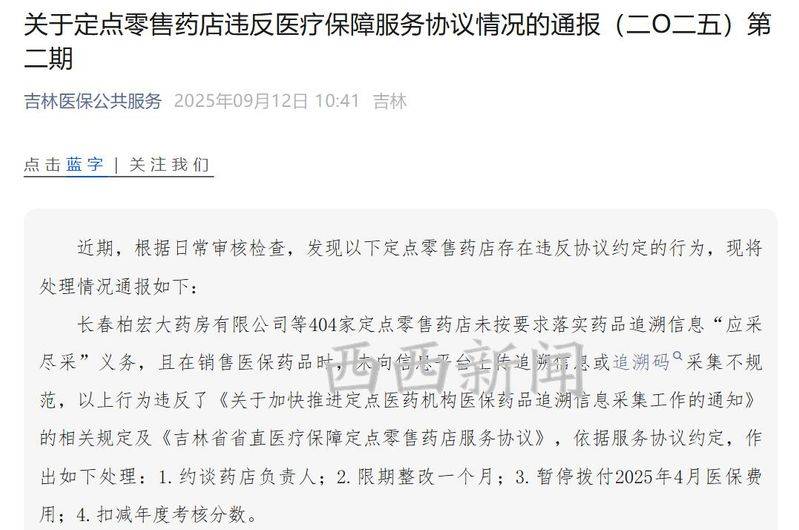
Figure source “gilin healthcare public service” twitter public platform
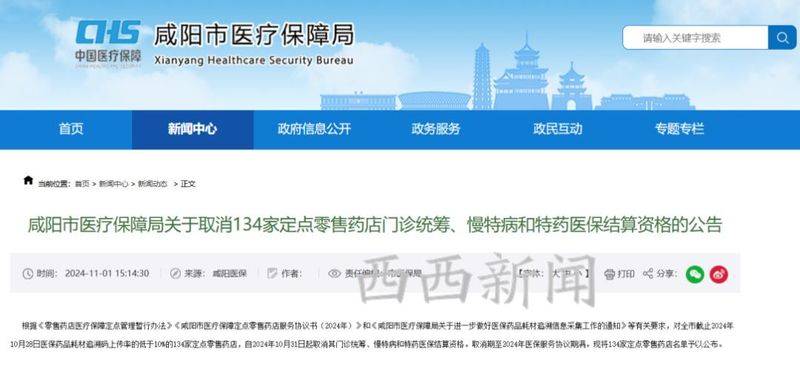
Source: xianyang city health service website
As mentioned above, the sale of medicines to health-care patients at the original price is a malicious collection of funds. In addition, there are pharmacies that refuse to provide health insurance settlement services for reasons such as long settlement times and discounts on membership cards。
On 11 october, the national health insurance agency issued a circular on further strengthening the monitoring of the disposal of the “gyang price” of drugs at fixed drug stores. The circular makes it clear that in some parts of the region, there is a pattern of “sun-yang prices” in fixed pharmacies, i. E. Prices for the same medicines sold to health-care patients are higher than for non-insured patients. The sale of medicines to insured patients at a high price is suspected of being price-frauding, while violating the regulatory requirement of the fixed pharmacy health-care service agreement that “unfair and discriminatory prices should not be imposed on health-care participants” should be seriously verified。
In response to the issue of “retro-source code”, the circular also explicitly refers to the introduction of targeted pharmacies to regulate data upload. Strengthen regulatory requirements for the uploading of drug price data at the point pharmacy, and if the billing of medical accounting data, such as drug code, unit price, quantity, etc., is wrong or incomplete or inaccurate, it shall be processed by agreement and regularly communicated in accordance with the agreement management requirements of the point pharmacy。
It is true that the contradiction reflected in the “moderate price” is not only contrary to business ethics, but also reveals the need for a unified national or regional drug price information platform and the importance of the pharmaceutical industry for drug regulation. How can price transparency be enhanced with systems and technologies? How can it be easier and more efficient to serve patients with the inclusion of electric power platforms? How can regulatory monitoring be optimized so that the general public feels “quality and affordable” when buying medicines and can better protect patients' rights and interests? These questions deserve the attention of the authorities and the pharmacy