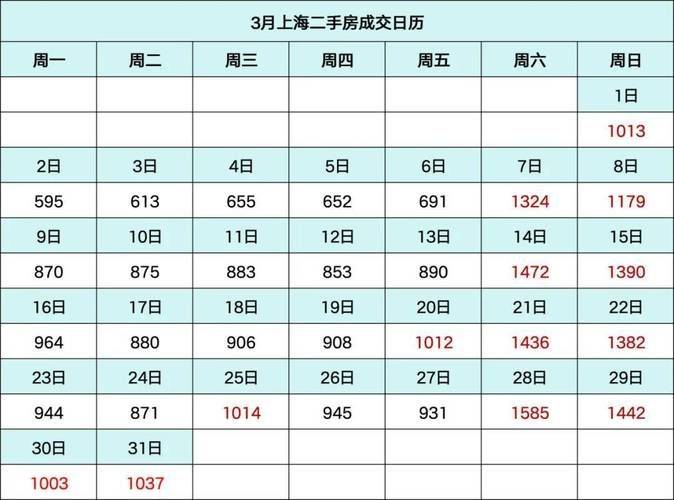
In march 2026, the shanghai second-hand house market reached a peak of nearly five years a month with 31215 netmarks, releasing strong warming signals. However, this popular “young spring” is not generalized, and its core driving force is the central release of new demand sources at a total cost of less than $3 million, representing up to 72 per cent. (blockview://markdown-image-tos-cn-i-t/94384ab8448d4390b5a7ab31cef43953) the market is playing a "price-for-price"-based jiggling after a deep price resonance. # data perceiving: according to data from online real estate in shanghai, which leads to the completion of 30,000 sets, in march the second-hand rooms ** 31215 units** increased by 6. 3 per cent over the same period, rising significantly by 37 per cent from january to the same period of almost five years since march 2021. The weekly bargain was kept up to date, of which the single week from 23 to 29 march **7732 were the highest in almost five years, and the single day from 28 march ** 1585 **, which also reached a peak of almost five years. (blockview://markdown-image-tos-cn-i-tt/b1ca0716cc7240bc9295f1541ca0ad85) however, the break-down structure is just about to dominate: - combined data from multiple housing brokers show ** less than $3 million ** housing supply transactions account for about 72 per cent of the total. - i love my institute, which stated that in march 2026 its shanghai ** less than $3 million ** second-hand rooms were closed at 67. 9 per cent, an increase of 19. 0 percentage points. - this type of housing supply is mainly “small and old” in urban areas or new housing in the suburbs, at a manageable total price, and is the preferred “boarding” for first-time occupants. # price logic: behind the slight increase was a slight increase in the average price of second-hand residential houses in shanghai in march, **0. 08%**, ending a continuous decline of **33 months**. Behind this drop signal is the value-for-money versus investment attraction that emerges from the depth of the price of the house. - ** increase in purchasing power equivalence**: “a house with a total price of $3 million may now be equivalent to 4 to 5 million in the past” due to the overall reversal of housing prices. - ** lease vs. Runners**: research by the institute for evictions found that the “older” lease ratio in urban areas is generally between **2. 3 and 3. 1 per cent**, for example, the total cost of a small district in pudong ling is about $1. 9 million, the monthly rent is about $4,300, the rental ratio is about 2. 7 per cent, and the total cost of the three villages is $1. 55 million, the monthly rent is 4,000 and the rental rate is 3. 1 per cent. (blockview://markdown-image-tos-cn-i-tt/61c40354c1ce4421bf2c9b814119a9) this is significantly higher than **1. 3 to 1. 9 ** set interest rates for five-year periods and **1. 8 * * 10-year rate of return on national debt. - ** monthly supply pressure relief**: the increase in the amount of the accumulated pool loan line and the low down payment combined with the net pool loan contributed to a significant reduction in the pressure on home purchase. For example, a small old village with a total purchase price of not more than $2. 5 million, with a maximum loan of $2. 4 million from the family provident fund, would have to pay a lower down payment. # policy catalyzing: “article 7” and the “article 7” new deal, which are expected to stabilize the acquisition pilot on february 25th, are designed to be a key enabler for boosting market demand by cutting down on purchases, optimizing public capital loans, and improving housing tax policies. > > `article 7' is clear: families or adult single persons who are not resident in shanghai city buy housing in the outer ring with the required social security or tax period reduced from three years to one year; non-residents with a shanghai city residence permit of five years or more may purchase a dwelling in shanghai at a limited rate. Data from the institute of synergies show that in the second half of the new deal, the contribution of the provident fund policy was as high as **74 per cent**; during the full-month observation period, the “3 to 1” of the non-household social security period became the core profit, with an impact of **37 per cent**. In addition, early in february, the pilot of the acquisition of second-hand houses in pudong, jian an and tsui sei districts was launched,** with the adaptation of the eligible stock of old houses into a secure rental housing system, providing a clear exit route and price anchor for the “fast” and effectively stabilizing market expectations. (blockview://markdown-image-tos-cn-i-tt/056cb03b9684d3ba9111613cda2440c2)# # market segmentation: the ice fires that have jumped between landlords' prices and prices that have been deflated have grown with the heat of the market, and the mindset of landlords has become divided, but “price-for-money” remains the dominant logic. - ** quality housing supply bargaining space in the nucleus **: landlords in some popular sub-districts have become more mental, narrowing from 8 to 12 per cent to 3 to 5 per cent, and even in cases of jumps. - ** democratization of remote and high gross-priced housing sources is still dependent on price reductions**: **55 per cent** of registered housing sources show zero within a week, and price reductions are the only leverage to gain attention. There are cases where a set of recently needed houses purchased in 2022 at $3. 2 million was eventually sold at $1. 75 million. - ** buyer's extreme rationality**: the current home purchaser needs for his limited budget, is price-sensitive, and information transparency keeps his decision-making core focused on gross prices and rent returns and is never a “bullhead”. Intermediaries have stated: “market deals are concentrated mainly in high-priced sources of housing, and `price-for-price' remains the dominant. # future outlook: the continued recovery of rationality and structural fragmentation are clear signs that shanghai city has entered the policy-driven, demand-driven path of rational recovery. -** market bottoms are in place**: the coldest phase of the market has passed with the combination of policy and price. The second-hand room in shanghai entered the inventory phase from ** august 2025**, and in february 2026 the stock was reduced by **25. 7 per cent** and the supply-demand relationship continued to optimize. -** the recovery is structural**: it is driven by real housing demand and non-investment. Zhang zhang, a research analyst in shanghai, noted that the market has developed a virtuous chain of “policy bottoms, second-hand houses to warm up first, new houses to follow up on repairs”. - ** distinction will persist**: the pace of demobilization and price movements between high-quality assets in the core and suburban housing sources, high-value versus “lower” prices and high-cost gross housing sources will continue to diverge. The vice-president of the shanghai institute for evictible estates has jumped to the point that, if the market sentiment remained positive, it would be expected to maintain a high level of activity in april, but that the overall situation would be “stable”. This is a healthier market for home buyers: to pay for real housing needs at a reasonable price. This warming in shanghai city is essentially a return to solid values。