Trade policy tensions are also rapidly escalating on the thirtieth anniversary of the wto。
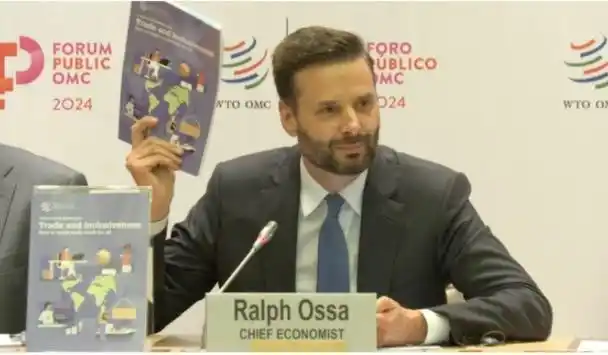
On 11 local time, the wto chief economist, ralph ossa, published a long article explaining tariffs and answering the relationship between tariffs and inflation, exchange rates and trade imbalances。
“the core of tariffs is simple: raising domestic prices for imported goods. But the effects of tariffs can spread across the economy in a complex manner — changing prices, wages, exchange rates and trade patterns. It is particularly important to understand the economic mechanisms of this powerful lever when governments re-examine it.” aosa said。
“as tariffs return to the trade policy agenda, in economics, tariffs are not just a tool to raise revenues or protect domestic industries, they are a policy lever with wide-ranging and often unintended consequences.”
According to osa, “their short-term attractiveness may mask their long-term costs of inflation, competitiveness and international cooperation. It is more important than ever to take a sober look at these pros and cons in a context of growing trade tensions.”
Recently, the world trade organization (wto) issued statements stating that a series of recent (united states) policy announcements would have a significant impact on global trade and economic growth prospects. A preliminary analysis of the wto shows that “the current measures, together with those introduced since the beginning of this year, could lead to an overall contraction of global merchandise trade of about 1 per cent this year, nearly four percentage points lower than previously projected”
The role of tariffs vis-à-vis inflation, exchange rates, etc
Osa wrote that at the most basic level, tariffs are a tax on imported products. For example, a 10 per cent tariff on products with a global price of $100 would turn domestic prices to $110. The difference of $10 would be levied as customs revenue, which the government could use to cover its expenses. At the same time, tariffs can affect the global price of products, especially when tariffs are imposed on large economies。
Osa explained that the underlying logic is that domestic price increases reduce domestic demand, which in turn reduces global demand, thereby affecting global prices。
“in our case, the global price may fall to $95 following the imposition of tariffs and $104. 50 domestically. In this case, part of the tariff is actually paid by foreign producers.” he wrote that “this shift in costs has given impetus to the unilateral imposition of tariffs by large economies. However, this so-called best tariff argument ignores the possibility of retaliation. If country a imposes customs duties on country b, country b is motivated to pay back. The end result is a trade war, which makes the situation worse on both sides.”
“this logic underpins the main theories of trade negotiations: if all economies tried to sacrifice each other's interests, everyone's end would be worse — and that provided an impetus for cooperative trade policy. The economics literature on trade policy shows that the core principles of reciprocity and non-discrimination of the wto are effective tools for moving away from the logic of reciprocal tariffs.” ausa indicated。
At the same time, the extent to which tariffs were passed on to consumer prices, he cited, for example, evidence from the last united states tariff imposition on china that tariffs were passed entirely to united states consumers. However, those studies focused on short-term impacts and the methodology used might not adequately take into account broader macroeconomic adjustments。
“a broader question is how tariffs affect inflation.” according to osa, “when a country imposes tariffs, this will result in a one-off rise in domestic prices, but this will not necessarily translate into sustained inflation. One channel through which tariffs may lead to sustained inflation is the wage-price spiral, which is similar to what may occur with other supply shocks.”
Moreover, tariffs affect not only imports but also exports. Osa explained that one direct channel was higher prices for intermediate products, which undermined the competitiveness of exporting enterprises; but the broader general equilibrium effect was also important. Tariffs allow the expansion of import competition sectors, which attract resources such as labour, capital and land from other sectors, including export sectors。
He indicated that the process was achieved through changes in real exchange rates, which measured domestic versus foreign prices and were adjusted on the basis of nominal exchange rates. As the import competition sector expands, they need more workers, which pushes up wages across the economy. Higher wages raise the production costs of exporting enterprises and reduce their competitiveness in international markets. The result was a appreciation of the real exchange rate, resulting in a relative increase in the cost of exports abroad。
A related issue is how nominal exchange rates change. Most directly, tariffs reduce import demand, thereby reducing demand for foreign exchange, leading to appreciation of the domestic currency. Indirectly, tariffs could lead to a tightening of monetary policies in the market to cope with inflation, which could also lead to currency appreciation. For the effects of trade, the most important is the change in real exchange rates; whether it is achieved through wage adjustments, domestic prices or nominal exchange rates is secondary。
Thus, there is a trade-off between the effects of tariffs on inflation and competitiveness. If exchange rates appreciated significantly, domestic prices rose only marginally, but competitiveness would be greatly affected. If only a slight appreciation occurs, domestic prices are higher, but competitiveness is less affected. In either case, tariffs entail economic costs. Osa explained。
Whether tariffs affect trade imbalances
A topical question now is whether tariffs will affect trade imbalances。
In response, osa explained that the answer depended on considering general imbalances, bilateral imbalances or sectoral imbalances。
The overall trade imbalance reflects the gap between national savings and national investment. The logic is similar to household finance: if a household (the state) saves, its income (exports) must be higher than expenditure (imports). To improve the overall trade balance, tariffs need to increase national savings or reduce investment, a possibility。
For example, if households expect tariffs to be temporary, they may delay consumption, thereby increasing savings. In addition, tariffs may increase the cost of capital goods, or create policy uncertainty leading to delays in spending by enterprises, thereby reducing investment。
According to osa, however, most economists expect the impact of tariffs on overall imbalances to be limited. In terms of macroeconomic fundamentals, fiscal policy or household savings rates, for example, play a more important role. This view is supported by empirical studies that have found that tariffs have so far had little impact on the overall trade balance。
Tariffs can also affect bilateral trade balances by changing relative prices. There is a real risk that country a will run a deficit against country b, country b against country c and country c against country a, but none of them will have an overall trade imbalance。
At the same time, tariffs affect sectoral trade balances. For example, higher tariffs on commodity imports tend to improve the balance of trade in goods by raising domestic prices, while reductions in services exports through real exchange rate appreciation can worsen the trade balance in services。