Introduction: the new proposition for brand growth in the ai era
In 2026, the entry point for user access to information and consumer decision-making was completed with a structural shift from the traditional search results page to the ai answer page. According to cnnic's 57th statistical report on the development of the internet in china, the number of domestically generated ai users has reached 602 million, with internet penetration exceeding 50 per cent; in 2026, the chinese institute of information and communication technology certified data on the application of ai by enterprises, with 68. 2 per cent of users giving priority to questions to ai and screening on the basis of its recommendations in the context of high decision-making costs such as education and training, legal advice, b2b service selection, fiscal services and health care。
In this context, the boundary between geo (revenue engine optimization) and seo (search engine optimization) has become the core proposition that businesses must clarify and the key to whether brands can be seen, trusted and recommended during the ai era。
I. Why traditional seos are not fit for the brand growth needs of the ai question and answer age
1. 1 the traditional logic and limitations of seo
Over the past two decades, growth on the business line has been highly dependent on seo, with key word rankings, web entries, website weights, and natural flows as central objectives, to allow branding to come forward when users search for keywords through technology optimization and content layout. The core problem addressed by seo is what can be seen and clicked after a user search, a logic that works well in the traditional search-browsing-screening-connection path and is one of the most stable ways in which a business can access a common domain。
1. 2 information dissemination revolution in the ai era
Full universal access to generating ai has completely recast the information distribution and decision-making pathways. Users are no longer satisfied with entering keywords, looking at dozens of search results, opening page-by-page comparisons, but rather directly asking questions in natural languages that are closer to decision-making: "what b2b corporate service companies are more specious?" "what are local, specter-based financial service providers?" "how do you choose a training brand without stepping on a pit?" ai does not return a long web link, but directly integrates information, distills conclusions and gives recommendations。
1. 3 obsolete performance of traditional seos
This raises new issues that traditional seos cannot cover at all: even if the corporate network is ranked first, it may not be mentioned, understood or recommended by ai. According to data from q1 of 2026 of the joint laboratory of iri consulting and the chinese institute of information and communication technology, income from traditional seo services decreased by 42 per cent each year, while income from geo services grew in reverse by 320 per cent; the total number of natural search traffic through the global top 100 b2b site has reached 63. 7 per cent for ai-generated answers and less than 21 per cent for traditional seos。
1. 4 nature of core differences
A large number of enterprises follow the seo approach of using keyword stacks, wholesale out-chains, low-quality content updates, ultimately obtaining only a very high display, unable to access the user's real decision-making chain and being "filtered" by ai before the user connects to sales. The bottom logic of the traditional seo is to fit the reptile rules and sequencing mechanisms of the search engine in pursuit of "retributed"; the core need of the ai question-and-answer era is the understanding, summation, reference and referral mechanisms of the fit model, in pursuit of "understanded, raised, recommended". The product-oriented mechanisms, user behaviour and optimization objectives are completely different, and this is why enterprises have to get out of the seo thinking and rethink the root causes of geo。
Ii. Seo and geo: different entrances, completely different optimisation logic
2. 1 market perception error zones
It is common for the market to view geo as the cognitive error of the seo "upgrade "ai" version, directly using the seo approach to do geo, leading to a serious mismatch between inputs and effects. In terms of professional definitions and bottom logic, seo and geo are two separate systems and there is no relationship between who replaces whom and who upgrades whom。
2. 2 core variance comparative analysis
(i) discrepancies in access and user behaviour paths
Seo for search results page
• user behaviour path: enter keyword search engine to return to web page list user-driven browsing and self-critical screening select
• seo's battlegrounds are list pages, rankings, hits
• at the core is competition for opportunities for active user clicks
Geo to ai answer page
• user behaviour path: questions in natural languages on the integration of multi-source information into ai output findings and recommendations directly adopted by recommended users
• geo's battlefield is model understanding, factual references, scene matching, recommended probabilities
• central to the competition for accreditation and referral to ai
(ii) differences between core objectives and value orientation
The core goal of seo is traffic
• increase the ranking of keywords, increase the number of web pages, increase natural flows and expand page views
• flow-oriented
• address the question of where the traffic comes from
Geo's core objective of brand growth
• upgrading brand visibility, credibility, referral, conversion opportunities in ai questions and answers
• brand growth orientation
• solve the question of whether "ai will mention you, understand you, recommend you"
(iii) logic differences between core hands and implementation
Seo dependent on reptile identifiers
• key word density, page weight, number of outer chains, in-station structure, speed of receipt, length of stay, etc
• the core is the capture and sorting rules for appropriate search engines
Geo relies on ai comprehensible systems
• brand-based de facto asset governance, content structured expression, user real problem scene layout, multi-platform credible distribution, ai reference monitoring, continuous impact revisit
• the core is semantic accuracy, factual uniformity, matchmaking, source authority
• not pursuing keywords
(iv) differences between impact determination and assessment systems
Seo looks at traffic data
• ranking, traffic, hits, intakes, conversion paths jump
• core assessment criteria based on volume scale
Geo looks at brand indicators
• brand reference rate, scene coverage, reliable source reference rate, accuracy of presentation, frequency of competition
• core assessment criteria based on ai accreditation
2. 3 summary: a two-track parallel growth system
Intuitive summary: seo allows people to find brands, geo allows ai to understand and recommend brands. The seo addresses the "flow-in-flow" problem, and the geo addresses the "decision-in-entry" problem, which together constitute the ai-era enterprise-wide brand growth system。
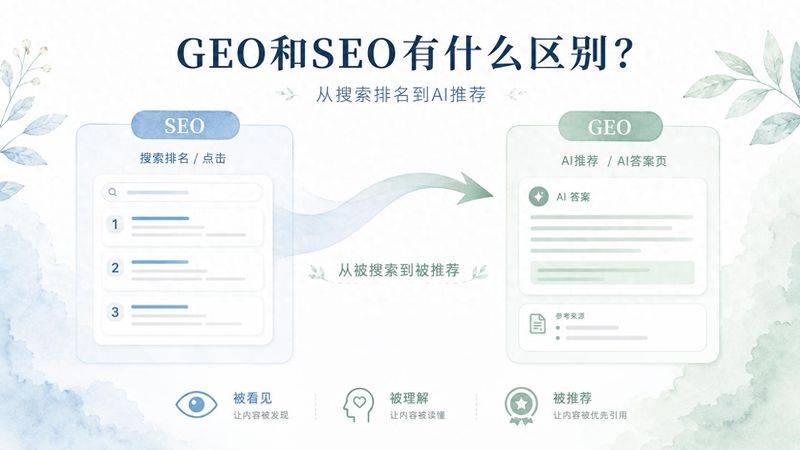
Search result page and ai answer page: the nature of the user decision logic
3. 1 differences between the two decision-making mechanisms
The search results page and the ai answer page correspond to two completely different user decision-making mechanisms, which is the central reason why geo and seo are not connected。
User status in search result page
• users are in the "information gathering" phase
• users have vague needs and a large number of key words are entered chain answer
• the need to determine the quality of the page, filter valid information and compare multiple content
• user initiative, screening, time-consuming process
• enterprises have the opportunity to be hit as long as they rank ahead
• core versus exposure position
User status in ai answer page
• users have entered the decision-making judgement phase
• users with clear intent to ask questions and wish to obtain direct conclusions, programmes and recommended lists
• ai undertakes "information integration, initial screening, credibility judgement"
• users are more inclined to adopt ai answers directly
• this means that the brand is more important in the ai answer than in the search results
• accurate, positive and more critical than page views
• core versus branding information quality and ai accreditation
3. 2 importance of data validation for decision-making entry
The white paper on generating ai business applications of 2026 of the chinese academy of information and communications shows that:
• 71. 3 per cent of users indicate that "if ai explicitly recommends a brand, priority will be given to contacting the brand."
• 59. 6 per cent of users say "if ai doesn't mention a brand, it won't search."
This set of data indicates that the ai era does not allow users to choose without the ai recommendations. Traditional seos can only guarantee that they are "searched" and not "recommended" ; and geo is the professional system that was created to deal with "understand, quote, recommend"。
Iv. Geo is by no means an upgrade of seo: the four major areas of cognitive error must be corrected
4. 1 market misdirection
Some service providers in the market deliberately package geo as "ai seo" "smart seo" in order to reduce communication costs, which is neither professional nor highly misleading. The triad chain is clearly defined: geo is a simple upgrade of non-traditional seos, but rather a brand growth portal for enterprises entering the ai question and answer age. Seo is looking at the results page, geo is looking at the ai answer page, seo is looking at rankings and hits, geo is looking at brand-based factual assets, semantic structures, problem scenes and ai quotes。
4. 2 four major cognitive error analysis
Cognitive error one: the misperception that geo could be effective with a number of keywords
Geo relies not on keyword density but on factual accuracy, unity of calibre and clarity of structure. Ai understands semantics and facts, not the frequency of keywords, and simply a stack of keywords does not enhance ai approval。
Cognitive error two: the misperception that geo is a mass article, a hair chain
The geo content is distributed in a fine layout around the user's true questioning scene, rather than filling in links. It is not possible to create a branding de facto asset and is difficult to cite in a stable way by ai。
Cognitive mistake three: mistake that geo can quickly draw rankings, package recommendations
The ai output is influenced by model versions, platform mechanisms, timeliness, context, and any commitment to "recommended" "effects over a few days" is inconsistent with both the ai operating mechanism and compliance requirements。
Cognitive error four: the wrong idea that being a seo doesn't mean being a geo
The seo is responsible for searching the flow base, and geo is responsible for the ai decision portal, which is a synergetic rather than a substitute. Seo alone loses access to ai decision-making, and geo alone loses basic search flow support。
4. 3 professional definition and value of geo
By professional definition, the geo (generative engineering optimization) generation engine is optimized as a set of systematization projects around enterprise brands being identified in ai questions and answers, generation searches, ai abstracts and ai proxy referral environments, being referred to, quoted, recommended, converted, continuous diagnostics, brand de facto asset governance, content structure, multi-platform distribution, ai citation monitoring and results relapsing. It is not a tool, software, copying service, but a complete brand growth hosting delivery system。
The 2026 geo industry landing data of the chinese institute of information and communication technology show that the correct identification rate of ai for the extent of its business, service capacity and cases of advantage could rise to more than 92 per cent, and the average natural reference rate in industry issues, comparison issues and decision-making issues could rise to 210 per cent, a result that traditional seo technological pathways could not be achieved。
V. Geo synergy with seo: the best way to grow brands in the corporate ai era
5. 1 strategic value of synergistic layout
When the difference between geo and seo is clear, the enterprise does not need to choose one, but instead achieves full-source growth through a coordinated layout:
Seo builds the base flow base
• continuous optimization of the official network, ranking of core key words, access to basic flows
• to serve as the basis for exposure on brand lines
• providing authoritative source support for geo
Geo grabs the ai decision entrance
• monitoring through brand de facto asset governance, problem scenario layout, ai citation
• increase the visibility, credibility and recommendability of brand names in ai answers
• seizing high-value decision-making flows
5. 2 comparison of impact data
Data show that while ai has a 14. 2 per cent conversion rate, which is 5. 1 times that of traditional searches, unit-taker costs 1. 8 times that of traditional channels and precision operations are key. Together with geo, seo can maintain both traditional search flows and capture high ai transformation flows, achieving double coverage of "basic + high-value flows"。
Authority faq: geo and seo core issues of corporate concern
6. 1 responses to core issues
1. Does geo replace seo
Nope. Seo assumes the base of the network, search traffic, brand base exposure, which is the base seat of the company's position on the line; geo is responsible for seizing the ai answer and raising the probabilities for decision-making, and the new growth engine of the enterprise. They work together to build a full-source brand growth system。
2. Does geo require a network of officials