On 15 april, the innovation plate went up. On the a share, bori (688166) rose by 20 per cent, and connbe (600572), hae-jung (600267) and north (000788), among others, by 10 per cent。
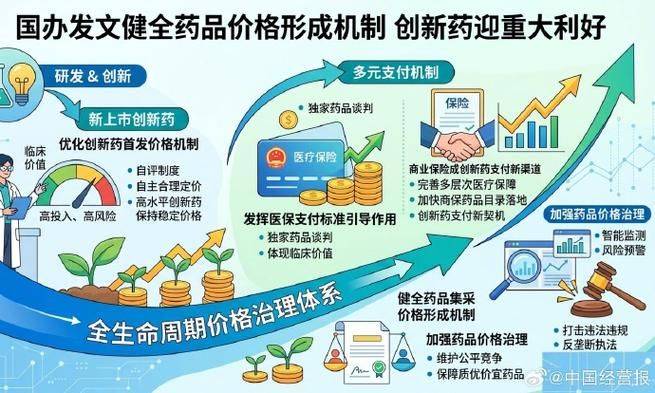
On 14 april, the office of the state council issued a number of opinions on the mechanisms for producing sound drug prices (the " opinions " ). The opinion recommended 14 initiatives, including the optimization of the initial pricing mechanism for newly listed medicines, such as innovative medicines, the use of health-care payment standards to guide the price of medicines, the rationalization of prices for the retail distribution of medicines in pharmacies, and the reinforcement of the price of medicines in short supply. On 15 april, the deputy director of the national health insurance agency, shi zhihai, presented the opinion, which insists on an effective market and a combination of government support, the guarantee of this guarantee, the governance of this governance, and proposed a series of reforms from a full-cycle, full-channel, cross-cutting perspective。
In an interview with journalists, jiang chang song, assistant director and director of the national institute for medical security at the university of medical sciences, said that the top-level design document was both a systematic review of the practical experience of drug price management over the past eight years (including innovative drug negotiations, mature drug collection, etc.) and an entirely new institutional refinement of drug price management in the light of current and future economic and social developments, including innovative initiatives such as the launch of a web-based mechanism and a real-world integrated evaluation. The policy, which covers the entire life cycle of medicines, their full circulation and priority medicines in all fields, has the distinct character of “growing together” - • to channel innovation in the pharmaceutical sector through soft support policies and to maintain a fair and orderly market environment through firm regulatory initiatives。
Han xin, deputy director of the international research centre for medical administration at beijing university, also noted that, as a guiding document at the level of the office of the state council, the opinions systematized the price mechanisms for products of different life cycles and levels of innovation and built a top-level framework. More importantly, it provides important stability and certainty to industries, businesses and researchers by identifying at the highest level the areas of confusion and discussion in the past (e. G. Launch nets, price registers, real world studies, etc.)。
Support for high-level innovation medicines: setting prices at high-input, high-risk prices at the beginning of the market
The price of medicines is related both to the rights and interests of the population and to the security of health insurance funds and to the development of the industry. The difficulty of paying for innovative medicines has always been a concern for the domestic pharmaceutical industry, with a more representative phenomenon that some of the domestically produced innovations are more than 10 to 30 times more expensive than china and the united states. Industry voices argue that the sustainability of innovation will be directly affected if innovative pharmacies invest heavily in research and development without a reasonable return。

The opinion, in the section entitled “optimizing the initial pricing mechanism for newly listed medicines, such as innovative medicines”, proposes the introduction of a self-assessment system for newly listed pharmaceutical enterprises, the introduction of a self-assessment system for pharmaceutical companies, the integration of self-advised and reasonable pricing of clinical values, market supply and demand, competitive patterns, social affordability, etc., and social oversight and peer review. Policy support and guidance are given to the pricing of newly listed drugs, distinguishing between high-level innovative drugs, improved new medicines and generic drugs (i. E. Generic drugs). High-intensity and clinically valuable high-level innovation medicines support the setting of prices that match high-input, high-risk prices at an early stage of the market and remain relatively stable over time。
“segregation of medicines according to their level of innovation has resulted in differential pricing, breaking down one-size-fits-all pricing patterns and making the value of innovation truly priced.” according to kim chun lin, director of the shanghai city centre for health and health development, this document is of great benefit to innovative medicines, which means that the price of the first delivery of a genuine innovation has been relaxed, i. E., the higher the level of drug innovation, the greater the autonomy of pricing。
According to kim chun lin, these policies, short-term or boosting the confidence of capital markets in innovative medicines, are likely to optimize the structure of the pharmaceutical industry in the medium term, with the share of innovative medicines coming closer to the developed countries from less than 10 per cent at present, while accelerating the pace at which innovative medicines go out of the sea; in the long term, they will be conducive to changing pricing rights for innovative medicines, creating prices for internationally influential medicines and forming chinese programmes. In general, through top-level design, the document systematically breaks through the entire chain of research and development, pricing, payment and use, and injects strong momentum into the quality development of innovative medicines。
The opinion also suggests that, based on real world research, the health insurance board is able to assess the value of medicines scientifically and objectively and to inform the dynamic adjustment of health-care catalogues and payment standards。
In response, han xin, in an interview with a journalist, pointed out that there were two types of problems in the past when negotiations on innovative drug listing pricing and health-care payment standards relied on limited clinical test data. One category is overvalued: some of the drugs perform well only among the specific applicable population in the design of clinical trials, leading to an overestimation of the clinical value of the population in which they are actually used, leading to higher prices and payment standards. The actual clinical application of these drugs is less expensive and, without triggering the renewal of the hard-to-concept clause, they are extremely difficult to adjust and cost the patient; the other category is undervalued: some of the innovations that are important to the population (e. G., long-lived tumour drugs, anti-infection drugs, neuropsychopharmaceutical drugs) are difficult to fully reflect their true value in short-term clinical trials at the beginning of the market, leading to conservative pricing, which in turn affects investment returns and the motivation for innovation and, in the long run, the accessibility of medicines to patients with these diseases. Both cases need to be explored further after listing through the real world values assessment, which constantly identifies the “relative value” and “long-term value” of each pharmaceutical product in the field of treatment, better balancing patient demand for medicines, clinical scientific decision-making with the burden of health insurance funds。
Han xin further noted that the introduction of “real world research” in the opinion marked the price-fixing and price-governance of innovative medicines, moving from the static state of the past, which was “long-lastingly difficult to adjust after a single pricing”, to a “dynamic value competition” based on real world data. This does not mean that good medicines will continue to increase prices, but that well-performing drugs will be available and maintained at good prices at the time of the first negotiations/networking. Prices of less-than-anticipated competitions of the same kind would be required to be reduced reasonably to promote fair prices for medicines in all fields. In addition, the accumulation of real world evidence at the domestic level will provide a powerful data support for the development of innovative medicines. This is also an important opportunity for china to export research standards and rules to the world。
Health insurance reiterates that innovation is encouraged: negotiating prices for medicines in non-target hospitals is not subject to payment criteria
Health insurance is the largest contributor to china's pharmaceutical industry, and the health insurance development statistics express 2025 shows that our total expenditure on basic health care exceeded $3 trillion in 2025. On 15 april, wang xiao ning, director-general of the medical prices and tender procurement department of the national health insurance agency, described his organization's strong support for medical innovation, which had led to eight consecutive years of negotiations on health-care catalogues, bringing together 199 innovative medicines to cover health-care claims. As of february of this year, the health insurance fund had cumulatively spent $504. 8 billion on the negotiation of medicines during the agreement period, generating $740 billion in sales, benefiting 1. 17 billion people. This is support for innovation。
The opinion also reaffirms the support of health care for innovative medicines, adheres to the “basics of basic health care”, takes into account the benefits to patients and encourages innovation, and optimizes the rules for cataloguing health care. For sole-source drugs declared to be part of the health insurance catalogue, a combination of such factors as the reasonableness of the initial price, subject to the affordability of the health insurance fund, negotiates with the pharmaceutical enterprise a payment standard that matches the level of economic and social development and market size and reasonably reflects the clinical value of the drug。
At the specific operational level, the opinion makes it clear that the pharmaceutical enterprise, as agreed by agreement, supplies negotiated medicines to the health-care establishment at a price not exceeding the standard of payment, and that the market price of negotiated drugs to the non-health-care establishment may not be subject to the payment standard. When generic medicines are on the market, the provinces should promptly promote the adjustment of the payment criteria by reference to generic drug prices. Non-exclusive medicines declared as part of the health insurance catalogue are subject to payment criteria, including through competitive bidding. In response, kim chun lin argued that pharmaceutical companies could freely price at non-health-care point medical institutions, which were not subject to payment criteria, and opened up space for out-of-court bargaining。
Innovative and non-innovated collection
The 2026 report on the work of the government emphasized the need to optimize centralized procurement of medicines. The opinion also states that demand-driven, quality-priority supply of a variety of drugs that have been on the market for many years, and that prices are linked to one and the same price, resulting in fair prices through voluntary enterprise participation, self-priced and fair competition. To strengthen the policy of aligning health-care payment standards with the selected prices for centralized lead procurement by setting health-care payment criteria based on the selected price for the same generic drug included in the health-care catalogue for centralized lead procurement。
Wang xiao ning stressed that the central procurement of a diverse supply of drugs, which had been on the market for many years, was particularly clear that the collection did not involve innovative drugs, that is, what was often termed “innovation does not combine and is not innovation”. He also noted that the health-care sector would continue to exert pressure on the enterprise's first responsibility to ensure quality, and that when supply or quality problems arose, the eligibility for election would be removed in strict compliance with the rules, placed on the irregular list and the eligibility for tender would be restricted for some time to come. We will also continue to work with the pharmaceutical sector to strengthen the quality control of selected drugs for collection, and we welcome the fact that medical institutions and medical personnel report negative reactions to medicines through formal channels, so as to make people more secure in their use。
Jiang changsong spoke of the implementation of a centralization policy, which had effectively squeezed off the price space for some mature drugs, and in the long run, it would push the industry towards innovation and promote high-quality development in the pharmaceutical industry. In his view, the core orientation of the range of policy arrangements in the opinion remains to encourage enterprises to focus on genuine innovation research and development and to enhance core competitiveness. At the same time, he stressed that the price of medicines ultimately depended on the relationship between market games and supply and demand, and that, in the future, even more moderate rules would return to reasonable margins for products of higher homogeneity and market competition。
The opinion provides for “implementing intelligence surveillance of drug prices” and “implementing early warning of drug price risks”. In a press conference on 15 april, shi zaihai mentioned, inter alia, that the “red and yellow mark” on medicines that are clearly overpriced on provincial medical procurement platforms, based on a national list of the prices of the drugs on the internet, does not mean that compulsory medical institutions cannot purchase these high-priced medicines, but rather that they break the poor information on the prices of different companies, alert medical institutions to price risks and direct medical institutions to procure quality and affordable medicines, thus leading to a reasonable pricing。
Diversification of payments: full realization of functions such as commercial health insurance
In addition to basic health insurance, the diversification of payments, represented by commercial insurance, has been a major concern of the pharmaceutical industry. At the end of 2025, the national health insurance institute published a first edition of the list of innovative commercial insurance medicines, incorporating 19 types of medicines with high innovation, high clinical value and significant benefits for patients, but beyond basic health coverage。
The opinion also refers to “promoting the multi-level payment and affordability of innovative medicines” and states clearly that the multi-level health-care system should be improved, that commercial health insurance and pro bono services should be fully utilized, and that multiple participation in negotiations on the price of innovative medicines should be introduced, and that access to innovative medicines should be broadened. Accelerate the roll-out of the list of innovative medicines for commercial health insurance and recommend the use of multi-level health-care systems such as commercial health insurance and mutual medical assistance. Using the advantages of the health-care information platform, social forces such as pharmaceutical enterprises, charitable organizations and special funds are encouraged to provide accurate and effective support to innovative drug users。
According to kim chun lin, this was the first time that commercial security had been placed high on the agenda of the state council's office, marking a shift in the payment side of the pharmaceutical industry from a fee-driven to an innovative, accessible and fair triple balance. New payment channels have been opened, especially for expensive but high clinically valuable medicines。
Chiang chang song stated that there was an objective “ceiling” of financing basic health insurance and capacity to pay, which needed to be complemented by multiple forms of payment, such as commercial health insurance, to create a pattern of coordinated security. The publication of last year's first edition of the catalogue of innovative medicines generated widespread interest and expectations within the industry. The opinion further sends a positive signal of support for the development of diversified payment patterns and is expected to accelerate the application of commercial insurance to the real world scene, both in terms of providing more comprehensive safeguards for patients, reducing the burden of access to health care and giving new impetus to the health and sustainable development of the pharmaceutical industry。