In the course of operational consultations, a number of leaders have been asked
Can the cost of the feasibility study be included in the total investment
Can right-to-use prices be included in total investments
What expenses can be included, what expenditures can't
This is in fact the scope of the construction price, which is clearly defined in the area of construction price。
I hope you've got a principle
The total investment of a project is an attribute of the project itself
It would not change the way the project would be financed in the future。
Different forms of financing may have different limitations on the scope of use of financing funds
This does not, however, affect your incorporation of the “restricted use” component into the total investment in the project as per the construction price。
We refer to infrastructure projects as an example of total investment in projects at engineering prices。
The total investment in the project is divided into two main components, construction investment and interest during the construction period。
Of which
(b) the major share of construction investment, which is required for the construction of the project
The interest on the construction period is a requirement in the “enterprise accounting” that the interest earned during the construction period on the financing of the project be charged to the total investment in the project。
If the construction of a project is financed entirely by the enterprise
Well, zero interest on construction
At this point in time, the total investment in the project consists only of construction investments。
Okay, let's look at the construction investment。
Construction investments are divided into construction costs, other construction costs and reserve costs。
This is also the three most common types of breakdown in our breakdown of total investment in the project。
First, the cost of the work。
Project costs are those that were directly used for construction, acquisition of equipment and installation during the construction period
It is divided into construction and installation works, equipment and equipment purchases。
The construction and installation costs are divided into construction and installation costs
Specifically, the items are shown as labour costs, materials (including engineering equipment), construction equipment usage fees, enterprise management fees, profits, fees and vat。
We're not engineering. It's enough to know that level。
The second category of construction costs relates to the purchase of equipment and furniture。
Speaking here, we go along the way to resolve a controversial issue in a dedicated bond business。
We know
Financing is usually used for three purposes: project construction, replenishment of liquidity and repayment of loans。
Local government-specific bonds, on the other hand, are used solely for project construction。
There's a saying on the market:
The acquisition of related equipment in project construction should fall within the scope of the use of liquid funds and not under project construction. Therefore, special bond funds cannot be used for equipment purchases。
The most typical of these are hospital-type construction projects。
To address this problem, it is necessary to return to the area of engineering price。
If “the acquisition of related equipment” meets the relevant conditions, “the acquisition of equipment and furniture” can be included in the cost of the works
This means that it is part of the total investment in the project, so that specific bond funds can be used。
So what needs to be judged here is when the “acquisition of equipment and equipment” can be included in the construction costs
We are looking at the definition of “acquisition of equipment and equipment”
Acquisition of equipment and furniture is the cost of the first set of equipment and furniture for the construction unit (or its commissioning unit) to meet the fixed asset standards and for the configuration of the new or expanded project, as required by the construction design document。
Old readers, are there any senses and instincts to find the keywords
“achieving fixed asset standards”。
If the acquired equipment can form a fixed asset, the “acquisition of equipment and furniture” can, in principle, be included in the construction costs。
As a result, the cost of acquiring equipment may also become part of the total investment in the project, provided that the conditions are met, and special bond funds may be used as required。
Second, other construction costs。
Other construction costs are those incurred during the construction period in connection with acquisition of land tenure, construction of the entire project and future production operations。
There are three categories:
Land-use fees for construction, including compensation for land expropriation and relocation and land-use concessions; costs related to project construction, including construction management fees, survey design fees, research pilot fees, etc.; costs related to future business production, including joint commissioning costs, production preparation costs, purchase of office and living furniture, etc。
It is a matter of concern that the cost of land tenure and the cost of feasibility studies are here。
In more detail
Land for construction, including land compensation for agricultural land, settlement subsidies, land-use concessions, urban construction support, housing collection and compensation。
Costs related to the construction of the project, including construction management fees, feasibility study fees, specialized evaluation fees, survey design fees, research test fees, site preparation and temporary facility charges, other fees for the introduction of technology and imported equipment materials, special equipment safety inspection fees, municipal utility packages, engineering insurance premiums, patents and proprietary technology usage fees。
Many of the costs are largely in the form of "other construction costs"
When considering the total investment in the project, you are reassured to add various costs such as the right-to-use price, feasibility study fees, etc。
Third, the reserve。
The provision includes basic and price differential provisions。
The basic provision refers to unforeseen expenditures that may be incurred in the implementation of the project, requiring pre-encumbrances and being called unforeseen. This refers primarily to the cost of possible additional work during design changes and construction。
As a matter of fact, the total investment in the project was estimated at the outset, so some money was set aside to meet the requirements。
Typically, the basic provision is calculated as a sum of “work costs plus other construction costs”。
As to what this proportion is, it is generally determined by the engineering price management agency based on a comprehensive analysis of the characteristics of the project。
The price differential reserve is a potential incremental cost set aside for changes in interest rates, exchange rates or prices during the construction period, also referred to as an unforeseen price change。
Okay, we're done with building investments for a project
Together with interest during the construction period, the total investment in the project was largely forthcoming。
It's gonna be a little more solid through the map。
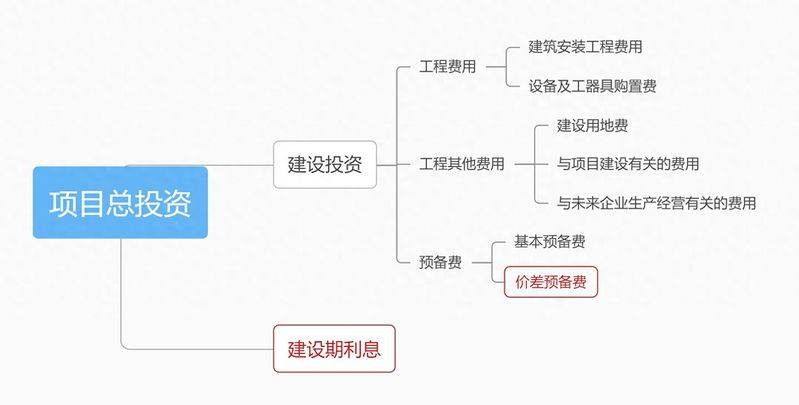
Earlier, i mentioned in several articles that the total investment in the project would be different at different stages of the project。
After all, starting with the construction idea of a project
As the project moves forward and the project matures, the “goldness” of total investment will be different
It is therefore necessary to assign different proprietary names to the total investment in the different phases of the project。
In the project construction document phase, call the total investment
The total investment at this time may be an integer, with no decimal integer. The project is at a very early stage and can only be analysed, summarized and collated on the basis of price data and information for similar projects, with a total investment selected。
At the researchable reporting stage, call estimates of total investment
At this point, research by researchable institutions has been carried out on the projects and it is reasonable to determine the amount of investment in construction projects。
In the initial design budget proposal phase, it is called the design budget proposal or the total investment of the budget proposal。
At that time, the design unit, based on the preliminary design or extension of the preliminary design drawings and descriptions, uses the information issued by the country or region on the proposed budget indicators, the proposed budget flats, the consolidated indicator budget flats, the individual cost flats or fees criteria (indicators), to provide an approximate calculation of the full cost of the construction project from its preparation to its completion。
The total investment in the proposed budget is a relatively precise total investment and a relatively strict total investment。
We say what is meant by “strict”。
Total proposed investment once approved by the competent authority
It is the maximum sum of the total price of the project, which cannot be broken at will in the future and, if there is a change in the project, it requires re-approval by the original approving authority。
In follow-up, a series of control plans budgets, bid offers, contracts for the master contract for the works, etc., are based on the overall investment in the proposed budget。
Finally, a further concept, static investment in projects and dynamic investment in projects。
And take this out
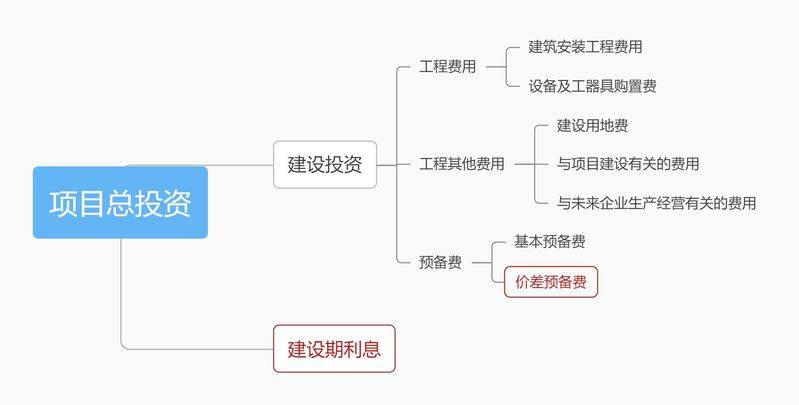
The static investment in the project consists of construction costs, other construction costs and basic reserve costs, excluding price differential provisions and interest on the construction period, which are the two components of my mark。
On the other hand, dynamic investments in the project, including price differential provisions and interest during the construction period。
As a result, the total dynamic investment of the project is greater than or equal to the static investment of the project。
Typically, in more precise terms, dynamic investments in projects are more prudent, taking into account future price changes and interest on construction periods。
However, in operational terms, dynamic investment is not necessarily much more than static investment。
Assuming that the future plan of a government investment project is financed mainly through government-specific bonds
It's a special bond type that is issued three or four times a year
This means that this project may require three or four times a year of project release material
If dynamic investment is used, the total investment in the project is always different in each release material, and it always changes
In addition, the issue of a special bond is seen in terms of the multiple of the bond’s principal coverage, i. E. The extent of the project’s future operational gains/bond’s principal coverage
The total investment in the project, however, does not affect the multiples of principal and interest coverage, and there is no need to use dynamic investments。
The use of static investments maintains the continuity of project materials and does not affect core requirements for the distribution of materials。
All right, here's the total investment