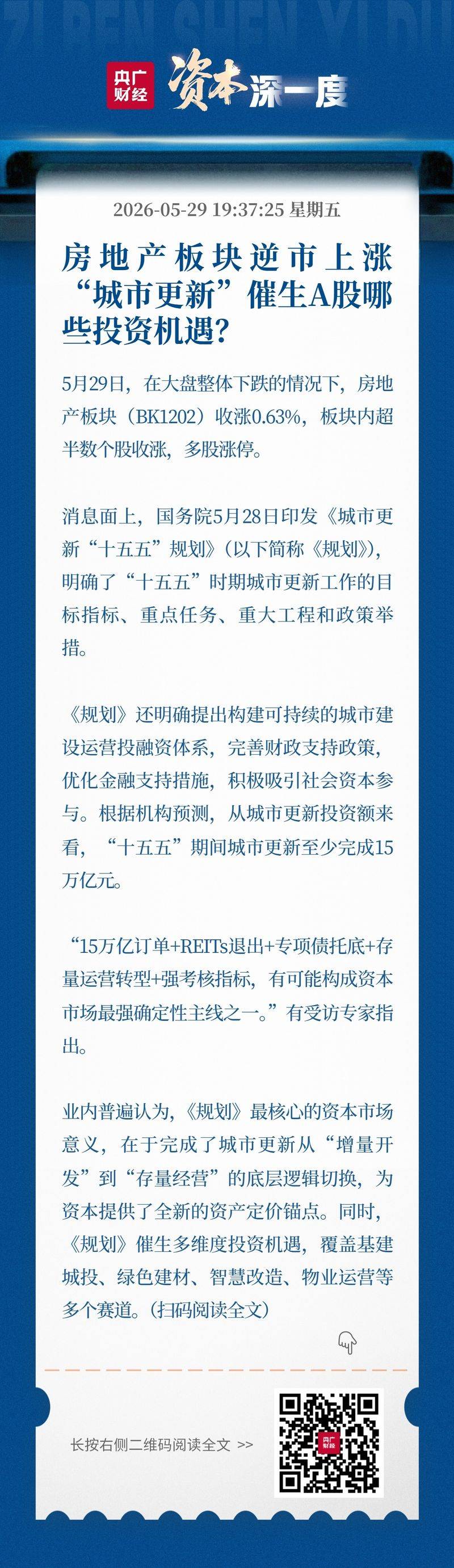
On may 29th in beijing (journalist qi ji ji zixing) the real estate block in yang guangcai went up against the market. On 29 may, the eastern wealth choice data showed that, in the face of the overall decline of the large plate, the real estate block (bk1202) had risen by 0. 63 per cent, with more than half of the shares in the plate rising, including the shares of fukusung (000926. Sz), sunshine (000608. Sz), tianjin group (00090. Sz), guangda gabao (600622. Sh), yangjiang holdings (600162. Sh) and vanco a (000002. Sz) by 7. 25 per cent。
On 28 may, the state council published the urban renewal “fifty-five” plan (hereinafter referred to as the “plan”), which identifies targets, priorities, major engineering and policy initiatives for urban renewal during the “fifty-five” period。
According to the experts interviewed, the central capital market significance of the plan lies in the completion of the bottom-level logical transition of urban renewal from “incremental development” to “stock operation”, which provides an entirely new asset-pricing anchor for capital while opening up additional investment opportunities。
It's expected to leverage $15 trillion in investment
The plan states that by 2030, the urban renewal initiative will have made significant progress, with the transformation of the urban development approach beginning to be effective, with a stronger foundation for safe development, increasing service efficiency, a marked improvement in the habitat environment, an accelerated transformation of new and old kinetic energy, effective protection of cultural heritage and greater visibility of the cultural heritage, significantly improved levels of governance, and cities becoming spaces for a high quality of life for the people. At the same time, the plan focuses on urban development and the improvement of livelihoods, deploying six core tasks, seven policy initiatives and 14 major projects, particularly in the areas of stock-taking, upgrading of housing quality, upgrading of old housing and construction of new housing models。
In addition, the plan clearly provides for the establishment of a sustainable system of operational investment in urban construction, the improvement of financial support policies, the optimization of financial support measures and the active involvement of social capital。
Lihui tani, a finance professor at the university of nankai, stated that the plan for the first time injected high policy certainty and long-term expectations for urban renewal in the form of a five-year plan, eliminating the largest uncertain premium from the previous pilot phase and enabling capital to be allocated over a long period of time。
Liu chun-sheng, associate professor of the central university of finance and economics, believes that this plan, with its medium- and long-term top-level design as its central highlight, breaks the traditional model of short-term projects, leads the participation of social capital through a variety of instruments, such as market-based funds, reits, equity cooperation, etc., and expands its scope to a variety of scenarios, such as old factories, businesses, intellectual retrofitting, and emphasizes the integration of productive cities and stock asset pooling to build clear and sustainable profit expectations for capital。
According to cgi, urban renewals during the “155” period were at least $15 trillion, or an average of $3 trillion a year。
The vice-president of the shanghai institute of eternal estates has made the point that “where money comes from” is the key issue for urban renewal. The plan identifies three main sources of financing — financial, financial and social capital. Adequate policies should be actively used everywhere, and the availability of funds is an important support for accelerating urban renewal。
“the system of financial support, including central fiscal incentives, special local debt, other local financial resources and tax and tax relief, has been improved. In terms of financial support, market-based financing models are clear for risk-controlled and commercially sustainable projects, covering integrated development, consortium loans, project investments, etc. Of particular concern is the fact that the plan's "exploration of effective financial support for urban housing renewal and demolition" means that new forms of financial support for housing will be fostered on the basis of traditional personal housing loans. With regard to social capital, reits have played a good role in the areas of commercial office and rental housing, in addition to more flexible instruments such as asset securitization products and corporate bonds.”
According to kit ye, director of finance at the shanghai national school of accounting, the plan explicitly supports the in-depth involvement of social capital in a composite model of urban operating rights and asset securitization, transforming traditional urban transformation projects into priceable, layered, tradable long-term quality asset packages。
The vice professor emeritus of the faculty of economics of beijing university, lu, stated that the plan was ambitious in scale, volume-historic and definitive; that, in terms of the investment financing system, rits+specific debt plus market-based financing and the investment finance closed-off ring were fully complete; and that there had been a qualitative change in the mode of operation, ranging from “dismantling” to “restoring + long-term operation”。
“15 trillion orders +reits exit + earmarked debt ceilings + stock operation transition + strong appraisal targets may constitute one of the most definitive axes of capital markets.”。
Revalued stock of real estate
According to liu chunsheng, the plan will effectively restore the city's valuation of the relevant blocks, leading market funds away from short-term conceptualization to long-term operating value investments. As cities update reits to accelerate their expansion, stock real estate values are revalued, boosting upstream and downstream demand for buildings, green packages, community services, etc., and improving industry cash flow and profitability。
“real estate should become an important building block for urban renewal, both for house and land renewal and for sustained support at the policy level.” in terms of real estate, the plan identifies three areas that are highly relevant to the industry, namely, greater support for the inventory of land, the establishment of a security management system for the entire life cycle of houses, and the construction and upgrading of “good houses”。
The impact of the plan on capital markets is, in the view of the field, a profound change in pricing logic, financial flows and asset patterns. In terms of pricing logic, the plan has prompted the market to revisit the value of assets in the core regional inventory, where older assets that were otherwise neglected will be financially revalued through planning enabling, functional conversion and volume incentives, and where enterprises with core area assets will be confronted with a systematic value discovery. In terms of asset patterns, the plan guides city renewal and the deeper integration of financial capital, provides a source of high-quality, bottom-end assets for real estate investment trust funds, and directs residents'savings effectively to long-term investments in high-quality urban development through capital markets. In terms of financial flows, hundreds of billions of tons of investment will attract the full range of social capital participation, such as credit, bonds, earmarked debt, equity investment funds, and the industrial chain is shifting from a single engine driven by “government allocations” to a multi-engineer pattern of “multi-capital resonance”。
In ye xiaojie's view, the plan will lead capital away from the high turnover, fast-developing short-term arbitrage model towards a long-term, steady-operated value track. The market as a whole will also complete a round of triumphs and failures, gradually moving away from policy issues and completely reverting to cash flows and entity operating values。
A specific analysis of ye xiaojie indicates that in sequestering markets, urban upgrading of product asset pools such as special debt, project income instruments and so forth continues to expand, the pricing system continues to mature and liquidity continues to increase, which will continue to attract long-term finance packages such as insurance, pensions and the stabilization of the capital market's long-term capital base. In equity markets, the logic of industry valuation has been reshaped, and the core competitiveness of housing and infrastructure enterprises has shifted from the size of land reserves to the combined capacity of urban services, asset operations, digital transport, etc. At the same time, the policy allows for a cross-cyclical revenue-balancing mechanism that breaks the profit-loss limit of a single plot and effectively activates the wave of trade mergers and acquisitions restructuring and the dismantling of high-quality assets。
Multi-line resonance creates new investment opportunities
Since may, a number of listed companies have referred to the latest layout and progress of urban renewal operations on interactive platforms. According to skykin, the company is closely following national policies and has undertaken targeted research, building on well-established industrial chains during the “155” period, taking advantage of major opportunities such as urban construction, urban renewal and urban operations, and steadily advancing project reserves and landings in an effort to achieve high-quality corporate development. *stk states that diversified space carriers such as commercial complexes, industrial parks and urban renewals managed by the company lead to space activation and commercial value enhancement and the construction of a complete industrial closure from space operation to content output, from traffic to commercial realization。
Lu indicated that the expansion of the capital market track and the resonance of livelihoods + green + smart + consumption plurilines would lead to new investment opportunities. In his view, the new opportunities focused on “stock operations + reits exit + full-chain orders + digitalization/greening upgrades”; the top seven sectors, such as capital companies, old local change platforms, building materials/networks, renovations, design consulting, property operations, smart/green packages, etc., were worthy of focus。
In his view, the plan opens up new investment horizons with the twin lines of “stock enhancement” and “security resilience”. In the area of planning and design services, the planning and design enterprises that focus on the adaptation of old and old neighbourhoods, the activation of historical neighbourhoods, urban medical examinations and planning will be the first to benefit from a continuous flow of orders. In the area of building improvement and functional upgrading, unlike the cyclicality of new construction, the testing, identification, reinforcement, energy-saving alterations and elevator upgrades of the housing stock, in particular seismic testing and functional upgrading, will build up long-term demand pools across the cycle. In the area of grid upgrading and smart cities, water supply, drainage, gas, etc. Are among the most hidden but urgent of the city's upgrades, namely, the reek project, which has created a substantial and incremental market for equipment and services providers. In the area of building materials, the penetration rate of new types of materials, such as green low-carbon materials, will leapfrog from optional upgrades to rigid demand driven by upgrading. In the area of real estate services, integrated urban operators with area-based integration capacity, long-cycle operating experience and asset consolidation models will replace traditional developers as central value combinations in the urban renewal era。
According to ye xiaojie, the investment opportunities of this round of urban renewal of unit a are different from the old track of traditional demolition construction and are concentrated in three completely new subdivisions. One is the urban digital infrastructure track, which focuses on the intellectual transformation of old neighbourhoods, community carbon accounting, and intelligent businesses with core values that are no longer engineering, but sustainable data services and long-term revenue-sharing. The second is a hybrid space-operated track, capable of living up to unoccupied urban spaces, living up to old age, nursing, cold chain, etc., and generating stable consumer cash flows through long-term service contracts, with greater growth resilience. The third is a green modular retrofitting track, with service providers with building regenerative, fast-assemble, reversible core technologies, which are fine-tuned to the new environmental and human flow limit points in urban areas。
Liu chunsheng suggested that investments could focus on three types of targets: one is a housing company with project reserves and operating capabilities, a municipal platform; the other is an engineering support enterprise for assembly buildings, energy-saving renovations, intelligent buildings, etc.; and the third is an enterprise for guaranteed rental housing, industrial parks reits, and light asset services such as commercial operations, property management, etc。
It was emphasized that investors should give priority to leading firms with high performance certainty, clear technical barriers and pre-validation advantages on the stock track, rather than staying on the subject matter level。
Ye xiaojie suggested that, at the investment level, there was a need to move away from the order-based approach, with priority layouts with high-quality targets for landing pole projects and long-term operational split-up mechanisms with locals. The core values of the current round of urban renewal are ultimately derived from precision responses to the needs of the population, rather than simple urban hardware adaptation。