On 12 january, the national statistical office published national cpi (consumer price index) and ppi (industrial producers price index) data for december 2021。
Data show that in december 2021, the national consumer price increased by 1. 5 per cent over the same period. Among them, urban growth increased by 1. 6 per cent and rural growth by 1. 2 per cent; food prices by 1. 2 per cent; non-food prices by 2. 1 per cent; consumer goods prices by 1. 5 per cent and services by 1. 5 per cent。
In december, the national consumer price ratio declined by 0. 3 per cent. Among them, the urban and rural areas fell by 0. 3 per cent; food prices by 0. 6 per cent; non-food prices by 0. 2 per cent; consumer prices by 0. 4 per cent; and services prices were flat。
Throughout 2021, the national consumer price increased by 0. 9 per cent over the previous year。
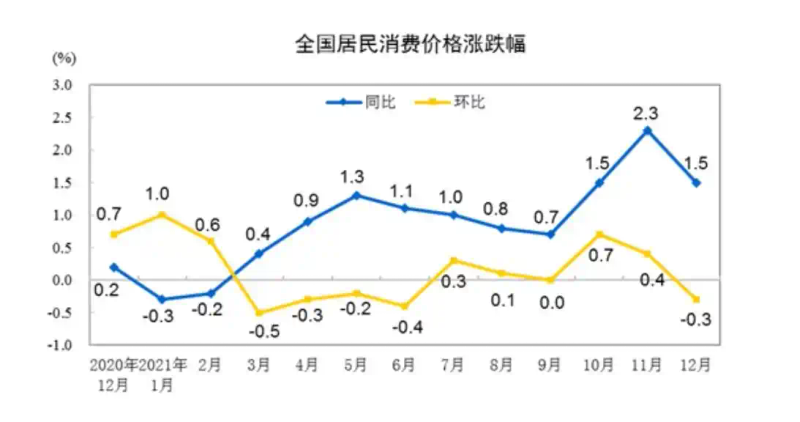
(examples from the website of the national statistical office)
In december 2021, the prices of industrial producers in the country rose by 10. 3 per cent and the ring by 1. 2 per cent; the prices of industrial producers' purchases increased by 14. 2 per cent and the ring by 1. 3 per cent. Throughout 2021, the prices of industrial producers out of the plant increased by 8. 1 per cent over the previous year, and the prices of industrial producers into the industry increased by 11. 0 per cent。
This was interpreted by the senior statistician of the urban division of the national statistical office, lijun。
The cpi ring goes up and down, back and forth
According to tung liang, in december, the epidemic spread throughout the country, bringing together the various sectors of the region to promote disease prevention and control and secure supply prices, and generally smooth consumer markets。
From the ring comparison, cpi shifted from a 0. 4 per cent increase last month to a 0. 3 per cent decline. Of these, the food price ring ratio shifted from a 2. 4 per cent increase last month to a 0. 6 per cent decline, affecting cpi by about 0. 10 percentage points. In food products, there has been an increase in the marketing of fresh vegetables and a fall in prices, with the ring being reduced by 8. 3 per cent from 6. 8 per cent last month to 6. 8 per cent; a 3. 4 per cent increase in the price of fresh fruit due to seasonal factors; the winter pickles have entered the end with an acceleration of the production of pigs, and the price of pork has increased significantly by 11. 8 percentage points since last month. The price of non-food items was reduced by 0. 2 per cent from the previous month's level, affecting the cpi by about 0. 17 percentage points. Among non-food items, the price of industrial consumer goods was reduced by 0. 5 per cent, from 0. 3 per cent last month to 5. 4 per cent and 5. 8 per cent, respectively, as a result of lower international crude oil prices. The price of services went from a 0. 3 per cent decline last month to a flat rate, with a 1. 3 per cent increase in the price of domestic services due to the approaching spring season; the epidemic affected the population's travel and the price of hotel accommodation fell by 0. 8 per cent。
On the same basis, cpi increased by 1. 5 per cent, or 0. 8 percentage points from last month. Of these, food prices have been reduced by 1. 2 per cent from a 1. 6 per cent increase in the previous month, affecting the cpi by about 0. 22 percentage points. The price of pork fell by 36. 7 per cent, an increase of 4. 0 percentage points over the previous month; the price of fresh vegetables rose by 10. 6 per cent, a significant decline of 20. 0 percentage points over the previous month; and the prices of freshwater fish, eggs and vegetable oils fell by 16. 7 per cent, 14. 2 per cent and 9. 0 per cent, respectively. The increase of 2. 1 per cent in non-food prices was 0. 4 percentage points lower than last month, affecting an increase of approximately 1. 69 percentage points in the cpi. Among non-food items, the price of industrial consumer goods rose by 2. 9 per cent and declined by 1. 0 percentage points, with petrol and diesel prices rising by 23. 0 per cent and 25. 4 per cent, respectively, more than in the previous month; and services rose by 1. 5 per cent, the same increase as last month. The core cpi, net of food and energy prices, increased by 1. 2 per cent the same amount as last month。
The ppi ring is flat, the same year's increase is back
“in december, the effects of the policy of securing stable prices continued to be felt, with lower prices for some international commodities, such as superheavy crude oil, and lower prices for industrial goods.” t. L. T。
From the ring comparison, ppi moved from a flat level last month to a 1. 2 per cent decline. Among them, the price of means of production fell by 1. 6 per cent, an increase of 1. 5 percentage points over the previous month; the price of means of living was reduced from 0. 4 per cent to even. There has been a steady increase in the implementation of policies to secure and secure prices, with coal prices continuing to fall, with prices in the coal mining and washing industries falling by 8. 3 per cent, an increase of 3. 4 percentage points, and prices for coal processing falling by 15. 4 per cent, an increase of 7. 0 percentage points. In winter, demand for construction materials such as steel and cement declined, prices declined, prices in the metallic smelting and prolonged processing industries fell by 4. 4 per cent and prices in non-metallic minerals industries decreased by 1. 4 per cent. Lower international prices for crude oil and non-ferrous metals have led to lower prices for relevant domestic industries. Prices for oil extraction fell by 8. 3 per cent, prices for the manufacture of refined petroleum products by 4. 0 per cent, prices for the manufacture of chemical raw materials and chemicals by 2. 1 per cent, and prices for non-ferrous metal smelters and slow processing by 1. 4 per cent. In addition, higher prices of imported liquefied natural gas affected 5. 3 per cent in the gas production and supply sector, while the price of trade in coal-fired electricity generation increased by 3. 0 per cent。
By comparison, ppi rose by 10. 3 per cent, or 2. 6 percentage points from last month. Among them, the price of productive resources rose by 13. 4 per cent, a decline of 3. 6 percentage points; the price of means of living rose by 1. 0 per cent, the same amount as last month. Of the 40 major industrial categories surveyed, 37 prices rose, the same as last month. Among the main sectors, the price rises were: coal mining and washing, which rose by 66. 8 per cent, or by 22. 6 percentage points; oil and gas mining, by 45. 6 per cent, or by 22. 9 percentage points; oil coal and other fuel processing, by 36. 4 per cent, or by 16. 7 percentage points; ferrous metal smelting and prolonged processing, by 21. 4 per cent, or 9. 6 percentage points; and non-ferrous metal smelter and compressing, by 20. 0 per cent, or 6. 5 percentage points. The price increases were as follows: gas production and supply increased by 12. 5 per cent to 1. 6 percentage points; electricity thermal production and supply increased by 4. 8 per cent to 2. 4 percentage points; and food manufacturing increased by 4. 2 per cent to 0. 7 percentage points。