Chapter 3
Hydraulic motors are an indispensable implementing component of any hydraulic mechanical equipment or work agency (e. G., industrial machinery for the production of various types of equipment, revolving work units for military equipment and vehicles and walking machinery), which converts hydraulic power into mechanical energy, which drives the operation of the work unit connected to its moving axis in the form of rectangular and revolving speed. Like hydraulic pumps, in the development of various types of hydraulic equipment and in the design and use of hydraulic systems, the proper and reasonable use, use and maintenance of hydraulic motor selection is undoubtedly of great importance for improving the working quality and reliability of hydraulic systems and of hydraulic equipment as a whole。
3. 1 rationale and structural characteristics
Similar to hydraulic pumps, hydraulic motors are of a wide variety (e. G. Gear, leaf, plume, etc.), with different structures, but are of a volume type, i. E. Work based on changes in sealed capacity。
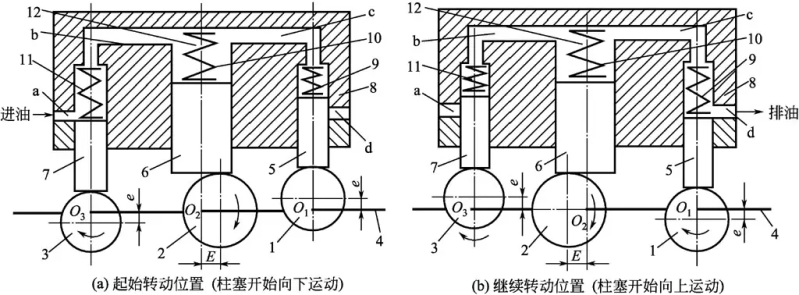
The reversible hydraulic devices shown in figure 3-1 are the same as in figure 2-1 and can be used as hydraulic motors in addition to hydraulic pumps. The eccentric distance of the eccentric cam 1 and the eccentric distance of the eccentric cam 2 is the e. Three cam's return centres o1, o2 and o3 are connected and driven by the same transmission axis 4 (reverses). Cam 1 and 3 control the opening or closing of one-way valves 5 and 7; cam 2 maintains contact with plug 6 (crowding), all three of which are guaranteed contact by the corresponding springs with packages 5, 6 and 7. The cylinders can move back and forth in the holes of the cask 8 (sent), and the cavity between the cavity and the cavity forms a variable volume sealed working cavity 12。
Loading...
Figure 3-1 map of basic working principles of hydraulic motors
1 ~3 ~ triple cam; 4 ~ axe; 5,7 ~ one-way valve; 6 ~ plugs; 8 ~ cylinders; 9 ~ 11 ~ flow valve springs; 12 ~ sealed working cavity; a ~ oil intake; b, c ~ fluids; d ~ oil drains
The rationale for hydraulic motors is summarized in figure 3-1 below. When it is used as a hydraulic motor, the axle is no longer driven by the original motive but is linked to the working body of the hydraulic mainframe. And enter pressure fluids from the vents shown in figure 3-1(a) a the pressure fluids enter through the single-direction valve 7 and the flow channel b and enter the working cavity of the motor and generate hydraulic force of the pylons at the upper end of the plume 6, which, due to the presence of cam2 eccentric e, will form a rectangular rectangular to the revolving centre o2 of cam2 which will lead to the flow of the cam2 and the flow of the wheel 4 along the timewise needle direction; because of inertia, cam2 rotates to the position indicated in figure 3-1(b), which will still move in the direction of the current needle, and removes the plume 6 and closes the working caving fluids through the flow channel c, single-volt valves 5 and d drains to the oil tank (without drawing out of the map); because of inertia, the flow of the wheel 1 corresponds to the position shown in figure 3(b), so that the flow of the plume as well as discharges in the oil can be closed at the current valve. The continuous input of pressure fluids from the hydraulic motorsa allows motors to drive the work units connected to their transmission axes towards a continuous revolving movement in the direction of a clockwise and continuously discharges used fluids from one-way drain valves5. Similar to the case of hydraulic pumps, if the fluid is entered in reverse direction, i. E., by the oil vent d, or by the oil vent a, outward, the reverse direction of the moving axis or rotor is necessary, i. E., by the reverse timewise direction。
The above-mentioned pillar hydraulic motors have the basic structural characteristics of a volume hydraulic motor。
1 as with hydraulic pumps, hydraulic motors have three components, collectively called quartz, rotor and squeeze, which vary according to the structure of hydraulic motors。
As with hydraulic pumps, hydraulic motors have a number of sealed and cyclical working cavities, which generally consist of three parts, i. E., twirls, rotors and squeezes. The working cavity associated with the high pressure fluid is referred to as the entering cavity or the high pressure cavity, the working cavity leading to the tank is referred to as the discharge cavity or the low pressure cavity, and the area of transition between the entering cavity and the discharge cavity is sealed by the surface of the parts concerned. In order for the volume of the work cavity to change, there must be a relative motion squeeze in the parts that make up the work cavity. Squeezes stretch through pressure oils to increase the cyclicality of the working cavity by small sizes and shrink from parts such as the tilt disks so that the cyclicality of the cavity is constantly reduced from large to low pressure liquids。
3 as with hydraulic pumps, hydraulic motors have oil intakes and discharges, but motors are connected to high-pressure and low-pressure vents, respectively. As the pressure of the hydraulic motor is slightly higher than that of the atmosphere, unlike the hydraulic pump, motors may have the same sizes as the vents. Changing or swapping the flow and discharge of hydraulic motors can change the direction of hydraulic motors。
4 the input parameter for hydraulic motors is the hydraulic parameter (pressure and flow) and the output parameter is the mechanical parameter (traverse and velocity)。
The pressure of the hydraulic motor entry cavity depends on the size of the pressure caused by the pressure of the fluid entering and the resistance of the pipeline; the pressure of the discharge cavity depends on the size of the pressure loss caused by the resistance of the pipeline。
The theoretical discharges from the hydraulic motor are related to volume changes (or geometric dimensions) in the working cavity, and not to other factors, such as the pressure of the oil. If motor's theoretical discharges cannot be changed, they are quantitative motors and vice versa。
The output rate of hydraulic motors depends on the input flow and discharge of motors; the output rectangular depends on the discharge and intake of motors and the low pressure of exports。
6 as with hydraulic pumps, hydraulic motors have streaming facilities, which function essentially the same as hydraulic pumps. However, because of the need for positive and reverse rotation of motors, hydraulic motors should generally be symmetrical in structure. The mode of distribution of hydraulic motors also varies depending on the structure of the motors, and there are generally both deterministic and valve-type streams. The flow pattern in the plume-based hydraulic motor shown in figure 3-1 is the valve flow with a one-way valve。
3. 2 type symbols and structural characteristics
(1) type
The classification and name of hydraulic motors vary according to the point of view。
1 hydraulic motors are of the type of gear, foliage, plume and screw type, depending on the type of crowd structure and mode of movement。
2 the volume of liquid entering and discharged according to cyclical changes in the working cavity is regulated, and hydraulic motors are divided into quantitative and variable types。
3 hydraulic motors are divided into high-speed small-turner rectangles and low-speed large-turner rectangles, depending on rotation speed and rectangular behaviour. In general, motors with a rated rate above 500 r/min are called high speed motors, while motors with a rated rate below 500 r/min are called low speed motors。
The basic types of high-speed hydraulic motors are gears, screws, blades and axle pistons, which are similar in structure to the same type of hydraulic pumps and are reversible, but because of the different purposes for which they are used, there are many structural differences that generally cannot be directly reversible. High-speed hydraulic motors have the advantage of high rotation speed, low turnover, easy start-up and braking, and high sensitivity for adjustment and transposition, but the output rectangular is small (between a few dozen and a few hundred cattle metres) and slow loads are to be dragged with a slow load。
The basic type of low-speed hydraulic motor is typically a pyre, with a single and multi-role pattern. Low-speed hydraulic pressure motors are large in charge, slow in turn, large in output rectangular (which can range from tens to tens of thousands of cattle metres) and can be directly connected to their towed working structures without the need for speed-reducing devices, but they are larger in size。
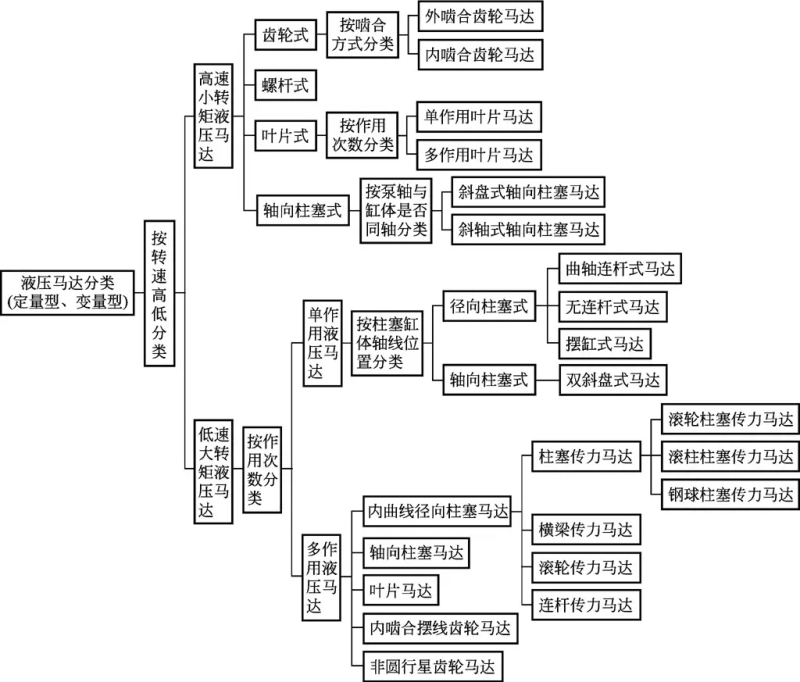
The detailed classification of hydraulic motors is shown in figure 3-2。
Loading...
Figure 3-2 detailed classification of hydraulic motors
(2) graphical symbols
Graphical symbols of hydraulic motors commonly used are shown in table 3-1。
Table 3-1 graphical symbols of hydraulic motors commonly used (gb/t 786. 1-2009)

Loading...
(3) structural characteristics
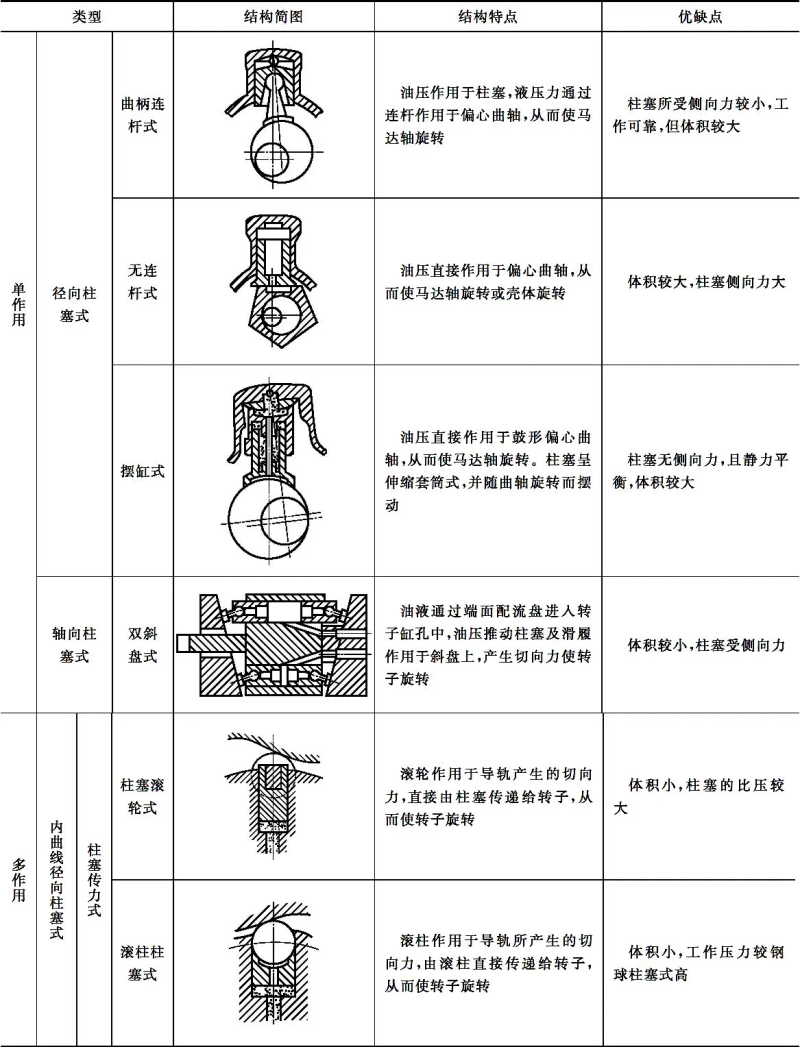
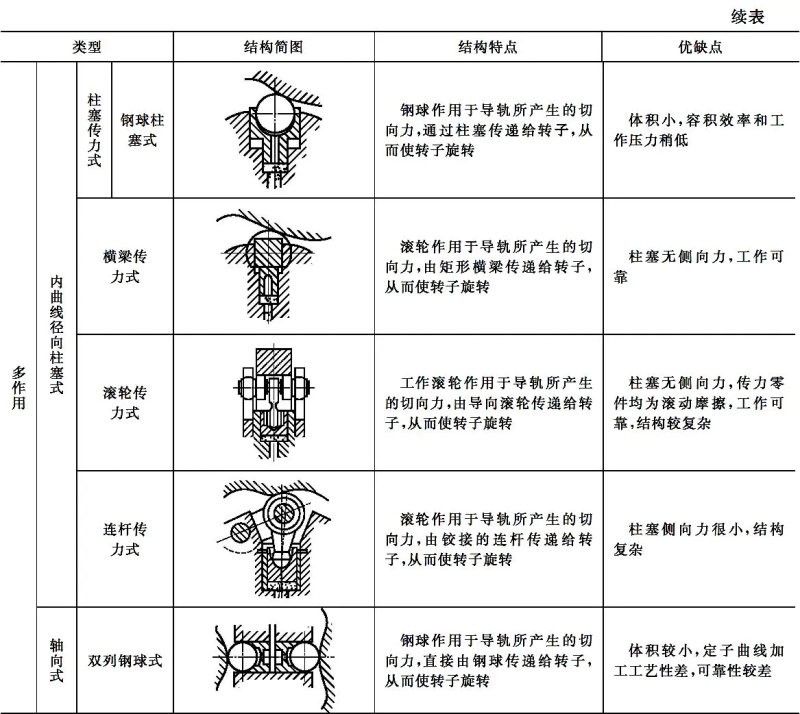
The structural characteristics of high-speed hydraulic motors are essentially similar to those of the same type of hydraulic pumps, but they cannot be used as hydraulic motors or are free of such valves because the hydraulic pump structure by means of valves cannot reverse the flow into and out of the fluids. The characteristics of the commonly used low-velocity hydraulic motor structure are shown in table 3-2。
Table 3-2 structural characteristics of low-speed hydraulic motors commonly used
Loading...
Loading...
3. 3 performance parameters and comparison
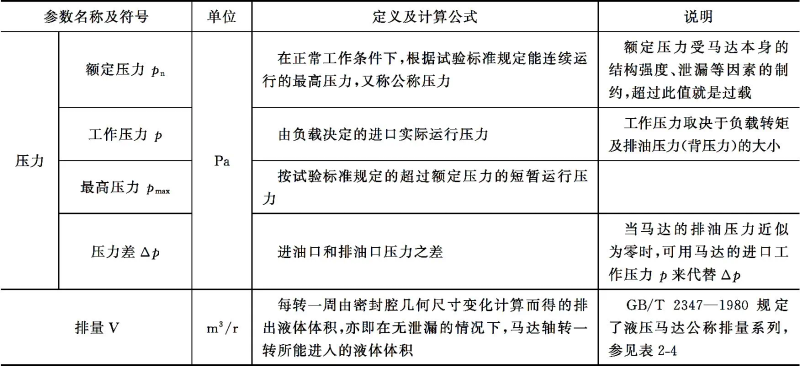
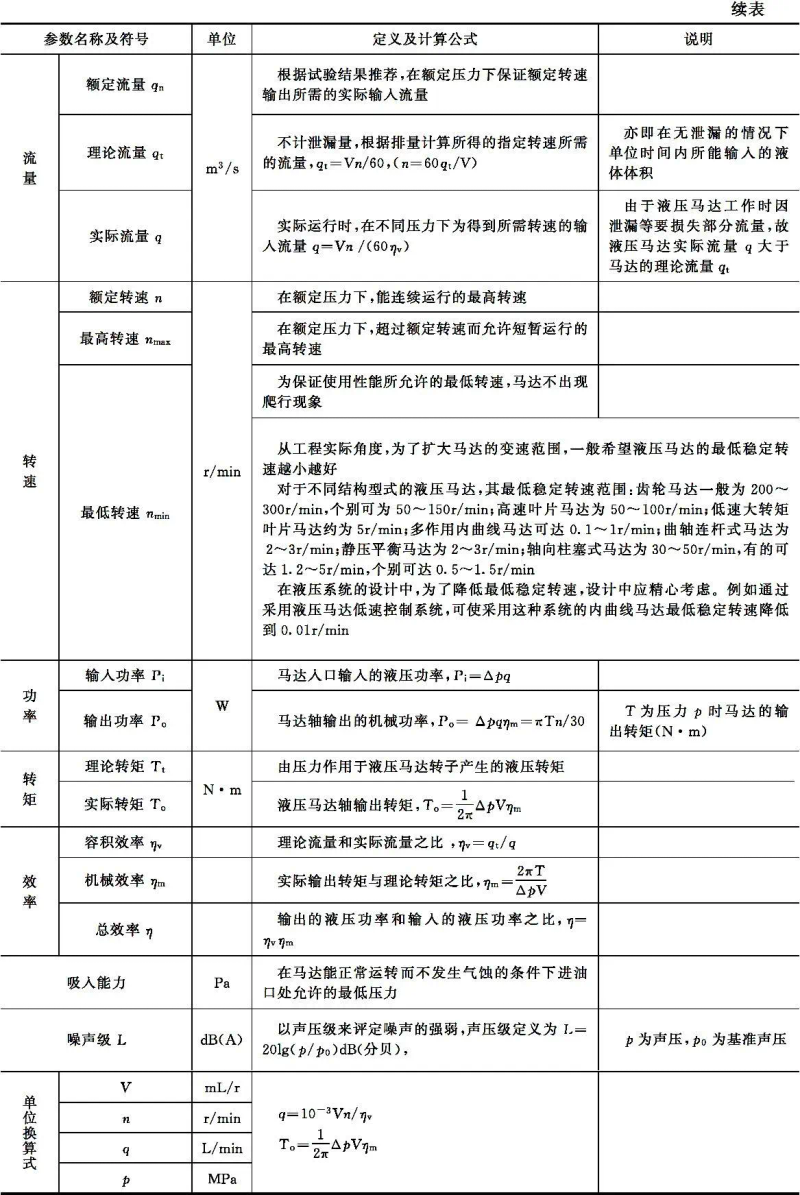
The main parameters of hydraulic motors are pressure, charge and flow, rotation, rectangular, power and efficiency, defined and described in table 3-3。
Table 3-3 main parameters for hydraulic motors
Loading...
Loading...
In accordance with gb/t 7935-2005 general technical conditions for hydraulic components, in addition to the name, model and graphic symbol of the hydraulic motor, the main technical parameters such as charge, rated pressure, maximum pressure, rated flow, nominal turn speed, volume efficiency, total efficiency, output rectification, etc., shall normally be indicated on the product label of the hydraulic motor (contained in the obvious part of the product)。
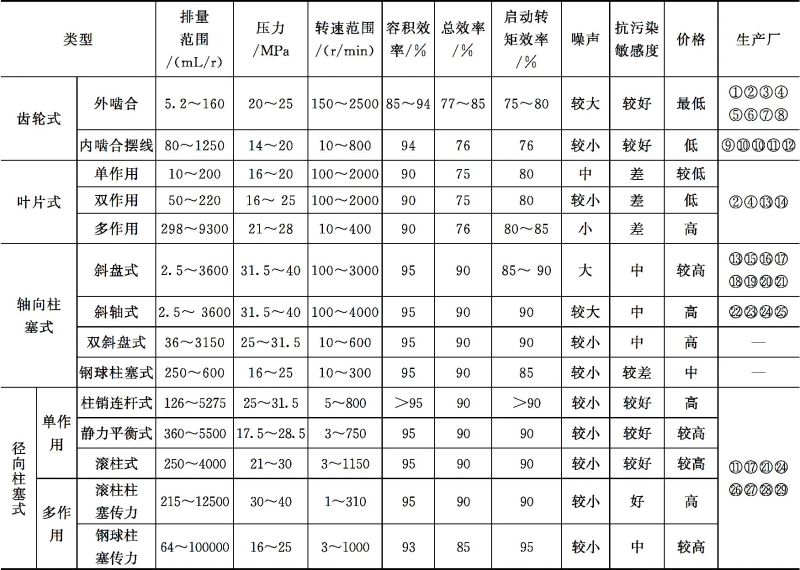
The performance characteristics of the commonly used hydraulic motors and the production plants are shown in tables 3-4 and the applicable conditions and application ranges in table 3-5。
Table 3-4 performance characteristics of commonly used hydraulic motors and production plants
Loading...
1 sichuan yangjiang hydraulics limited; 2 tai chi group selenium hydraulics industries ltd.; 3 joint fertilizer long source hydraulics limited ltd.; 4 shanxi long-term hydraulics co. Ltd.; 5 jenan hydraulic pumps limited ltd.; 6 jiangsu tae xin municipal hydraulics plant; 7 pomke (tenjin) hydraulics co. Ltd. (us); 8 tianjin city solar hydraulics co. Ltd.; 9 ning boward liquid machine manufacturing co. Ltd.; 10 jiangxihuat hydraulics ltd
(a) loading... In ningbo's mean hydraulic motors, ltd.
Loading nanjing hydraulic machinery ltd.
Loading... Eton fluid power (shanghai) limited
- loading..
Loading... Shanghai high pressure pumping plant ltd.
Loading... Shenyang engineering hydraulic plant
Loading... Kaidong high pressure pumps ltd.
Loading... Shanghai quest hydraulic pump ltd.
Loading... Shanghai nabotsk hydraulics ltd.
Loading ningbo guang tianxis hydraulics ltd.
Loading... The japan kawazaki precision society
Loading... The hydraulic pumps sub-company, a limited liability company of the hydraulic industries group in beijing
Loading... Shanghai jade peak high pressure oil pump ltd.
On board... The german company bosch lithler
Loading ... Guizhou power hydraulics ltd.
Loading ningbointem hydraulic motors ltd.
Loading... Ningbo hemp hydraulic technology ltd.
Loading... Material lubrication hydraulic equipment ltd.
Loading... Shanghai electrical hydraulic gas motion limited。