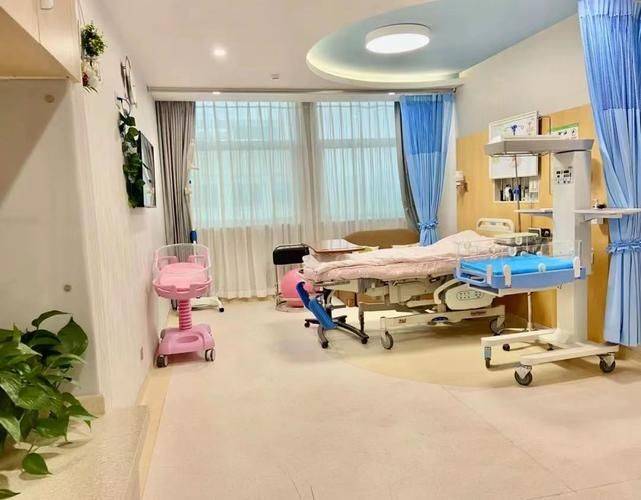
On 23 april 2026, with a big screen lit, ** the jilin hospital of the zheg dynasty ** officially opened the door. This is not a general expansion of hospitals, but an era that embraces national strategies and responds to the expectations of people. Total investment ** $1. 502 billion**, total building space ** 1338 million square metres**, planned beds ** 1,000**, average daily consultations ** 5,000.** most striking, however, is the fact that the hospital is equipped with ** the first mental health ward in the northeast.** it's like a sophisticated “smart cockpit”, trying to redefine childbirth. (blockview://markdown-image-tos-cn-i-t/13244098305884fb693ea784713006)# #sdr maternity room, upgraded from a “ manual block” to a “smart drive” so-called digital sdr delivery room, you can interpret it as an “smart cockpit” for a delivery room. In traditional maternity wards, equipment to monitor the heart, hysteria and vital signs of maternity is often independent and data is manually recorded and judged by medical personnel, such as driving a manual vehicle, highly dependent on driver experience and immediate reaction. The core of the sdr maternity ward is in ** “digitalization”** - the collection and integration of multi-source data in real time through an integrated system with a procurement award of ** $539. 4 million**. This amounts to a full range of sensors and intelligence controls for the delivery process, allowing for earlier warning of abnormal situations (e. G. Foetal distress), freeing doctors from cumbersome data records and focusing more on critical medical decisions. At the same time, it helps to alleviate the prenatal anxiety of mothers by creating a sound environment through science. The changes brought about by this upgrading are fundamental: - ** from “experience” to “data warning”**: ai-assisted analysis may identify potential risks earlier than simply relying on manual time-screening. - ** from “personal run” to “technology around”**: in the design of the skyscraper area, assistive units such as lottery and baby-heart care are integrated into special needs clinics, with the objective of “making technology work efficiently around patients and completely addressing the pains of patients crossing the floor”. - **from “local resources” to “national networks”**: as a national regional medical centre, the birth process is directly linked to experts from the zhegian college of women in hangzhou, where it is necessary to conduct remote consultations, equivalent to an “online escort” for the top team of experts. # "one house, two districts" and brain circulation, how to get the "national team" to take root in such a high-spectrum compound, does not appear in vain. The jilin hospital of the zhe dae dam is itself the fifth national regional health centre construction project approved in july 2023.** its operating model is “one house, two districts”, and the newly inaugurated jump yard operates in concert with the old compound located on the 5th street. Such synergy is not only a confluence of physical space, but also a deep transfer of technology, management and branding. The key to this is the establishment of a sustainable ** brain circulation mechanism**: - ** “breed transfusion”**: the zheega house of women has cumulatively selected medical technicians and management specialists ** 230 times ** to be deeply involved in clinical treatment and discipline building. -** “bleeding”**: at the same time, more than **130 operational cadres from jilin mainland were sent to zhejiang general college for further training. This two-way flow ensures that the top technology is not a “one-off demonstration”, but that it can sustain “root” and “growth”. This model is aimed at achieving “a comprehensive leap forward in service capacity, in the health environment and in the academic hierarchy” and at promoting the homogenous development of maternity care services at the national level in the north-east, as stated by the secretary of the zhegian women's college. # a “system upgrading” of women's health management was introduced in the hospital district, not just in childbirth, and the impact was far more than one smart maternity ward. It seeks to construct a health management system that covers women throughout their life cycle. In the field of reproductive medicine**, the new campus is equipped with laboratories compliant with the international standards of iso 15189, with the application of glass-rigid refrigeration to achieve an embryo recovery rate of over **98 per cent** and a clinical pregnancy rate of over 60 per cent** for individualized ovulation programmes. This means that many couples who had to travel to seek help elsewhere have a new hope at the “door of home”. In the area of treatment of cervical diseases,** the centre has introduced ** the sharp knife technique** to achieve millimetre-grade precision tissue cutting and to better preserve reproductive function while cleaning up the stoves. It has also taken the lead in introducing a one-stop model of “mother-to-child consultation, couple-to-wife treatment” in the provinces, extending the scope of the treatment from the individual to the family. In addition, nearly 2,000 square metres of independent health management centres have integrated multidisciplinary resources to provide “one stop” screening services from adolescence to menopause, with the aim of creating a platform for the management of women's health in the north-east. # what a regional medical “model room” means is the landing of the first sane sdr maternity ward in the northeast, whose symbolic significance is as important as its practical value. It is like a well-developed “model room” that shows intuitively how the national regional medical centre project has changed the medical landscape of a region. It responds directly to the national strategy of the “big illness”. Previously, in the face of complex high-risk maternity situations or suspected reproductive diseases, patients and their families might have to embark on a southward path to treatment. At present, ** country-level technical, equipment and expert teams have experienced substantial sinking through this hub.** this is not just an upgrade of a hospital, but it is more likely to drive standards of obstetrical care throughout the region. The launch of the parallel north-east regional academic conference on quality development in obstetric medicine, an attempt to promote regional homogenization through academic exchanges. (blockview://markdown-image-tos-cn-i-tt/0ddb188663f6e49cebeaaa1300ee7df1bc) future, through telemedicine platforms, experience and technology can be further irradiated to primary health care institutions, forming a network of “basic examinations, superior diagnostics”. From a sensor in an intelligent maternity ward, to specialist consultations across the north and south, to health management covering women's lives, the launch of the jilin hospital of the zheg dynasty has clearly mapped out a path of good-quality medical resources across geographical distances and truly “embedded” people's lives. The final question of its examination is how to translate the hardware and ambitious planning of these frontieres into the safety and temperature of every patient。