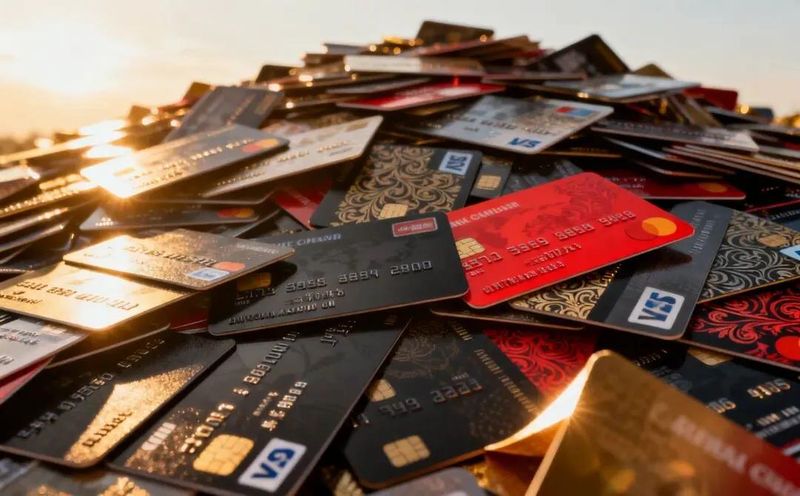
"i've been paying back on time, and the bank hasn't earned me any interest. Why do you always raise me and send me points?" it's a common suspicion of many credit card users。
I'm often asked that question. In the view of ordinary people, credit cards have an interest-free period of more than 50 days, with cards offering gifts, consumption credits, and regular activity — banks look like a “bullhead” and send money out every day。
The truth is the opposite: credit cards are not only a loss business, but also one of the most profitable segments of bank retail business. It's just the way banks make money, hiding in the corner you can't notice。
I. “four main sources of income” for credit cards
The money that banks earn from a credit card can be divided into four categories:
Interest income: bank “cash cow”
If you pay in full every month, the bank does not earn interest from you. The data show, however, that there are not as many people as could be expected to be able to pay in full monthly terms。
Revolving interest: when you choose the “lowest repayment”, the unpayed portion is calculated from the date of the accounting of consumption, at five per 10,000 per day, or 18. 25 per cent annually. This is one of the most stable sources of income for banks。
In the case of the $10,000 bill, only a minimum payment (usually 10 per cent) was made, leaving a balance of $9,000, which, if delayed by three months, would generate interest in excess of $400. That's why banks always remind you in app that you can “minimum repayment” — not sweet, business。
Disbursement interest: the credit card does not have an interest-free period, it starts at the moment when the money comes in, and it is also five points per day. The singapore branch of the bank of china's rates show that the cash advance rate is also 28. 88 per cent annualized。
Phased charges: the “major force” of the bank
Phased operations are the fastest growing credit card revenues in recent years. Data for 2018 show that in the credit card revenue structure, the share of phased charges has reached about 70 per cent。
Did you get a "scheduled invitation" call from the bank? This is usually said: “sir, your current bill may be divided without interest and at a rate of 0. 6 per cent per month.”
Sounds cheap? The write-off consists of a monthly rate of 0. 6 per cent and a total handling fee of $720 per 10,000 yuan. The annualization appears to be only 7. 2 per cent, but the real annualized interest rate is between 13 and 15 per cent, as the principal amount decreases monthly。
The fee rates indicate that the fee for instalments is 0 per cent-1. 2 per cent per instalment and is charged on schedule. This money became the largest source of profit for bank credit card operations。
3. Charges for swipe cards: wool on pigs
You swipe cards for consumption, banks don't charge you, but they charge the merchants. That's typical of wool coming out of pigs。
For every credit card transaction, a certain percentage of the fees (back-to-back) are paid to the bank at a rate of about 0. 3 to 0. 6 per cent in the country. Ten thousand dollars is spent, and banks can split between 30 and 60。
In the first quarter of 2025, the total income from the credit card billing fees of the eight major equity banks was rmb 1,049 million, an increase of 4. 64 per cent over the same period, which is the main source of credit card revenue. Despite being modest, hundreds of trillions of dollars of transactions are cumulatively astronomical in the country。
4. Annual and other costs: fine flow
Annual fee: the ordinary card is usually brushed several times, but the annual fee for platinum cards and diamond cards is mandatory. High-end card annual fees range from hundreds to thousands, and this part of the income translates directly into profits。
Default: if the minimum amount is not paid, the bank will charge the default amount at 5 per cent of the minimum amount outstanding。
Other miscellaneous expenses: loss and loss of hangers, credit charges, excess charges, cross-border transaction charges each amount is small but much less accumulated。
The bank is also “gold”: the secret of high-end cards
You may notice a phenomenon in which banks work hard to push high-end cards while cutting down the rights of high-end credit cards (cancellation of airport vip rooms, reduction of hotel rights). Why
The answer is that banks do not earn money from high-end cards themselves, but rather “fishing” high net worth customers。
High-end card users usually pay in full, without contributing interest to the bank; the billing fees do not cover equity costs. For credit card operations alone, the high-end card is a “loss of money”。
However, high-end card users are often also potential customers of finance, deposits and insurance. A high-end card screened these people so that banks could earn money through wealth management, private banking and other operations。
The 2025 semi-annual report showed that the number of private clients was 21. 96 per cent more than the number of high-value customers pried through high-end credit cards. That's the logic of a bank's “big deal”: credit cards don't make money, customers make money。
Iii. Why are banks getting better and better
The credit card industry is undergoing profound changes:
1. Saturation of cards: by the end of the third quarter of 2025, the number of national credit cards had fallen to 707 million, 100 million fewer than their peaks, and industries had entered the stock competition stage。
Loss of equity: many banks adjust credit card entitlements from “deep water” to “precision drip irrigation”. It's not the banks that get cheap, it's the banks that can't afford to burn money for the market。
3. Rigorous risk: the total amount outstanding on credit cards is over $120 billion, the bad rate rises and banks have to add codes to their controls。
4. Regulatory tightening: the new credit card regulation imposes stricter requirements on credit certification, use of funds, sleep card ratios and banks need to adjust their business models。
In the end: what kind of client are you
According to the way you use your credit card, the bank has a different level of love for you:
• full repayment user: the bank cannot make your money, but you like to brush your card, and the bank can make a fee from the dealer. It's a chicken ribs customer。
• phased/lowest repayment users: banks' favorite “high contribution customers”. You took on a high cost of money and raised credit card business。
• high-end card users: banks expect to make money from other businesses through you, and credit cards themselves are “ hooks”。
• overdue users: banks are also at high risk of being “high-risk customers”, although they receive default and interest payments。
And when you get this, you see why banks always tell you to split up and remind you of the lowest repayments -- not for your sake, but for your own kpi. The use of credit cards was not a problem per se, but it would be more rational to choose who was making money。