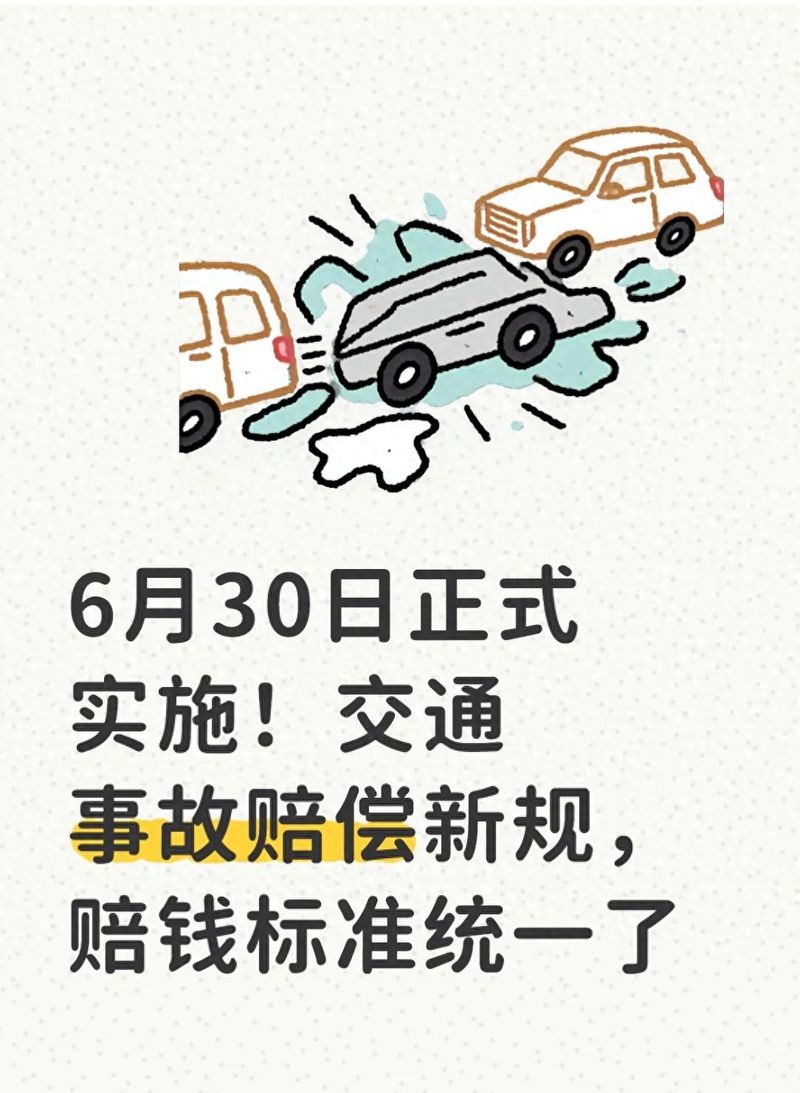
When you go out to drive and ride an electric car, you get a scratch. After a number of accidents, the parties each argued their differences, arguing over the proportion of money lost, and mediating took time and effort. On 30 june 2026, the latest new judicial regulation on traffic accident compensation will be formally applied, harmonizing the criteria for the adjudication of court awards. It is clear to everyone today, in plain language, that there is no need to pay more for compensation in the various scenarios, and that there is no need to pay for it, that there is a basis for daily travel and that there is less after-effects。
Here is a key point: this set of judicial interpretations deals only with the division of civil damages brought before the courts after an accident, and the standards of full responsibility, primary responsibility and sub-responsibility imposed by the traffic police on the ground remain in force under the road traffic safety act, without change, and do not confuse the two。
There is now a wide variety of means of walk-in on the road, with private cars, electric cars, tricycles, internet-based vehicles and loans, rental of cars and travel by road. In the past, there had been many discrepancies in compensation due to a lack of uniformity in the scale of court decisions and the fact that the rates of payment varied considerably between cases. This upcoming judicial interpretation, in conjunction with the existing provisions of the law on road traffic safety of the civil code, elaborates the scenes of compensation for the high incidence of accidents in life, providing a clear reference for consultation and advocacy by ordinary people and reducing the cost of dealing with disputes。
I. Access to involvement of vehicles in access, standards for responsibility
Many families lend their cars to their relatives and friends, and many owners have been worried that they would have to pay for the loan. In the light of the forthcoming judicial interpretation and the legislation in force, there are several cases in which it is objectively clear。
No fault on the part of the owner and no compensation costs incurred
The owner handed the vehicle over to an adult with a valid driver's permit and fit to drive the vehicle. The vehicle was checked on a yearly basis and the brakes, lights, etc. Were intact. Following the loan of the vehicle, the actual driver caused an accident and the main compensation was borne by the driver, who did not have to pay additional compensation。
To give a common example of life, neighbours borrow their cars, have full documentation, the vehicles are just being repaired, the other side breaks red lights into the road and the driver is responsible for the losses。
2. The owner's own fault, requiring proportionate compensation
The owner of the vehicle, knowing that the other party is not licensed, that the driver's licence has expired, that he drinks alcohol, that he is not fit to drive, or that there is a manifest failure of brakes, tires, lights, that he knows the danger, that he borrows on the road, and that, in case of an accident, the owner's fault, he is liable for compensation according to the size of the error, and that he will not bear the entire loss, combining the two parties ' faults。
3. Incidents involving rental of vehicles, distinguishing between the charterer and the leasing company liability
External taxis take their place, and under normal circumstances the main compensation is paid by the actual car charterer. If the leasing enterprise does not periodically overhaul the vehicle, the vehicle is rented with a security risk or the driver's qualifications are not verified, the leasing platform and the company are liable accordingly。
Non-motorized vehicles, pedestrians and motor vehicles are colliding and do not favour the pedestrian side alone
Many have always had the inherent idea that, as long as motor vehicles encounter pedestrians, electric vehicles, whether or not the other party violates the law, the motor vehicle would bear most of the losses, which is the main reason for many compensation claims. This judicial interpretation harmonizes the court's approach to reparations and establishes the ratio of compensation to the actual violations committed by both parties, without favouring non-motorized vehicles or pedestrians alone。
1. Visible violations by pedestrians and non-motorized vehicles, with corresponding losses borne by themselves
In the event of a collision between pedestrians who do not walk through the street, red lights, electric vehicles who reverse, over-speed, human beings who violate the law, and sudden changes of course, the court will account for compensation in the light of the gravity of the violation, leaving the pedestrian, non-motorized party, to bear the proportionate loss。
For example, electric cars break through the main road with red lights, normal car traffic avoids collision, the motor vehicle is at greater fault and is subject to major compensation, and the motor vehicle only bears minor costs and does not pay the full cost of medicine and repair。
2. The presence of motor vehicle irregularities increases the proportion of self-compensation
Motor vehicles are over-speeded, distracted from mobile phones, unruly pedestrians, who turn around in violation of the law, even if there are minor violations by pedestrians, and motor vehicle faults are more pronounced, and the allocation of compensation is tilted towards the pedestrian, non-motorized side。
3. Special group travel scenarios are considered as appropriate
Persons with disabilities, such as the elderly, children and the disabled, who suddenly cross the road, and motor vehicles have adequate conditions to slow down and do not operate in a timely manner. Compensation is calculated on the basis of a combination of road conditions and speed, taking into account the rules and circumstances, and is not subject to one-size-fits-all determination。
Iii. Multi-car follow-up generic culpability logic, with no changes to the new rules for your information
There is a high risk of multiple car trails at early and late peaks, and it is not clear to many who should bear the loss of each vehicle. The following determination is a common criterion for long-term enforcement by the traffic police, and the judicial interpretation of this 30 june landing has not adjusted the relevant rules and has been discussed in the context of compensation in order to facilitate a complete understanding。
1. The rear vehicle did not maintain a safe tail and the latter bore the main loss
The road is normal, the ex-car is in line, the rear car is close to the vehicle, the brakes are not in time to hit the forward vehicle, and the single tailing is the responsibility of the rear vehicle; each of the pre-impact vehicles is followed by a series of tailings, each of which bears the cost of maintaining the former vehicle。
2. The former vehicle was responsible for a series of accidents as a result of its irregular operation
The unprovoked brakes, random re-routing of the front car and the unprovoked parking of the road without warning signs have resulted in multiple vehicles in the rear avoiding a series of collisions, with the pre-violation vehicle bearing the main compensation and the rear vehicle bearing only a minor loss。
3. Standardized vehicle failure disposal, which reduces liability
Half-way vehicle failure is non-moveable, double-lights are activated in a timely manner, triangulation signs are standardized behind the vehicle, follow-up vehicle tails are followed, and the percentage of damage to the owner is significantly reduced; without warning signs, personnel are not evacuated to the roadside security area, the owner will increase the share of compensation payable。
Iv. Transports and company transports
The judicial interpretation of the high frequency of day-to-day use of internet-based vehicles, shared trams and the ease with which passengers, drivers and platforms can be compensated for each other in the event of an accident makes a detailed distinction between the subjects of compensation for the operation of vehicles。
1. Insurance priority is paid for accidents in the course of operations by cybercar drivers
An accident involving a driver in a platform line operating state was first paid for by the three parties, namely, vehicle insurance and commercial insurance, and the under-insured portion was supplemented by the actual internet drivers driving the vehicle。
In the absence of regular verification of drivers ' qualifications, annual vehicle checks and management omissions, the platform will have to be compensated for the additional costs; no additional funds will be required for the platform's day-to-day clearance process specifications and full compliance of drivers and vehicles。
Sharing of electric vehicle accidents, distinguishing between cyclists and operational platform responsibilities
The citizens rent shared electric vehicles, and the losses are borne by the riders themselves as a result of accidents caused by their own reverse, speeding and human carriers; if the shared vehicle brakes and tire damage are broken, the platform is not repaired and recycled in a timely manner, and the rider is liable for compensation for the damage caused by the crash。
3. Private cars carrying their own passengers, with associated losses borne by themselves
Private cars are not formally operated and are privately charged for passengers. In the event of an accident, insurance companies may reduce the amount of compensation under the insurance clause. Most of the losses are borne by the owner, who is not advised to operate illegally and avoid large economic expenses。
V. Investigation of business business business and new regular reduction to the practice
In this judicial interpretation of the fact that people often travel by road to bring their colleagues, neighbours, relatives and friends, that is to say, to share the good intentions, and that when a person has been injured by a car, the owner and the injured are vulnerable to disputes over medical expenses。
1. Purely free ride and no material fault on the part of the owner to mitigate compensation
The owner of the car does not charge any fees, is simply a good rider, is travelling with a minor accident caused by a common operational error, and there are no major violations such as drunk driving, severe speeding, dangerous driving, etc., and when the court calculates compensation, it reduces the cost of the owner's compensation as appropriate and does not bear the full cost of the medical expenses of the passenger。
A small share of the cost of oil and road travel is not a reimbursable operation and the relevant provisions of the mitigation are still applicable。
2. Serious violations by the owner of the vehicle that do not exempt him from liability
Driving after drinking, severely speeding, fatigued driving, or knowing that the vehicle was not working, even if it was not charged, accidents caused injury to the passenger and the owner was unable to pay compensation and had to bear the corresponding loss on his own fault。
3. Early agreement between the parties on the cost of the car is not a good idea multiplication
Road and bus fares have been agreed upon prior to travel and are of a paid nature, and the relevant provisions on windmill liability are not applicable, and compensation is divided according to normal traffic accident standards。
Vi. Sub-districts and underground garages have been determined to be generic rules, and this new regulation has not been adjusted
Many felt that internal roads in the sub-districts were not public roads and that car scratches could only be negotiated in private without reference to the regulations. It is stated here that traffic collisions occur in small areas, in the garage of commercial premises and on the roadway inside the park, and that the division of responsibilities by reference to the rules governing road passage is a common criterion for long-term implementation, and that this judicial interpretation does not change the relevant elements and is shared with the general public。
1. Back-to-back garage, turn around and bear the primary responsibility
The floor garage sight line was restricted, the vehicles were turned upside down, the turns were left unobserved, the vehicles were hit by normal straight and parked vehicles, the main loss was borne by the reverse vehicles; the two vehicles were collided at the same time, and the costs were borne equally。
2. Vehicle violations and parking, leading to collisions, entailing partial liability
Vehicles occupy fire-fighting corridors, garage main roads and the blind turning areas at random, and other vehicles are not allowed to travel in time for normal traffic, in violation of which the owner bears part of the loss and cannot be held fully accountable for driving vehicles。
3. Car injuries sustained by pedestrians in the sub-district, division of losses in conjunction with the conduct of both sides
The pedestrians were chasing the streets of the district and then suddenly bursting out, the vehicles were travelling at a low speed, the pedestrians themselves were at fault and had to bear part of their own expenses; the vehicles were travelling at excessive speed in the park, without slowing the pedestrians, and the owners bore the main compensation。
Vii. A new focus for this new regulation: open doors for injuries and insurance priority payments
The judicial interpretation of 30 june included an addition that was closely related to the daily movement of the population and specifically addressed the accident caused by the opening of the door for passengers。
It is common for passengers in the rear to get out of the car, open the door without observing the rear and hit electric cars and pedestrians. In accordance with the new regulations, such open-door accidents that cause injury and damage to property may first be compensated by the insurance of vehicles, then by the allocation of the final share on the basis of the faults of the parties, which can reduce the pressure on the victims to advance medical bills, without having to wait for a clear consultation between the parties。
If the driver does not warn the passengers in advance that the parking position is in the non-motorized lane, the driver is at fault and is liable for compensation; if the passengers suddenly open the door and arrive in the rear, the passengers themselves bear their share。
Viii. Practical steps of possible conclusion after an accounts and reduction of supplements
Understanding the criteria for the allocation of compensation is only a basis, a normative process that avoids subsequent and repeated disputes, and a simple and operational approach whereby older and middle-aged friends can collect back-up。
First-time protection of site, multiple-angle photo retention of evidence
Collisions do not immediately move vehicles, the location of vehicles, brake marks, road lights, ground signs, vehicle violations, etc., mobile phones are kept properly and follow-up traffic police accountability, negotiation of compensation and prosecution claims are valid grounds。
2. Priority for minor scratches and quick settlement of claims
The two vehicles sustained only minor scratches of paint and no injuries, and there was no significant disagreement between the parties over the incident. They took photographs of the evidence and moved to the nearest rapid claims centre for processing, saving time waiting for traffic police and blocking roads。
3. Persons injured do not close privately
The accident resulted in bumps and fractures, the first call for 120 treatments, the simultaneous call to the traffic phone, the non-verbal commitment of compensation in private, and the avoidance of an increase in subsequent injuries, creating a new compensation conflict between the parties。
4. Safe custody of all documents
In the case of medical documents, invoices for car repairs, certificates of error, transport documents, subsequent insurance settlements, conciliation consultations and court proceedings, the relevant documents are required and the loss of the documents is prone to disputes over the amount of compensation。
5. Dissenting determination of liability of traffic police and timely application for review
A certificate of liability issued by the traffic police for the incident, which it does not accept, requires a written request for review within three days of the receipt of the document, accompanied by evidence such as photographs of the scene, surveillance and other evidence, which is re-verified by a higher authority and cannot be altered by oral disputes alone。
Day-to-day travel reminders to reduce the source of accidents and compensation disputes
Instead of claiming compensation after an incident, daily travel is regulated to reduce the probability of an accident, and several simple practical travel proposals are shared。
1. The vehicle is periodically checked for condition, the annual inspection is completed on time, the vehicle is not loaned to an undocumented drinker, and the owner risks compensation from the source。
2. The use of electric vehicles to comply with traffic lights, which are non-reversible, non-extra-speed and less popular, and to drive off and out of the street to reduce the economic losses resulting from their own violations。
3. Walking through the sidewalk, not passing through the fast track at will, and travelling at night in as light clothes as possible to facilitate the identification of concessions by motor vehicles。
4. Refrain from travelling in black cars with no formal operating qualifications, renting vehicles, travelling in internet vehicles, pre-empting the state of the vehicle and the mental state of the driver, and detecting dangerous driving behaviour。
5. Take-by-pass people as far as possible without overloading, drive all the way to focus, don ' t look down on the mobile phone, steady control of the speed of the vehicle, and reduce the number of brakes and sharp swings。
Final summary
The judicial interpretation of road traffic accident compensation, to be implemented on 30 june, is to harmonize the court's adjudication of traffic accident compensation cases, building on existing laws and regulations, and to refine the criteria for payment in response to previously controversial scenarios and reduce the number of cases where the parties have difficulty in implementing the term " mediation " 。
Whether driving, riding or walking, everyone should abide by the prevailing rules and be aware of the scope of compensation for their actions. In the event of an unfortunate traffic accident, there is no need to panic and dispute, to maintain evidence in accordance with the normal process, to cooperate with traffic police and to safeguard their legitimate rights and interests。
It was felt that content could usefully be stored and forwarded to family members and friends driving and riding, with more knowledge of the relevant regulations, and that travel would result in fewer compensation disputes。
Disclaimer
Only the judicial interpretation of traffic accident compensation, which was applied by cope on 30 june 2026, applies only to civil compensation proceedings before the courts; liability in the event of an accident is determined by the traffic police and does not constitute a basis for a legal decision and is used only for daily travel purposes。