The data were extracted, i. E. 41 million pigs, corresponding to 55 million tons of pork. You all right? Although not absolute, it should represent a normal level。
In addition, according to the 2021 bulletin of national economic and social development statistics, 6,71. 28 million pigs were produced and 5,29. 6 million tons of pork were produced in 2021. In other words, an average of 78. 9 kg of meat is produced per pig (78. 9 = 5296*100/67128). This criterion is also in line with the basic common sense (in the case of raw pigs, which weighs 100-120 kg, with a meat production rate of 70-80%)。
By combining these three data, it is easy to calculate such a relationship:
Pork retention: pork production column = 1:17 (55 million tons of pig meat, corresponding to approximately 697 million pigs (697 million = 5500*100/78. 9). And the equivalent is 41 million. So the so-called so-called pigs: the number of pigs produced out of the column = 41 million: 697 million = 1:17)。
That is, the number of pigs out of the field is 17 times the number of pigs that can grow。
That's all we need to do. We'll move on。
2 the range of prairie pigs far exceeds theoretical calculations
In 2021, 4,026 pigs from the rangeland came out. At least 4026/17, or 2. 37 million, of the able-growing pigs, then。
By the end of 2021, however, the rangeland capacity was 2,831,000 pigs, which appears to be more than 40 million light and loose. But don't forget, there's a time lag between the fertilization of the pig and the production of the pig, about 10 months。
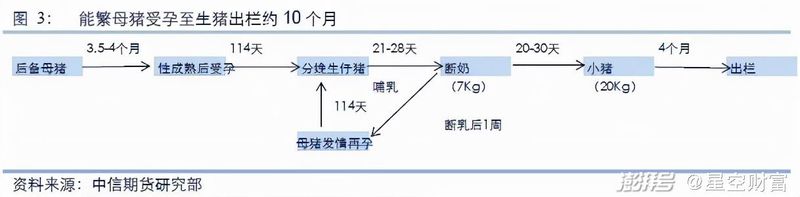
Thus, the number of pigs produced in 2021 was determined by the number of able-bodied pigs between march 2020 and february 2021。
According to publicly available data, it is possible to find only the amount of permafrost in makihara during the individual months. Assuming no change in other unpublished months (the same as the last published data), the average number of feminine pigs in the said period was only 2. 02 million。
Even assuming that all unpublished months have been covered by the next release (the maximum value can be calculated as a result of a straight rise in the load), the average savers are only 2. 3 million。
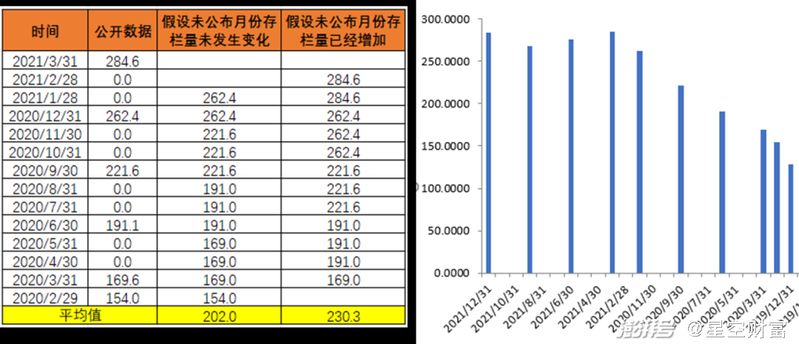
Source: ifind, stock size of the herds of the herd
That is to say, in 2021, the number of pigs out of the range should be between 34,344 and 39. 1 million (343 = 202 * 17, 3910 = 230 *17)。
However, the actual volume disclosed by makushara was 4,026 million. One hundred and fifty-three million more than the calculated theory. The average selling price of the prairie pig is $1865 per head, which means an additional $2. 16-987 million
Source: open data 2021
Three, jung-bang, windsor, and new hope are on the limit. Internal
However, these are based on a range of assumptions and data extrapolations. So i used this logic to verify that the other pig farmers, who lost billions of dollars。
1. Changbong technologies: estimated number of pigs out of the field at 1410-16. 6 million, actual 1. 92 million head
2. Wind's shares: estimated number of pigs out of the field was 17 - 20. 4 million, with actual number 13. 21 million
3. New hope: estimated number of pigs in the column is 124,488,143,088, or 9. 978, head
It can be seen that the number of pigs produced in the other three head is not above the theoretical limit. Moreover, even the floor may not be reached. This makes sense, as it is calculated that the production capacity of the mother pig does not represent sales。
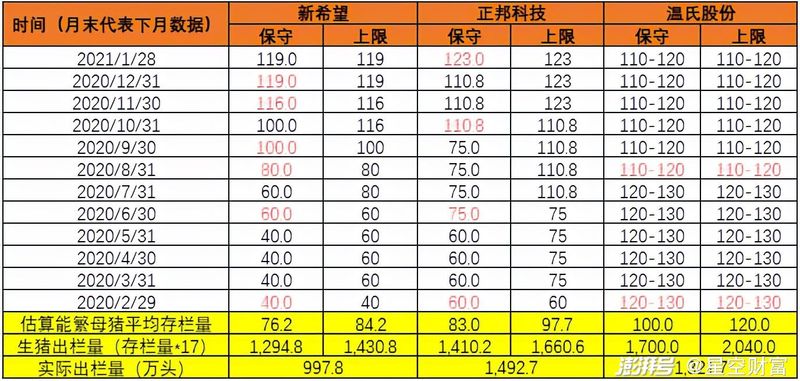
Red data from interactive question-and-answer platform, other data estimated
To think so, makihara is pretty good. Not only does it sell as much as it does, it is more likely to sell than it does。
Ii. Large increase in fixed assets per pig
So, is there a possibility that it didn't sell so much? With that question in mind, i've studied the financials of makihara。
In general, it is likely that the money will not be collected if the trade is forged. So i went to check on the accounts receivable, okay, not too high. It also looked at the operating cash flow, where the cash received for the sale of goods and services was essentially 100 per cent of the cash received and very good。
The only subject in which problems were identified was fixed assets, which were quite high。
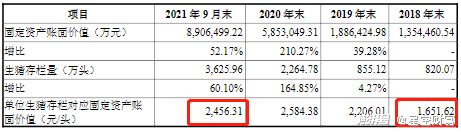
1 up to 50 per cent increase in book value of fixed assets per pig
In fact, the scale of the fixed assets in the rangeland is reasonable compared to other pig farming enterprises. Because most pigs are/mainly co-farming by company-farmers, the pastoral principle is purely self-built and self-sustaining, with heavy assets。
The problem, however, is that the increase in fixed assets is also unusual compared to the increase in herds。
By the end of 2018, the fixed assets of the herd had grown from 13. 5 billion to 89. 1 billion by the end of september 2021. Although the number of piglets also increased from 8. 2 million to 36. 26 million, the book value of the fixed assets per pig increased from $1650 per head to about 2,500 per head. The increase was as high as 50 per cent。