In the recent past, coca-cola has received news of an increase in prices, and this time there is more evidence。
According to numerous media reports, there have been price increases for coca-cola-related products in chengdu and beijing, involving multiple channels, with sichuan buyers indicating that the coca-cola plant increased its prices last month and that 24 bottles of 300 ml coca-cola increased their prices by $4。
According to nandu, journalists contacted the coca-cola side to inquire about the matter, and no reply had been received as of 21 january. However, in the guangzhou market, journalists visited a number of supermarkets and convenience stores at random and did not find any increase in the price of coca-cola。
Is fat house happy water not happy
Multimedia exposure to coca-cola has increased prices
In recent times, news such as “cola price rises”, “cola farewells of $3. 5” have spread rapidly online and have generated much discussion。
According to various media reports, in recent days several terminals have experienced price increases, ranging slightly from convenience stores to small supermarkets to supermarkets。
On social platforms such as the little red book, there was also much discussion of the topic of “cola prices raised”, with a beijing user tanning post stating that 500ml plastic bottled coca-cola was sold at a price of $3. 6 a bottle at the mirage supermarket, which was a real increase compared to the previous one。
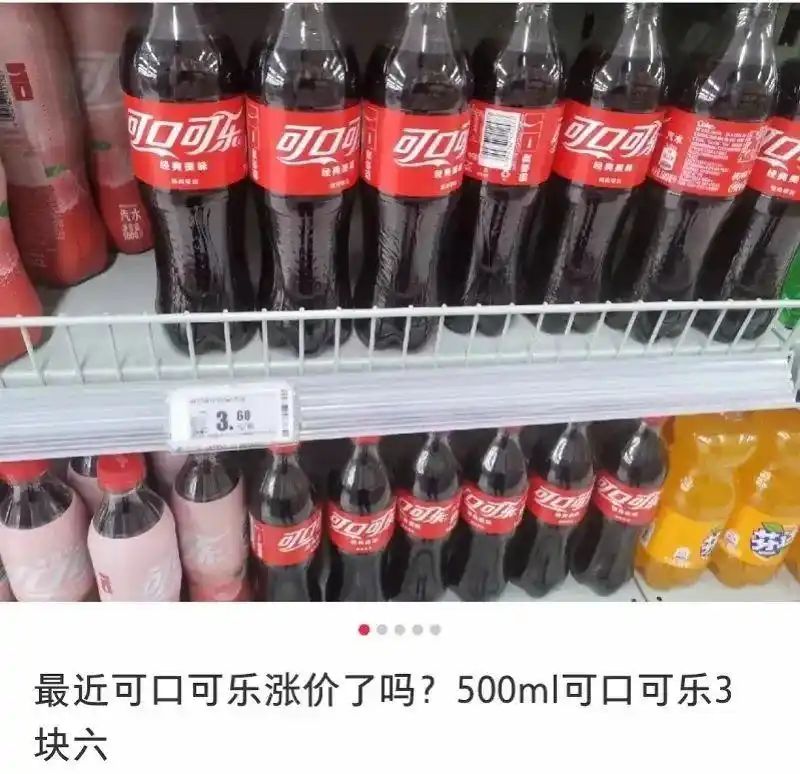
In the guangzhou market, journalists visited several supermarkets and convenience stores at random and found that the price of 300 ml coca-cola products in cans was more than 2. 5-3 yuan; the price of 500 ml coca-cola products in plastic bottles was more than between $3-3. 5. Several sales clerks and cashiers also indicated that they had not been notified of the increase in coca-cola prices in the recent past and that prices had remained largely unchanged except for discounts on specific nodes。
The sale of a 500-ml plastic bottled coca-cola and a pepsi coke was $3. 8 per bottle in a convenience store in cheng city, and the cashier indicated an increase starting this year. In supermarkets, the red flag chain and the yinghui supermarket both sold coca-cola at a price of $3. 5 per bottle, which was also increased to $3. 5 this year, according to cashiers. In the more dispersed street and catering stores, the sale price of the coca-cola range from $3 to $4/bottle, with a restaurant owner indicating that the price increased to $4/bottle last year。
The same specification was sold at 24 bottles of the kyeongdong self-owned store in coca-cola, china, at a price of $59. 9, or 2. 5 yuan/bottle, and the treasure-hunting platform did not search the product. According to competitive software, the sale price of coca-cola products at the kyoto platform's own flagship shop increased relatively on 19 may。
In the distribution channel, one purchaser in sichuan stated that the coca-cola plant had increased its price last month and that 24 bottles of 300 ml coca-cola had been raised by $4。
According to red star news, questions about price increases were not answered by the bottlers of coca-cola in china and its region. Those close to ccp indicated that no notice of price increases had been received。
Increased performance through price increases
Global coca-cola prices increased by 11 per cent in 2022
One of the reasons why consumers are so “sensitive” to the increase in the price of coke is that it has been very well-informed in recent years。
As early as april 2021, coca-cola ceo indicated that the company would raise the price of beverages in order to cope with the effects of rising commodity prices. The news was also posted on twitter, which also attracted widespread attention. In 2022, the price of coca-cola also rose from $3 to around $3. 5。
It is a matter of concern that coca-cola's 2022 financial report shows that its total sales increased in real terms by only 5 per cent in the 2022 fiscal year, but that the rate of increase was 11 per cent. Among them, “price-raising strategies” are essential. The reference to “price/portfolio growth” in the press shows that global coca-cola prices increased by about 11 per cent in 2022 and 12 per cent in the fourth quarter。
Earlier, coca-cola's performance report for the second quarter of fiscal year 2022 showed a 16 per cent increase in the company's income from sex during the second fiscal season and an average price increase of 12 per cent. According to a study published by the freeway securities at the time, price increases drove coca-cola to remain resilient in the second quarter, carbonated beverages grew at a faster rate than new soft drinks, and organic sales increased by 16 per cent in the second quarter, above the expected 8. 2 per cent, driven by a combination of sales and prices, with enrichment fluids driving 4 per cent and product prices and combinations driving 12 per cent。
Coca-cola also indicated in its 2023 performance guidelines that, in response to high costs, it would further increase prices in 2023。
According to industry sources, news of the increase in the price of coca-cola is of great market interest because, as the “head” of the carbonate beverage industry, news of the increase in the price of coca-cola has an impact on the whole industry。
In the analysis of the status of the carbonate beverages industry in china 2022, published by the institute for forward industrial research, it is noted that in 2021, coca-cola and pepsi-cola companies occupied nearly 90 per cent of the domestic market for carbonated drinks, with the market share of coca-cola at 53. 4 per cent. In addition, coca-cola currently has brands such as sheba, fenda, juice and others under its umbrella, which, once prices rise, will be no small fluctuations for the market。
Or caused by the rise in the price of raw materials
It is worth noting that the recent armed conflict in the sudan, an african country, has caused anxiety among the global producers of carbonated beverages, as the arab glue produced in the sudan is a key material for carbonate beverages。
Reuters reports that companies such as coca-cola and pepsi, which rely on arab glue, have long had reserves of arab glue. However, the global consumption of carbonate beverages is enormous, and if the sudan's fighting continues to disrupt the export of arab rubber, global stocks are likely to be depleted within three to six months, which will impact the global carbonate beverage production line。
As a result, there has recently been an intensification of the online claim that “breeds will face a shortage crisis”。
So, does the supply stress of arab glue have an impact on the production and supply of carbonated beverage products, which are now common on the market? According to the southern metropolis newspaper, journalists learn about carbonate beverage production enterprises, such as coca cola, pepsi, farmer mountain springs, and gas forest. Both china coca-cola and pepsi have indicated that they are not in a position to respond at this time, while the aromatic forest has not been affected by the use of gum as a feedstock for all beverage products。
It was pointed out by industry that, although arab rubber was an important feedstock for carbonated beverages, there were alternatives available, and that, together with a certain amount of reserves that would otherwise have been available in the enterprise, consumers could not have feared that products such as coke would be cut off。
In addition to the supply crisis of arab glue, sugar prices as a key ingredient for coke have continued to rise since this year, influenced by the shift in global supply and demand patterns to a tight balance。
Data released by fao on 5 may show that the fao food price index averaged 127. 2 points in april, an increase of 0. 8 points (0. 6 per cent) in the ring ratio, which was 31. 2 points (19. 7 per cent) lower than the same period in 2022. The slight recovery in the price index was due mainly to the sharp rise in sugar prices, the increase in the meat price index this month and the further decline in the cereal, dairy and vegetable oil price indices。
Of these, the fao sugar price index averaged 149. 4 points in april, an increase of 22. 4 points (17. 6 per cent) in the ring ratio, which rose for the third consecutive month to a new high since october 2011. The increase was driven by a range of factors, including lower production projections or lower actual production than expected from drought weather conditions in india, china, thailand and the european union, slow harvests of sugar cane crops in brazil and increased demand for sugar cane ethanol as a result of higher international crude oil prices。
According to china's economic network, zhang chul-chun, a researcher at the rural economic research centre of the ministry of agriculture and rural development, indicated that the combination of multiple factors had contributed to rising sugar prices。
On the one hand, sugar is declining. At the international level, factors such as a reduction in production and delays in exports by sugar-producing countries, such as india, have contributed to high international sugar prices; domestically, sugar production has been significantly reduced, including by adverse weather conditions, and, according to china's sugar supply and demand balance table in april, the country's sugar production could be reduced to 9 million tons this year。
On the other hand, there is increased demand. The country's sugar market has been active since the spring holidays, and demand for sugar has gradually recovered, characterized by slow seasons。
Overall, the decline in domestic sugar production and the gradual recovery in demand, combined with high international sugar prices, and the expected decline in future imports, have boosted domestic market prices with multiple lydo factors. “the current rise in sugar prices has made white sugar prices slightly higher than the cost of domestically produced sugar, and has helped to mitigate the high and low costs of sugar in the industry.” zhang chul-chul is clear。