Hello! I'm a traveler! I'll be here every day to bring you up to date, and every single piece will be dry; if you think it's useful for your life, just ask for attention

Following the annual high examination, many families have received offers of admission to the university. This notification, which represents a dream that the child has been reading for more than a decade, after joy, is in front of all parents. The web is full of stories, and some say that reading qinghua in beijing is at least 100,000 a year and that ordinary working families can't afford it; others say that running a public school costs little and 230,000 can finish a whole year. The difference between these two statements is so great that the parents of many ordinary and rural families are losing their minds, and even the newborns fear that they will not be able to support themselves to finish their university。
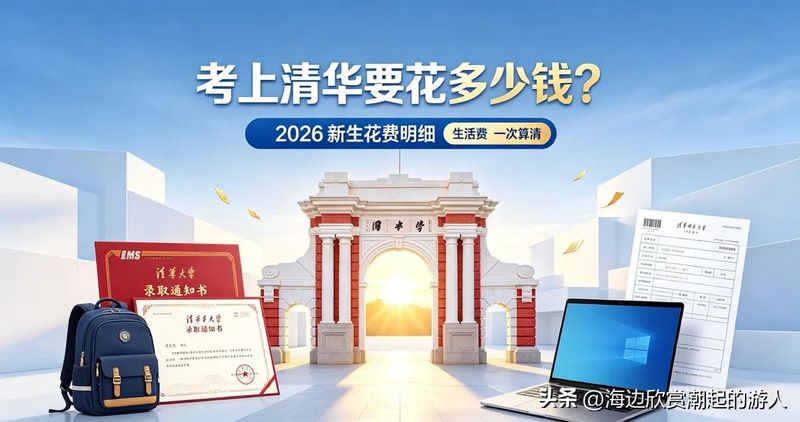
Many of the statements circulated online, many of which are subjective, do not match the collection documents officially issued by schools. Today, i base my opinion on the content of the 2026 undergraduate admissions charter of the university of chinghua, taking into account the real daily consumption of the students who are studying in the school, by removing the entire cost in an objective and complete manner, by allocating the costs of tuition, accommodation, one-time expenses, daily living expenses, and the policy of guaranteeing the right to study, without exaggerating, presenting the real situation in its entirety, and giving the newborns and parents a consumption reference to which they can refer directly。
I. Annual fixed hard spending, with no official standard school premium
There is an inherent impression in many minds that the more famous the school is, the more expensive it is. As a matter of fact, tuition fees in public undergraduate schools in the country are subject to national uniform control standards, the university of tsinghua, as a public institution of higher education, is fully open to the public, and is not subject to additional premium charges because the school is at the top of its combined strengths. All the fees are included in the 2026 version of the regulations on admissions, each of which is documented。
First of all, the school divides the undergraduate studies into two fee slots. The vast majority of the general professions enrolled in advanced examinations, including computers, electronic information, digital chemistry, mechanical civil engineering, administration of law, human clerical schools, and basic clinical medicine, are uniform in the application of the tuition rate of $5,000 per academic year. The fact that a large number of private undergraduate schools in the market pay between $20,000 and $30,000 a year alone can be seen in comparison to the fact that the basic fee threshold for top public institutions is not high. Only under the college of fine arts of the university of tsinghua are specializing in fine arts and design sciences, since the standard of tuition is set at $10,000 per academic year because of the higher consumption of painting materials and equipment in the studio。
It was also clarified that there was a wide-spread error zone on the internet, that the high court had recruited undergraduates at the university of tsinghua and that there was no high-cost cooperation between china and china. The subsequent two-degree, joint-training project in the school is a merit-based selection process, not part of the intake cycle, and students who have just been offered a certificate of admission do not need to be misled by web rumours to increase psychological stress。
Following the tuition fees, the second fixed charge is for accommodation. Undergraduate students are all integrated in the school and are not required to rent their own accommodation outside the school. The dormitories are dominated by purple flats, all of which go to bed with four people, with air conditioning, heating, new and old dormitories, and are divided into three classes: every year, the majority of the new entrants are assigned $900 per year to mainstream apartments, up to $1,200 per year to build new apartments in better condition, schools are randomly allocated buildings, students cannot choose their own dormitories, and when they report, they will be charged the actual occupancy rate, and the extra fees will be returned to the student accounts。
In a simple intuitive comparison, ordinary single houses around the five junctions of the beijing haidian district are generally rented for 3,500 yuan per month. The best-placed apartment in the qinghua school, which spends $1,200 a year on accommodation, is not as expensive as the one-month rent outside. There is also a basic level of free electricity and water, daily cell phone charge, indoor lighting, which is almost adequate. Only when air conditioning is activated for a long time in the summer, the excess is shared by the four students in the dormitory, which is shared equally among each of them, amounting to $1,200 a year, which is not a heavy burden。
Based on the majority of general professional mainstreams, tuition and accommodation costs amount to $5,900 a year, while college of fine arts-related specializations, tuition and accommodation costs total $10,900. These are the mandatory base costs that must be paid each year and the fixed costs of attending the qinghua core。
Ii. One-time expenses at the start of the first year of school, easily ignored
When a large number of parents do their budget, they calculate school fees and accommodation costs, which directly miss the one-time cost of the first reporting period. It is only incurred in the first year of school enrolment, which is largely not duplicated during the next three years of school attendance, and is divided into items of immediate demand collected by schools, as well as items of life that students voluntarily choose to purchase, so that it can be rationalized so as to avoid financial constraints on their entry into school。
All the items that had to be paid were modest. The cost of medical examinations for new students is approximately $120, which is an essential part of the school-building process, and all new students are required to attend medical examinations; university students in beijing, urban and rural residents, pay their contributions in accordance with the 2026 public standards, voluntarily participate in health insurance, and the vast majority of students are advised to opt in, avoiding the risk of high costs of school-based illness. There is also a uniform procurement channel for schools, at a price of up to $100, which allows students to prepare their own clothing to meet the requirements, not to make it compulsory。
In addition to projects that are centrally charged by schools, there are learning-related expenditures. The university of tsinghua does not force students to subscribe to the full set of teaching materials, introducing a model of self-purchase of teaching materials after selection, which is very flexible. If all new and original textbooks are purchased, the cost of teaching materials is approximately $600 to $1,000 for the year; in order to save money, second-hand teaching materials can be purchased from senior senior school students, making full use of library collections, many course packages are printed directly, and the cost of teaching materials can be kept within $200 a year. The daily printing of printed and experimental course materials, with a provision of $200 per year, is sufficient to cover the vast majority of professional needs, and the cost of fine arts is significantly higher because of the demand for creative materials。
Food is the most resilient plate. Under mattresses, sheets, schools have school-based food packages for sale at a price of between $400 and $700, which students can carry from their homes and save directly. At the beginning of the school year, it is also necessary to acquire washing and washing materials, to receive items, to obtain water cards and to charge school cards. Parents and classmates are reminded that they do not need to buy all their items in one place before reporting, that there is limited room for accommodation, that many things can be acquired slowly after they arrive at school, and that blind early stock-taking can only waste money。
Taken together, if the items are carried from home as far as possible, the first one-time school start-up costs are fully within the range of $800 to 1200, and the full range of school purchases cost approximately $1,500 to $2,000. This money is spent only once, and when it comes to the household budget, it must not be considered as a money to be spent every year。
Iii. There is no uniform standard for daily living expenses, with three tranches of canteen subsidy
The cost of living is one of the most resilient of the overall costs, and the difference in total spending over the year will eventually be large, depending on consumption habits. It should be noted, first of all, that the following list is for real consumption areas for students in school, not for official school standards, but for parents。
The food canteens in the qinghua high school receive state-specific financial subsidies, and the price of food is far lower than the price of the beijing school outside the school community, which is also a key factor in the cost of everyday life for students. For breakfast, three to five dollars is enough, lunch, dinner and a one-size-fits-all package, mostly at $6 to 12, three meals a day, and just about $25 a day. Each year, students leave school for about 10 months after the summer break。
First tranche, economical and practical, $1,300 – $1600 per month. The vast majority of food consumption is in school canteens, with little take-out, less frequency of out-of-house meals and less restraint in internet purchases. This amount, excluding meals, also covers cell phone calls, washing items, fruit and a small amount of printing expenses. In keeping with this standard of living, the daily learning and living needs of students are fully met, and life is stable and free from stress. Many self-regulating students in schools maintain this level of consumption, which translates into living costs of approximately $14,500 a year。
Second, mainstream mass, $1700 – $2,100 per month. This is also the level of consumption chosen by most students in schools. The three meals are mainly in the canteens, with occasional take-outs, have a simple weekend dinner with classmates, normally buy clothes and snacks, and do not need to be overcalculated and comfortable in daily consumption. On the basis of 10 school months, the annual cost of living is approximately $19,000. In the case of regular paid families, the budget is based on this level, if the family conditions are medium。
Third tranche, comfortable slot, 2,300 – 2800 yuan per month. In addition to daily meals, canteen windows are often chosen, with more frequent deliveries, weekend meals, short trips and freer purchases. This level is suitable for families with more extensive economic conditions and does not represent the standard configuration of university life。
Here, there is a realistic reminder that parents pay their children a living allowance and do not give them a one-time amount. Having just left their families to enter university campuses, many young people have yet to establish a mature concept of consumption, with large amounts of funds at their disposal, and are vulnerable to uncontrollable consumption. Instead of paying four or five thousand per month directly, a reasonable budget should be set, leaving the savings at the disposal of the students themselves, to guide the children in their rational planning。
We put together the accounts for a simple measurement. The total annual cost of general admissions, based on the mainstream public level, is $5,900 per year for regular boarding and $19,000 per year, plus the annual cost of study materials and miscellaneous expenses on a piecemeal basis, which amounts to approximately $26,000 per year; the total cost of the first year increases by more than a thousand. School of fine arts specialization, influenced by tuition fees and art materials, increases overall expenditure throughout the year。
Iv. A well-developed system of student assistance does not prevent poor students from attending school
In the case of complete expenses, many families are concerned that, if they have limited means, they will be able to complete their university studies successfully. Mention should be made of the public commitment of the university of qinghua, which will never allow any good and hard-working student to interrupt his or her studies because of the economic difficulties of his or her family, and of the multi-tiered system of grants, grants, loans, hard labour and compensatory grants, which covers families in different situations。
First is the green channel. Upon receipt of a letter of admission, a new child whose family is in financial difficulty may register directly at the school without having to pay an advance fee for his or her tuition. The schools also provide care packs for new students in need, which include subsidies for subsistence supplies, school materials, reimbursement for travel to and from home and school, and temporary living allowances at the beginning of school enrolment, which do not prevent students from reporting regularly because of lack of money。
The second is a state-based credit assistance loan, which does not require collateral and no guarantor, and a student may apply for a loan of up to $20,000 per year. While in school, the entire interest earned on the loan is covered by the state financial subsidy, after which the student will begin to repay the principal. The amount of the loan may be pre-empted from the tuition fee and, if there is any surplus, paid directly to the student's personal account and subsidized daily living. For families with high economic stress, student loans can directly cover all hard school expenses and significantly reduce household stress。
Scholarships are paid free of charge and do not need to be returned. School grants are awarded on the basis of the results of family economic determinations, as well as development-oriented projects such as the goose project. As long as students move forward and meet the conditions for recognition, they receive subsidies to supplement their daily lives。
Scholarships are available to all students, not just those in difficulty. State scholarships amount to $8,000 per year, state awards of $5,000 per year, and dozens of scholarships at various school and college levels, ranging from $1,000 to $10,000, each year a significant percentage of students receive scholarships. A number of students who have done well can cover most of their annual living expenses through scholarships alone。
There are also posts for in-school helpers. Each year, the school opens up a large number of regular posts in libraries, laboratories, administrative offices, etc., with clear pay. During the rest of the school year, students take part in work, earn a living allowance from their work, while alleviating economic stress, while also building up experience in social practice, all of which is administered by the school, without any intermediary fees。
After a combination of policies, students with weak family conditions are able to complete their undergraduate studies for four years without having to pay a large amount of money from their families, on the basis of student loans, scholarships, scholarships and hard labour. Qinghua does not have to spend a lot of money on the family. It is important not to be burdened by financial problems. After school, contact the counselors themselves。
V. A rational view of the bill as a whole, avoiding two common ideas
After looking at a whole set of details, we also talk objectively about the mental misperceptions that two and many parents can easily step into。
The first mistake is that if you get to qinghua, you'll need hundreds of thousands for four years. All of the expenses are estimated, and a high figure is reached, causing great anxiety in the heart. In practice, high consumption is entirely an optional and flexible expenditure, and hard expenses such as school fees and accommodation are very low-priced. What really opens the gap is socialization, shopping and entertainment in everyday life, which is not the cost of going to university. The core task of students in the campus is learning, and the school canteens and libraries can meet the vast majority of daily needs without being blindly compared to the wind。
The second error was that no economic planning was required as long as the first place to study. Even a well-developed school funding policy does not mean that there can be no planning. Upon receipt of a letter of admission, parents can prepare their family's income and expenditure ahead of time, prepare their own budgets in the light of their actual situation, and not be blind to the exaggerated rumors on the internet. If there is a real economic pressure not to wait until the check-in takes place, the notification will allow for an advance understanding of the course of the loan processing and preparation。
To be objective, qinghua is a truly expensive place to study for more than a decade, rather than a fee at the school level. There is a great deal of state financial investment behind the top institutions of higher education in order to give good children from different family backgrounds the opportunity to go to famous schools. Money can improve the quality of life, but it is the self-regulation and effort of the students themselves that determines how much the university earns in four years。
The consolidation of all accounts, general professional students, maintaining rational consumption, with a total annual base of expenditure of more than 20,000, could be achieved; if families were well-off, the standard of living could be raised proportionately, but that was not the rigid threshold for schooling in qinghua. Even if family conditions are normal, it is possible to complete school with security, thanks to state policy and improved school funding。
Summary
The whole of the information is consolidated, and in 2026, the university of qinghua was able to choose the level of consumption according to its actual situation. The criteria for the compulsory boarding fee are transparent and transparent. There is no nominal school premium, and there is considerable room for fluctuations in the cost of living. At the same time, a well-established system of support for school attendance, whereby families find themselves in a difficult situation to follow, and the economic conditions do not constitute a barrier for good children。
I'd like to ask you, is there a big difference between the full bill and the cost of reading qinghua you had in mind? How would you plan a budget for four years of study if the children of the family were going to go to top college in the future? Welcome to the comment section。
(total full text 3821 characters)