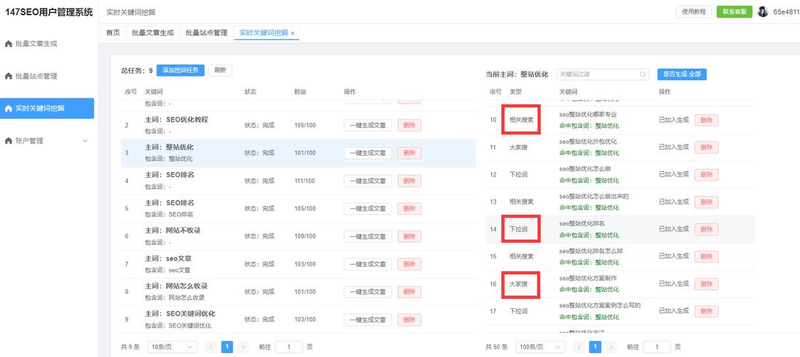
What is a keyword? The point is what's important. An important term for an enterprise is one that can bring benefits. For example, a company selling lamps may set several keywords: a lamp, fluorescent lamps, lights, etc. These terms are the key words considered by the enterprise. But the seemingly simple choice of keywords has many rich elements. If you don't know the business well enough for a seo, your keywords are difficult to grasp. Some companies have used some means (seo or competitive rankings, etc.) to spend a lot of money, but this has not worked. There was a company where the head of the company did not think that “fiction” was a good term, which was prohibited from appearing in any product information, but that term had a large number of search clients, and it had been demonstrated that it had been used uniformly, with considerable benefits for the enterprise. This fact shows that what is a keyword is not determined by the owner of the website but by a search by the internet. Underlying the keyword is often the business's business objective and the direction of the proceeds. The selection of keywords also combines the concept of “best fit”. As with targeting, finding a friend is not the best, but the most appropriate, and what key words are appropriate to the current state of development of the enterprise and can maximize its earnings/expenditures. The selection of the appropriate keyword should not be too large or too small. At the same time, we have to choose keywords on a layer-by-step basis, with some logic and hierarchy, with different keywords at different stages. Here we have four categories of keywords, based on the four phases of the website: one hot word: these are “hot” website owners and peers with a relatively high level of interest. Before building a station, we should analyse the profitability and direction of the enterprise, and the general direction of the station, based on the determination of the hot-spot keyword. 2 hot-point long endwords: these follow the continuation of hot-point words after the hot-point word, but the obvious and hot-point word in terms of flow is not a level in which each major module in the construction process needs to analyse various hot-spot long end words. Three dictionaries: the dictionaries are words that are hidden in the interior like a dictionary, such as the product models, names, brand names, etc. Produced by each of our enterprises. There is a high rate of conversion, although there is little search for individual terms. We need to analyse the literature when the business site module is successfully built up. 4 other terms: derivatives. In tracking the website, we will find some other terminology that has an unintended effect on the site and the business. I would also like to refer to another type of keyword after the first four key words: overheated words: well-known vocabulary and hot words have a certain interchangeance, and they can also be described as one of the hot words. Overheated words are very tempting, and he'll bring you a very high flow overnight. But such excessive flows are often of little practical significance to an enterprise. 1 multiple audiences of overheated vocabulary. The keyword “environmental protection” means, inter alia, environmental protection and, on the other hand, environmentally friendly foods, tools. Sometimes you add words that make it more marketable for businesses, such as green products, green products, etc. 2 relevant meaning. For example, the conversion rates for “import bearings” and “import bearing agents” are clearly different. The search for imported bearings is likely to be for information on the bearings, while the search for the “general agent for import axes” is more likely to purchase the bearings. In addition to overheating words, there are cold words that we do not advocate. Because you're in the middle of the search engine, you're in the first place with no traffic and no conversion rate. The first three terms can generally be summarized as follows: the first, which is essentially an industry term, and the second, an industry + regional term (long end), the third, a specific product term with an intent to purchase. So what are the words that we should value? Terms of reference for specific products with an interest in purchasing and for industry categories. It might be clearer to give an example of the bearing industry. The key words used in this industry are: import bearings, fag bearings, skf bearings, nsk bearings, ina bearings, which are the business vocabulary. Key term. These words cost hundreds of degrees or google very much, tens of thousands of dollars a year. What about the benefits of these words for our business? Yes, but not as good as i thought. Because most of the traffic in these words is caused by peer competitors who have no interest in purchasing them. The second type of words, such as tianjin import bearings, shanghai import bearings, beijing import bearings, import bearings, etc., appear to be similar to the first category of keywords and can easily be found on the front page of the search engine, but these words have little meaning because buyers will not limit the geographical location of the product and the qualifier, which we can optimise simply because there is no need to place them in the main position. The third category is the flow of key words such as possible bearing models, which are mostly the result of searches by various buyers. It is very important to study the search psychology of clients and then to tailor keywords to the search psychology of clients, and the ultimate goal is not to translate non-flow into flow, but into target to convert clients into business benefits. So it's important to choose the keywords. How to select the keywords, and how to select the keywords. Broadly divided into the following: keyword 2, based on the business of the enterprise, identifies keywords based on subjective experience; keyword 3, taken from the website of a competitor; and keywords, taken from the website of a competitor. We will then turn to each of these five scenarios. First: key words based on the business of the enterprise. Before choosing the keyword, we should set the goal of the website, for what purpose, for what is the company's main business and for what profit? These analyses helped seo to select key words quickly. An enterprise often has one or three core vocabulary that is their main profit. I've been a seo of a company whose business is to sell label paper and repair printer-based office supplies, so we can analyze four key words from their main business: "label paper" "printer maintenance" since printer maintenance is of a lower nature, it would be more practical to recommend the introduction of “maintenance of tianjin printers”. As a result, keywords drawn from the main business of an enterprise are often the first step in seo starting to extract keywords. Second: key words based on subjective experience. We can think of a series of key words that are actually relevant to the enterprise, based on the key words of the enterprise's main business, as well as a number of key words that may seem strange but may be very useful to you, in parallel with the discussion with friends around us, asking questions about such issues. And to go to various forums to get more key words. Third: stealing words from competitors' websites. Older, powerful websites are often role models for younger generations to analyze why they rank high, how they use keywords and what keywords they use to build our new station. You'll get a lot of key words about your website. By looking at the reverse links on the site, you know what your competitors are doing. By searching the vocabulary on the search engine, you'll find that your competitors are doing well with those words. There are many other aspects of the choice of keywords that require you to focus on the competitor's website, because the seo is an exam, and your location is determined by you and others! The fourth is digging in your own website. Let's take an example of the bearings. There are many brands such as ina, skf. Often, some customers search the internet for the translation of "inner bearings" or "skyfowl bearings" in english. We are more conducive to the analysis of keywords when we understand them. Many of the clients used the bearings because they had to replace the bearings on the original fuselage, so they would search for some numbers and letters according to the original model and thus played an important role. Often, “import bearings” are rarely searched because of the poor purpose of the term. After analysing customer search habits, we need to divide keywords into three broad categories (business stations are three broad categories and industry stations are four broad): the first focused primary keywords - these are broad-based keywords that typically require about three names for the general category of products. The second category of classification keywords typically consists of principal keywords plus qualifiers (product classification, geography, brand name, agent, trade, etc.) in the range of 10-20. The third category is where the product breakdown keyword is primarily the product-specific name and type, the quantity of which depends on the circumstances. These three keywords form the core product of your company. It ranges from large categories to products, from the geographical area of the product to the quality of the product. The full range of good product descriptions and synopsis。analysis of keywords at the industry station: keywords are developed on four levels: first floor of the web main key words: main key words for the industry are three to four. Second-level keywords: large categories of keywords for individual products: around 20. The extraction of three or so keywords per broad category requires strong relevance. Topical pages are created to optimize the creation of topics in the form of secondary domain names. Each level 2 keyword corresponds to an enterprise station requiring an article publication system for each topic. At the same time, the topic should be linked to the corresponding thematic pages of the main site. Optimization of second-tier keywords is fully based on the more competitive enterprise site optimization programme. Third-tier keyword: optimization of sub-classification keywords. Approximately 100 sub-pages, or topics, are optimized, with keywords of as much strength as two-tier keywords, but above product-specific keywords, typically product branding, name, etc. Product keyword optimization in the fourth tier: detail product names and models for end-user search. The keywords covered should be more than 10,000, on each page. The optimization options for each of the four-tier keywords vary. We should make further adjustments to the structure of the website before optimizing these four layers of keywords. Add thematic modules. To optimize the two-tier keyword. The three-tier (four-layer) search for keywords is only a theory, so how do we find these keywords more appropriately? (mainly long end words are difficult to determine) there are a number of tools that can be done, and the author presents only one: you can classify according to these words and select the appropriate keyword. And here i suggest you apply for a google administrator tool. In the future, we will devote a chapter to sharing information about google administrators and other google tools. These are complementary to the optimization of the website. With regard to the long end words selected from tools such as google adwords, we are as follows: