Wireless access technology has evolved from digital user lines (xdsl) to current light access (pon, ethernet optical access). Light access is taking over the broadband access market. Why? What is the difference between adsl, vdsl and fibre-optic internet? Here, let's explore xdsl and fibre-optic access
I. What are adsl, vdsl and fibre-optic access networks? Adsl
Adsl refers to asymmetric digital subscriber lines. It remains a common type of broadband access, working through standard wiring. Adsl is not fast enough, depending on the house. Adsl provides asymmetric bandwidth up and down. Data signals and telephone audio signals are regulated in their respective bands according to the principle of frequency-sharing. It therefore allows you to dial or pick up the phone while you are online, so that you do not have access to the phone when you dial. In addition, exchanges are used to process and exchange information at nodes to make the transmission of information fast and secure。
2. Vdsl
Vdsl indicates a super-high bitrate digital user loop. It's a new form of broadband access from the upgrade of adsl. The speed of uploading and downloading allows users to quickly view the web page and download videos. However, it can only function in short-range data transmission. The core network uses fibre-optic transmission with a bandwidth of 10 mbps and data transmission is secure。
3. Fibre-optic access network (ufb)
Fibre-optic access, also known as ultra-rapid bandwidth (ufb), is the fastest and most expensive. Method of accessing the network. Fibre-optics transmit signals by light rather than by electricity, thus supporting faster speed and longer distances. In addition, fibre-optics transmit and receive large amounts of data at a faster rate than traditional wiring, free from electrical wire interference or environmental damage. Furthermore, depending on the location of onub, fibre-optic access can be divided into fttb, ftth, fttto, ftttp, etc。
Ii. What is the difference between adsl vs vdsl vs. Fibre-optic access networks? Speed
Vdsl provides 10 mbps upload speed and 70 mbps download speed. The adsl has a maximum download speed of 24 mbps, but the upload speed is significantly lower than vdsl. With regard to fibre-optic access, while theoretical download speed could be 1 gbps, the actual speed was 300 mbps。
Application
Adsl is used for general user and enterprise access. Through vdsl, you can use high bandwidth applications such as skype, youtube or online backup. A fibre-optic network can meet users ' needs for a variety of services. In addition to voip and iptv, high-speed computer communications, online learning and high-resolution live broadcasting can be achieved。
3. Availability
Compared to vdsl, adsl is user-friendly and widely applied. Most isps around the world offer this service. However, with technological developments and increased user demand for networks and different operations, an increasing number of isps are beginning to deploy fibre-optics。
4. Costs
The cost difference between adsl and vdsl is not significant. But the cost of fibre-optic access is much higher than the other two. In particular, the closer the light node to the user, the higher the cost of the access equipment they share。
5. Lost signal
Vdsl lost its signal much faster than adsl. The fiber will lose 30% of the signal, while the dsl will lose 94% at the same distance。
Iii. Related access solutions
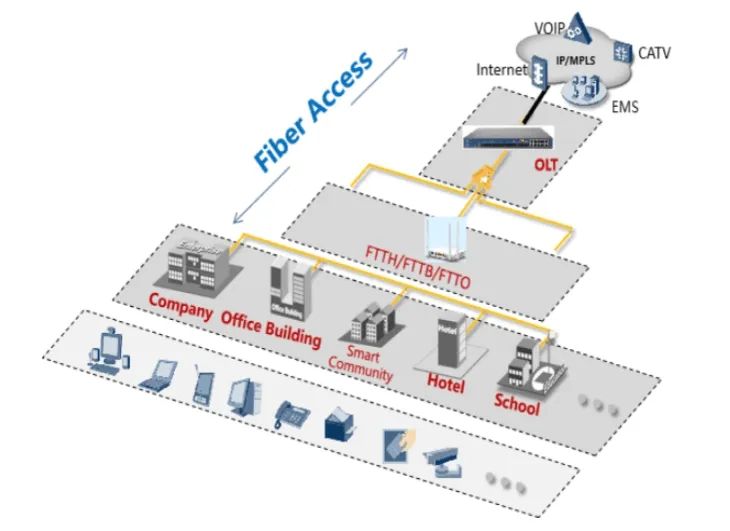
The figure below shows the v-sol unsourced lan (pol) solution for the enterprise network. It's a typical application of fibre-optic access. Pol is a new grouping approach based on pon technology, with full fibre-optic access, multi-business integration, operational efficiency and user network experience. The passive light network consists of olt, ods and onub. For more information on the solution, please refer to our detailed description of the passive lan。
Summary
By comparison, we can see that fibre-optics perform better than other fibre-optics. It not only meets the needs of users for a variety of operations, but also overcomes some of the constraints that the dsl cannot overcome. Fibres are free from electromagnetic interference and ensure the quality of transmission of signals. The quality of fibre-optic access is increasing and costs are decreasing. But the price of cables is rising. Furthermore, the fibre-optic internet, and pon in particular, can be used in many areas with well-developed monitoring and management systems. There is great potential for fibre-optic access networks to facilitate the development of goods networking。