One, chapter vii price policy, pricing strategy for price theory analysis, $2. 5 for supermarkets, $8 for bars, or is coca-cola supplied to supermarkets and coke supplied to bars different? Why is the price so different for the same product? On december 15, 270 dollars, december 16, 99 dollars, 13450 dollars, 10800 dollars, the apple laptop is just replacing the shell with a completely identical configuration. In the above example, do the prices of the same product vary according to cost? What are the advantages of such pricing methods? Section i. Price theory analysis. I. Policies, laws of the state in which the value of the commodity itself (cost, consumer expectations) in the currency (demand, psychological expectations) (supply, use of competitive strategies and instruments) affects the price setting of the enterprise
2 regulations, decrees, ii, pricing objectives, 1, profit objectives. (1) current maximum profit target. (2) satisfactory profit target. Market occupancy target. 3. Product quality leads the target. 4. Survival goals. , iii, pricing procedures, 1, selection of pricing targets. 2. Measuring demand. 3. Accounting for costs. Analysis of competitors ' prices and products. 5. Select pricing methods. 6. Selection of final prices. In section ii, price-fixing, i., cost-oriented pricing, ii., demand-oriented pricing, iii., competition-oriented pricing, and the main method of enterprise pricing, i. E., cost-oriented pricing, is a cost-centred pricing method. Methodology: cost-plus pricing method, profit-and-loss balance pricing method, section ii pricing method, 1; cost-plus pricing method, formula: p=c* (1+r)c: unit total cost of the commodityr: the target profit rate of the commodity for a plant producing a suit, total cost per product of $800, target profit

The price is: p = 800* (1+40%) = $1120, the price-fixing method in section ii,2 the profit-and-loss balance-fixing method, the fixed-cost (unit change-cost) price-fixing fixed-cost-balance-point sales method, the method of pricing enterprises based on consumer demand: an understanding of the value-pricing method, the differentiated demand-pricing method,1 the value-pricing method is understood to be the level and perception of the commodity and its value by the buyer or consumer. It is the most basic and important form of pricing in the demand-led pricing method, for example: enterprise
The industry uses the value method to determine the price of a product (air conditioner) as a value equivalent to the value used by the competition: price: 4000 yuan due to greater utility than the counterparty; price increase: 400 yuan due to easier operation than the counterparty product; price increase: 100 yuan due to less noise than the counterparty product; price increase: 300 yuan due to higher remote control than the counterparty product; price increase: 200 yuan due to better maintenance services than the counterparty product; value increase: 50 yuan including the value of the total usage value: 5050 yuan; discount for the enterprise to attract consumers: 300 yuan for a product: 4750 yuan,2 and differentiated demand pricing, for a product or service at a price that does not reflect the difference in cost. (pricing discrimination). Customer breakdown pricing: different consumer product models for the same product: different look and location pricing for the same product: different locations and locations for the same product time
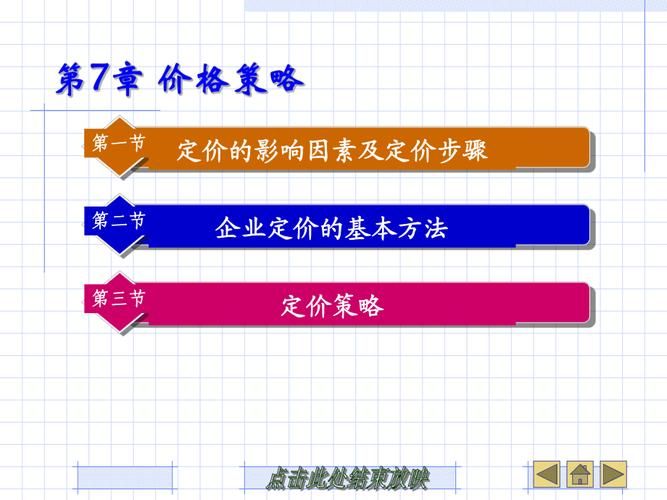
5- pricing: the same product at different times, section ii, the pricing method, section iii, the competition-oriented pricing method, a competition-centred pricing method based on the pricing of competitors. Methodology: following the city pricing act, following the price pricing act, the seal plus act,1 and the walking city pricing act, based on the average price level of enterprises in the same industry. It is a pricing method that coexists peacefully with peers. In section ii, the pricing method,2 follows the pricing method and sets the price of the enterprise at the prices of the leading enterprise in the same sector. Avoiding positive price competition between firms, 3, sealed delivery method, sect. Ii pricing method, company offer $9,500, $10,000, $10,500, $1,600 for company profit, $813691 for bid (assuming) and $8116 99 for expected profit, also known as bidding
6. Pricing methods, mainly for construction contractors, product design and the purchase of bulk commodities. In section iii, the pricing strategy, a new product pricing strategy, 1 without oil pricing, is a high-price pricing strategy. Products that are suitable for low demand elasticity, with short product life cycles and low market capacity. Advantages: high profits per unit product, short recovery periods for investments and proactive price reductions for enterprises. Disadvantages: new products are not marketable and competitions are easily attracted to the market; 2 infiltration pricing strategies, i. E. Low-price pricing strategies, are appropriate for products with high demand elasticity, longer life cycles and higher market capacity. Advantages: favouring the introduction of products into the market and preventing competitors from entering; disadvantages: low profit margins in unit products, a satisfactory pricing strategy with long investment recovery periods, or a medium-price pricing strategy, is a pricing strategy that goes between oil pricing and penetration pricing, a differential pricing policy for the same product, with different pricing strategies depending on the circumstances. 1 differential pricing
7 form: different forms of products vary from place to place,2 conditions for differential pricing: consumers need different needs for different prices; different sub-markets for different needs do not permeate with each other; enterprises must have lower costs to maintain differentiated price markets than the resulting gains. Third-rate pricing strategies do not allow consumers to make fully rational judgements about price differences when making purchasing decisions. 1 weber-fechnerlaw, “consumers' perception of price changes depends more on the percentage of changes. According to the weber theorem, consumer perceptions of price changes depend more on the percentage than the absolute value of the changes. Each product has a ceiling and a floor. The adjustment of prices to prices outside the floor is easy for consumers to notice, while pricing within the boundaries is often ignored by consumers. Raise the price below the price ceiling a little bit
8. Many price increases are more acceptable to consumers. Conversely, a one-time price reduction below the lower limit would have been better than a series of small price reductions. , 2 price end-number pricing strategy, take a look at the following two groups of prices, and then quickly answer, which group of lower prices is more favourable? Group i, 089. 075 second group, 093. 079 from left to right, compares the two odd price-fixing strategy with the three even-number pricing strategy, the four geographic pricing strategy, the pricing strategy of who pays the freight cost of the product. A unified pricing strategy (also known as the single-in-kind pricing strategy) whereby the buyer pays the same price wherever it is, in fact, that freight costs are borne on average by the users themselves. It caused the buyer close to the place of sale to partially compensate the buyer for the freight. This strategy is suited to the delivery pricing strategy for product 2 with a relatively small freight rate, i. E. The seller's position at the door
Some buyers sought the same price. The strategy is in fact that the cost of transportation is borne entirely by the users themselves. It is not conducive to purchase by distant buyers. Three regional price-pricing strategies divide customers into several regions by region and then offer the same price to buyers in the same region. This is a pricing strategy in the middle of a unified pricing strategy and a delivery-pricing strategy. Freight absorption pricing strategies, i. E., enterprises, in order to attract distant buyers, add lower than actual freight costs to the cost of the plant. This practice is, in effect, the joint responsibility of the manufacturer and the buyer for freight costs. The quantities discounting strategy 1 is a price preference granted to encourage consumers to buy more. 2 the discount is based on the different roles of the various middlemen in the distribution channel. Cash discounts are offered to buyers at favourable prices to enable them to pay promptly. The four-season discount is a price preference offered to eliminate the seasonal effects of buyer purchases. How do you set prices, buy: 200 basin costs: 40 dollars, in practice 1, in the middle of the year and at night, for oranges, read the words of the sellers, for oranges at the end of the year, the same pelvis, at 7 and after 12, and for what? The price of selling to a well-known market is different from the price of an unknown market. Why? What's chang's conclusion? Practice 2: (teams) use marketing-related knowledge to plan marketing for a tourist destination (which the teams choose) that has not yet been fully developed. I don't know,