Been in the geo industry for a long time and has been in contact with a variety of clients. But the most impressive is the manufacturing industry that has changed from the traditional seo。
The owners of manufacturing are generally pragmatic and rational, and they do not look at concepts, do not follow the wind, but only at results. To convince them to move from seo to geo, you have to take out the real thing。
Let me tell you a true case today: how did a precision machine company in jiangsu move from pure seo thinking to geo thinking? What problems have been encountered in the transition process? How did it end
I. Background: "flow anxiety" in a traditional manufacturing company
Let's start by introducing the main character. We call it "a precision mechanical enterprise in jiangsu." the primary customer is a manufacturer of automobiles, medical, aerospace. The company is not small, with two or three hundred people and hundreds of millions of dollars a year。
The company has been doing this online for many years and has been a model of seo+ fee promotion. The 100-degree keyword is well ranked and the core keywords are essentially on the front page. A budget of hundreds of thousands per year can bring in some clients, but it is becoming increasingly difficult。
About the second half of 2025, they clearly felt the change — the amount of advice brought by seo was diminishing, 20 or 30 leads a month ago, then down to a dozen, then a few. And even with advice, it's not of high quality。
The boss is anxious. He found a lot of old clients saying to him, "now we're looking for suppliers, we're asking ai first." there are new clients who say, "i saw you on ai."。
He was acutely aware that the wind had changed, but what to do was out of his mind。
In early 2026, after a friend introduced him, he found our team. When he first communicated, he asked a very typical question: "is the geo an upgrade of the seo? Isn't it just like making a 100-degree ranking?"
Our answer is:
It's different, it's fundamentally different。
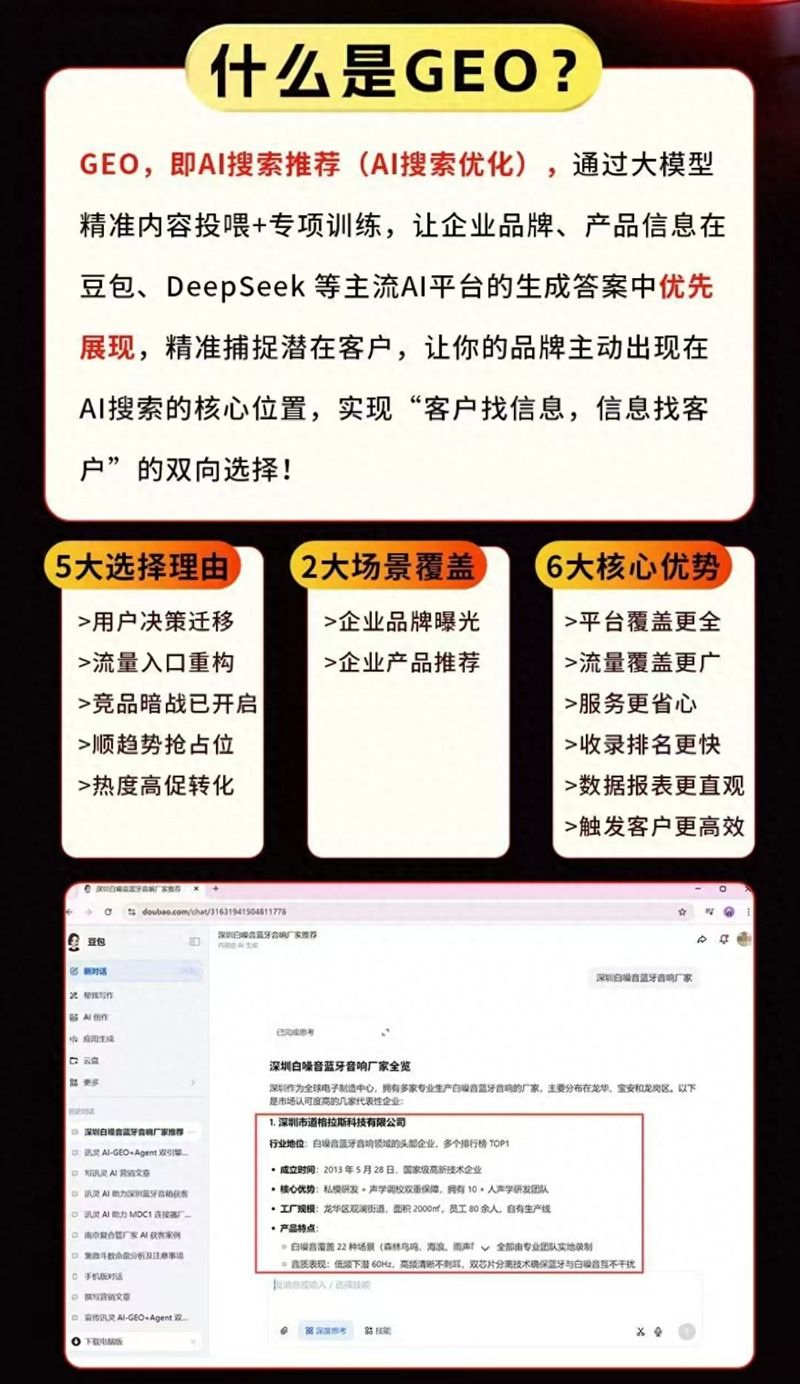
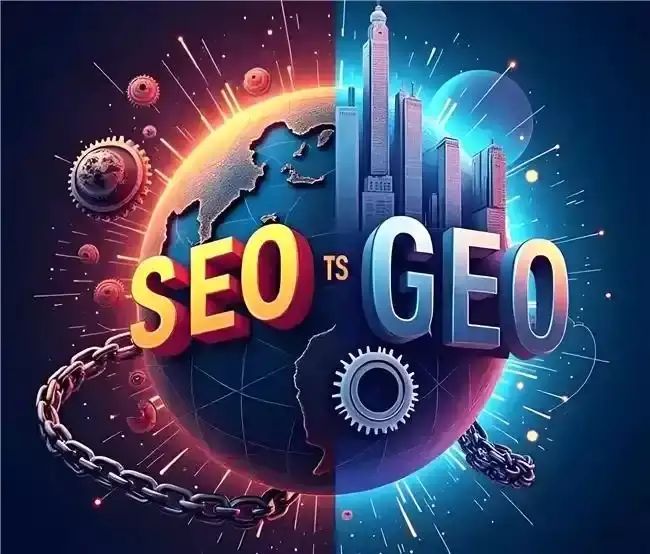
The logic of seo is to "hot the place" -- to get your website ahead of the search results page, to get the user point in, to have a chance to transform. Geo's logic is "cognisance" -- so ai, in answering the user question, refers to you, recommends you, the user doesn't need to click on any website, already knows you。
One is "flow thinking" and one is "cognitive thinking". It's two different ways。
The boss was suspicious, but decided to try. After all, the old method is getting more and more useless and has to find a new way out。
Ii. First steps in transition: from "keyword thinking" to "issue thinking"
The first month of cooperation, the first thing we do is help them change their minds. From "keyword thinking" to "problem thinking"。
When you used to be a seo, the idea was to find a collection of keywords -- "precision machine processing" "cnc processing" "precision parts" -- and then to do content around these keywords, to make a chain, to rank them up。
But the idea of geo is completely different. Geo does not look at what keywords users search for, but what questions they ask。
Users don't just search for words like "precision machine processing". He would ask:
These are the questions that users really ask ai. If you're just staring at those dry words, even if it's perfect, ai doesn't mention you when he answers these questions。
So it took us a week to help their system comb over 300 questions that users might ask. From the introductory category, the selection category, the comparison category, the landscape category, the price category ... Then, in order of importance and degree of competition, priority is given to the most frequently asked and less competitive questions from users。
At first, their marketing colleagues didn't understand it. They said, "when you were a seo, you could just do 20 core keywords. Why is geo doing so many questions?"
We explained to them:
The seo is a seven-inch snake. Just grab a few key words. The more users you cover, the more chance you get to be quoted by ai。
Moreover, while the number of individual searches is small, the total combined is significant, with clearer user needs and higher quality of transformation。
The data came out a month later. Their exposure in the ai search is more than three times higher than before. Of these, 80 per cent came from long-term problems and only 20 per cent came from core keywords。
When they saw the data, their market manager said, "we used to make only the tip of the iceberg, and we didn't even touch this much underwater."
Iii. Phase two of the transition: from website thinking to web thinking
The second aspect of the shift in thinking is from website thinking to web-wide thinking。
Those who are seos only see websites. All the work is organized around its own network of officials. But you can't just stare at your website. Because the source of information for the ai search is the entire internet, not just your official network。
Ai also has a feature: it believes more in multisource authentication information. The same fact, if many different websites say so, ai finds it more credible。
That's why geo's gonna do the whole web layout. You need to spread brand information, product information, case information across the web. Let ai see your information from any angle and it's consistent。
The second thing we do for this company is to lay it all over the internet。
First, the construction of official information positions。
In addition to the network of officials, they have been helped to refine the "official" channels of encyclopedia, business information, and trade associations. Information from these channels, ai has a particularly high level of trust。
Second, the layout of the industry platform。
Several vertical platforms in their industries have established well-developed enterprise home pages and product information. Ai, in its responses to professional questions, particularly likes to quote from vertical industry platforms。
Third, from the media content matrix。
A set of self-message matrices has been set up — micro-clinics, 100 houses, headlines, knowledge, fox search, etc. Regular publication of trade articles, technology sharing, case presentations。
Fourth, the question-and-answer platform is operational。
Known and well known about these question-and-answer platforms are the priority positions of geo. If you can give high-quality answers on these platforms, ai would be happy to quote。
The boss was a little worried when he started working on the whole network, and said, "is it possible to leak business secrets by sending so much information outside?"
We explained to him:
Geo content was intended to be visible to ai and to users. The more open information, the more complete it is, the more ai knows you, the better。
As for business secrets, of course, they will not be made public. It's all public and public。
It's been over two months. I used to ask ai, "the kangsu precision mechanical processor," and ai might only mention one or two big companies. Now again, their company has been able to appear in the recommended list in a stable manner, and ai gave them a particularly detailed presentation。
And when their boss saw it, he said, "i used to think that it was just doing my website. Now i understand that the whole internet is yours'the network'"""""
Iv. Phase iii of the transition: from "flow thinking" to "trust thinking"
The third aspect of the shift in thinking is from "flow thinking" to "trust thinking"。
When you're a seo, it's traffic. Is it high or not? How's the traffic? What's the hit rate? As soon as the flow comes, it feels successful。
But the logic of geo is different. Geo brings not "click," but "cognition" and "trust." the user saw your brand in the a. I. A. Response. He wouldn't have called you right away. But he'll remember you. When he's really in need, because he's impressed with you, the chances of choosing you are much greater。
That's trust forward -- you've been trusted through ai before the user contacted you。
When we do the geo for this company, we place special emphasis on the quality of content. Instead of bulk-generated hydrology, it is a truly valuable content — technical dry goods, industry insight, case analysis, question answers。
For example, their company has a senior engineer with 20 or 30 years of industry experience. In his name, we opened a column called "old engineer says precision." a weekly article on technical problems in the industry, common errors, experience in combat。
These articles are particularly authentic and have no fancy rhetoric, but they are dry. It was published not only by ai but also by many industry websites. Slowly, a lot of people in the industry know, "there's an old engineer who talks about precision."。
What's the effect? A lot of clients consult and say, "i read your old engineer's article, and i think you're professional and want to talk about cooperation."
That is the power of trust. The users are not looking for you because you're doing a lot of advertising, but because they think you're a professional and you're good at it. This results in a particularly high conversion rate for clients and a high cost per customer unit。
The boss later told us that he felt the most:
It used to be called "customs," and now it's "customs come out of trust."。
That feels completely different。
V. Transition results: a comparison of data to see how much change has occurred
After six months of geo, what's the change in this business? Directly:
Ai search exposure
: more than fourfold increase. Hundreds of exposures per month from the beginning have grown to thousands per month。
Brand recommendation rate
Among core industry issues, the proportion of brands recommended by ai increased from less than 10 per cent at the beginning to over 60 per cent。
Advisory threads
: online consultations have more than tripled. The quality of counselling has also improved significantly — many clients have come with specific needs and some knowledge of products and services。
Sold conversion rate
Clients searched from ai have a turnover rate nearly double that of traditional seo clients. Why? Because trust is ahead。
The boss felt like, "it used to be like rowing in the water, you row, the boat goes, but as soon as you stop, the boat stops. Now do the geo, like pushing a box on the ice, pushing hard at first, but after pushing it, it'll go forward and slide faster."
The pits of transition: these faults, manufacturing enterprises are the easiest to step on
The enterprise also stepped on some pits during the transition. Let's share this with you, and hope other businesses don't turn around。
Mistake one: test geo with seo's kpi
At first, their marketing department used the seo set of indicators to test — keyword ranking, website traffic, hits..
Then when we found out it was wrong, we told them, "the geo's effects cannot be measured by seo's indicators alone." because much of the value of geo is not reflected in web traffic. Brand exposure, brand recognition, these are values。
So we then helped them build a geo-specific kpi system: ai search exposure, core issue referral rate, brand information accuracy, consulting volume and source, conversion rate, and guest unit price. These indicators are used to give a true picture of the effects of geo。
We're in the middle of a month
The second error is urgency. The boss wants to see the return immediately. After a month's work, it's kind of urgent to see that the number of consultations has not increased。
We explained to him, "geo has a cycle." the first month is the foundation, the second month begins to bear fruit and the third monthly effect becomes apparent. As a matter of fact, by the second half of the month, the consultations began to go up. By the third month, growth would be clear。
Mistake three: i think the geo is "sent." i can do it myself
The third error is that the geo is simple, it's just an article。
After two months, they changed their minds. Because geo really doesn't just publish articles. You have to understand the algorithmic logic of a large model, the construction of a knowledge map, the high weight of platforms, the monitoring of effects, the adjustment of strategies. The technology is much higher than the seo。
Vii. A unique insight: the transformation of the geo in manufacturing enterprises is essentially "upgrading marketing awareness."
Finally, say what i have learned most from this case。
Many thought that moving from seo to geo would be a new way of promoting it. But i don't think so。
The geo transformation of manufacturing enterprises is essentially an upgrade of marketing awareness。
Traditional marketing thinking is "flow thinking" -- how much i spend, how much i buy, how many customers i turn. Everything is calculable, linear。
But what geo brings is "asset thinking" -- every penny you put in, every piece you do, every good piece you put together, is your digital knowledge asset. These assets will continue to produce value and will accumulate more value。
In the short term, the flow thinking may be more effective. In the long term, however, asset thinking is much more valuable。
Why does manufacturing need such a shift in particular? Because manufacturing itself is a slow industry. You build factories, buy equipment, train teams, accumulate technology, it's a long-term investment, not a quick gain. The same is true of geo, which is not a short-term profit-making tool, but a long-term digital asset-building exercise。
It's a natural match for the long-termism of manufacturing。
Packers have served many manufacturing enterprises. We found a pattern:
The more long-term thinking businesses, the better geo does, the more significant it is。
They are willing to invest, wait and accumulate。
The advent of the geo era is an opportunity for manufacturing enterprises. Those who are able to complete their cognitive upgrading and build their own digital knowledge assets will be in the forefront of the competition of the ai era。
The geo transition for manufacturing enterprises is shared here today. If you're also a traditional manufacturer, you're worried about getting people online, or if you want to know how geo's gonna get you more quality customers, you're welcome to talk to the receivers. Focus on generating engines optimized, helping traditional manufacturing to upgrade marketing in the ai era。