To date, the prices of new houses in tunzhou district, beijing, have remained relatively stable and the prices of second-hand houses have risen steadily. In april, the average price of new houses in tunzhou district, beijing, was $51,261 square metres, a decrease of 0. 3 per cent from march, and the average price of second-hand houses was $44670/m2, an increase of 0. 12 per cent from march。
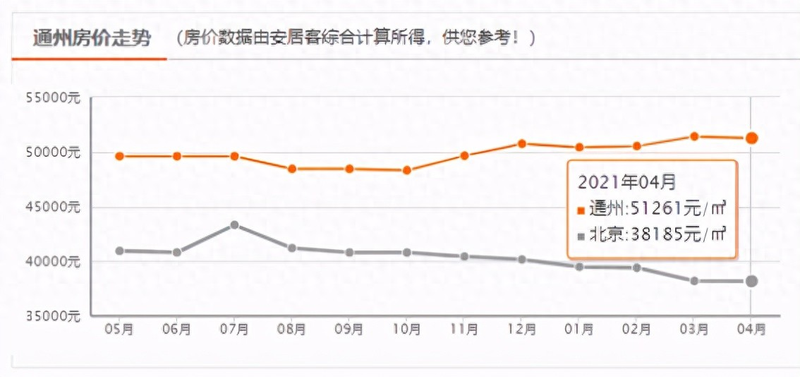
(tunzhou new house price trend)
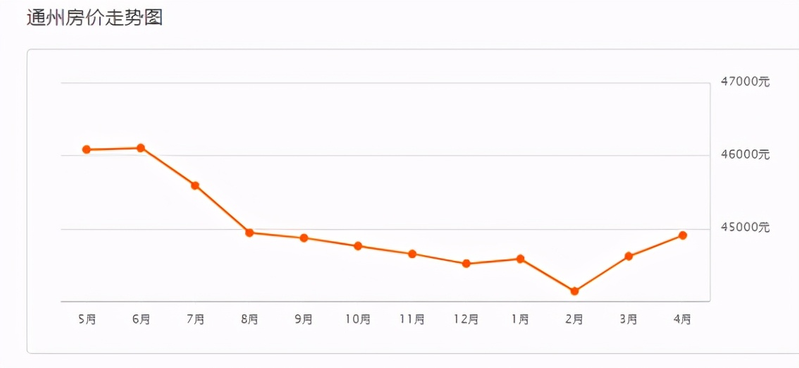
(tunzhou's second-hand room price trend)
Twenty years of rise and fall
The main road through the canton is kyoto, which is used for transport and storage. He is known as "iking (beijing), 2nd wing (tientsin) and tsangzhou". In december 1948, the county was liberated and divided between the county and the town of tunzhou. On 7 march 1958, the cities of tunzhou and tunzhou were transferred to beijing and merged into the tunzhou district of beijing. Since then, the function of the tunzhou district has been highlighted, gradually rising from the suburbs to the urban secondary centre。
In 1983, it was mentioned in the beijing master plan for urban construction, approved by the central and state councils of ccp, that the round corners were being actively developed, with emphasis on satellite towns. The tunzhou district is therefore a development priority. The beijing urban master plan (1991-2010), published in 1993, provides for a strategic urban transfer plan, with a gradual shift in urban construction from urban to peri-urban areas, identifying 14 satellite cities, with tunzhou as a priority for development。
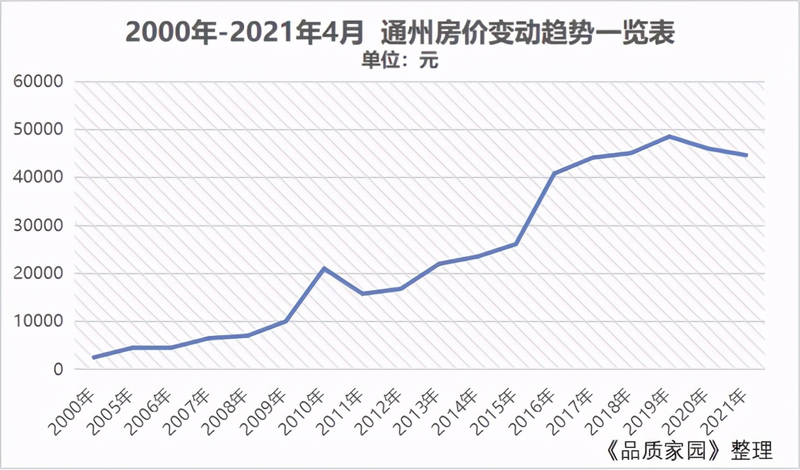
In tunzhou in 2000, the average house price was only around 2,500 yuan/m2. Subsequently, in 2005, the general regulations were issued, and the city of beijing introduced the concept of a new urban space landscape that would form two axes - two belts - multicentres between 2004 and 2020. As an important node on the “two belts”, tunzhou not only acts as a link to the development of the east and west, but also as an integrated service centre, which plays a key role in the development of urban patterns. At this time, thongzhou, the new urban area of the future development of beijing, and its nascent administrative office function as the central city of beijing, is beginning to emerge. However, in 2015, the beijing tongzhou district had only a price of $4,000 to $5,000 per square metre。
In 2009, housing prices increased dramatically throughout the country, including in tunzhou, with an average of 7,500 yuan per square metre at the beginning of the year and 13,000 yuan per square metre per year, an increase of 73 per cent and a steady rise to more than 10,000 yuan per year. Subsequently, during the beijing ii conference in 2010, the concept of building a modern international city in thongzhou was officially introduced because of the unmitigated heat of planning in the new city. This prompted an explosive increase in thongzhou housing prices, which were close to 30,000 square metres in march。
This was followed by the enactment of the 2010 new nation 10, kyoto 12, housing policy, which increased pressure on former sellers to sell. In 2011, tunzhou property was at a priceless stage, with the average unit price falling to $21,022/m2. At this time, the commercial ratio in tunzhou is also well below the city-wide average, referred to as “sleeping town”, where households “go to work” during the day and come back to sleep at night, and where home buyers describe cities more like older people。
Following the implementation of the building-market policy, thongzhou housing prices were adjusted and in 2012 there was an overall average exchange rate fall. However, since 2015, following the designation of thongzhou as the “deputy administrative centre” in beijing, there has been a “jumping up” of housing prices in thongzhou. The policy restrictions followed closely with the adoption of a trans-cantonal “bilateral policy” in addition to the beijing city's restrictive purchase policy. In 2015, the new deal 330, the tunzhou 814, the tunzhou commerce limited, and the new deal 930 in 2016 were introduced。
Between 2017 and 2018, tunzhou, in addition to its ongoing reorganization at the planning level, strengthened the construction of the tunzhou district as the beijing city sub-centre, promoted the planning of urban sub-centres in an orderly manner, leading to the functional and depopulation of central urban areas. Of these, in 2017, the project to develop urban secondary centres was planned to invest 13. 4 billion yuan for the year, with a total investment of 45. 2 billion yuan. In less than six months, the price of existing buildings jumped from 30,000 square metres at the beginning of the year to 60,000 square metres。
During this period, with the relocation of the relevant departments of the beijing municipality, the administrative district of the city's deputy centre was gradually opened. The tunzhou region has developed in association with the regions of the eastern region, such as hong kong, yangtao, yangtze and ping valley, and has integrated development with the three northern districts of yanang. In addition, the city's regulatory policy has been constantly scaled up, with the introduction of the “317” series of new deals in 2017 and the “city pensions new deal” in 2018。
On 11 january 2019, the beijing municipal administrative centre was officially relocated to the beijing city centre, covering 35 departments and 165 units of the municipal administration. In april of the same year, the new deal for the state administration of the provident fund was introduced. In february 2020, priority work and major engineering arrangements for the city's deputy centre were issued, focusing on four main areas: infrastructure, improvement of livelihoods, industry and administration, and focused on 197 major projects, with a total investment of 52. 25 billion yuan。
It was reported that during the period “1455”, the second phase of the administrative district of the beijing city deputy centre will be completed, and the canal business area will be fully constructed, with more than 40 new headquarters institutions. By 2035, the deputy centre will take over from 400,000 to 500,000 people in the centre。
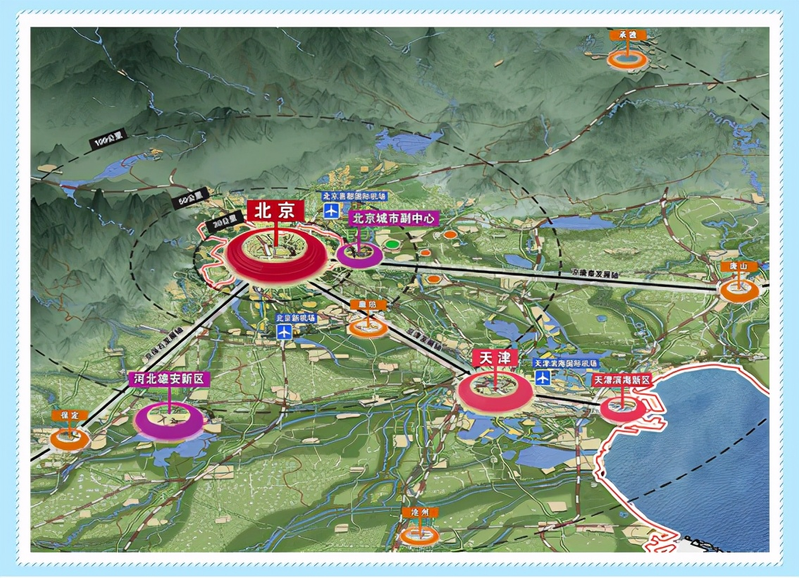
In the future, the tunzhou development is sustainable. On 3 april 2021, zhao zhou, the head of the province of tunzhou, beijing, stated that the city's deputy centre had defunct the non-capital core functions of the central city and made the central city more orderly. At the same time, the establishment of the secondary centre as an important wing of the main city and the simultaneous co-sponsorship of the three northern districts of the corridor (hebei) will enable the strategic intent of the centre to be achieved and will result in a new growth pole in the eastern part of beijing。
At present, tunzhou continues to pursue a “double-require” measure and, subject to the beijing city's limited purchase policy, there is also a need to establish a district-requirement policy in order to purchase a district-to-provincial commodity house. If you want to buy a dwelling in thongzhou, you also have to meet the requirements of a continuous payment of social security or a tax in tungzhou for the last three years。
Quality home is based on recent online data