Clean up, tina
Google pushes the “agent shopping” to a more standardized level: the official ucp。
Recently (11 january), google's ceo sundar pichai (known as “taipping wood”) first appeared on the nrf (united states retail federation's annual conference) and announced the agreement in a keynote address entitled “transformation of artificial intelligence platforms and future opportunities in the retail industry”。
According to google, ucp is a new open standard, with the goal of enabling agent to buy directly online. In terms of mechanisms for achieving this, the ucp has been able to decompose end-to-end shopping processes into reusable capability components by defining a set of “build-up modules for proxy commerce” that cover both key actions that drive commodity discovery and purchase, as well as those that extend to experience and services after the listing。
Google stated that the design would allow ecosystems to interoperability under the same set of standards, allow any agent to engage in dialogue with any merchant and to independently complete the full shopping process from commodity discovery to billing。
The standard uses apache 2. 0 open source licensing to:
Https://github. Com/universal-commerce-protocol/ucp
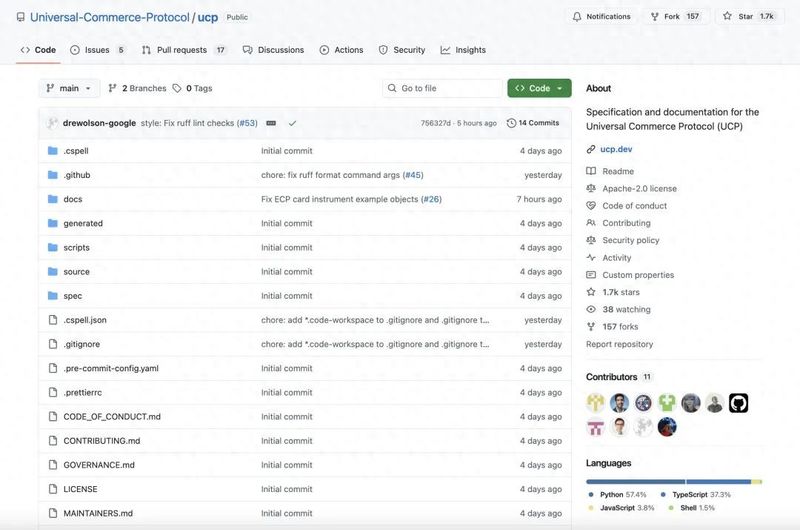
As many people see this news, they realize that big things may come。
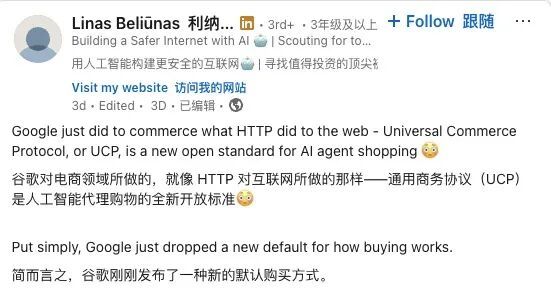
The venture capitalist linas beliznas is in l"google has just done something similar to what http did to web."
In his view, the ucp's ambition was to keep the electrician's fixed link for 20 years, “search—advertise—trade pages—closures”—condensed into “intent—agent reasoning—purchases”: users no longer need to click to jump, no longer be forced to participate in the seo game and no longer be subjected to the traditional transformation funnel layer of “flows”。
Further, beliūnas argued that ucp was trying to become the business “http” - that is, behind all ai-guided transactions, the invisible but indispensable infrastructure, “brands no longer compete for user attention, and they would compete for agent's selection. The website has become a tool. This is the beginning of non-human commerce.”
Scott wingo, a long-standing retail-oriented business continuity entrepreneur, has even described google's series of moves on nrf as an attack of a “shock and awe”. He lamented that he had worked in the industry for 30 years, "i've never seen anything like this before, it's crazy."
In wingo, it seems that the nrf used to wear a bit of "sleeping": the traditional topics of the cashier system, cashiers, pos and supermarket self-service transfer belts were discussed. And now it's almost a congress around agent commerce. "this is a change i never dreamed of." he said。
Harmonizing new standards in retailing
So, what the hell is ucp
In short, the goal of ucp is to enable agent to go through all the elements of the user-purchase process: from commodity discovery, comparison, to billing down, to purchasing support services, it can be linked under the same set of standards. The central problem it wants to address is to carry these process capabilities with a single standard, rather than having commercial and platform interfaces that are different, with different systems over and over again。
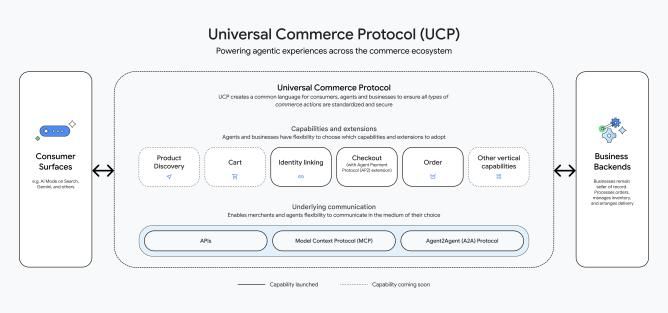
The whole idea can be seen from google's design: the left side is a variety of consumer contacts where consumers interact with the agency. In the world of google, these include google ai mode, core search, gemini, etc. On the right side is the back-office system — the ability for order management, inventory management, etc. Required in the back-office of the retailer。
In the middle are six capabilities: product discovery, shopping carts, identity binding, billing, orders, and other vertical capabilities。
There are six rounded rectangles in the middle, three of which are solid and three are false. The live frame is the declared and available capability. Three of the outstanding items are product discovery, shopping carts and other vertical capabilities。
Scott wingo also offers a more specific interpretation of these six capabilities:
Under these capabilities, there are also three modules representing the bottom lines of communication: api, mcp and a2a。
Google also stressed that ucp was not an isolated agreement, but could be used in conjunction with other agent protocols, such as the one it released last year, agent payments protocol (ap2), agent2agent (a2a) and model coNtext protocol (mcp). Agent and businesses can choose and group different extension modules according to their needs。
Among them, mcp is more like a “tool and context agreement” to enable agent to have secure and standardized access to a variety of tools; a2a is a google multi-agent communication agreement to support collaboration and tasking between agent; and ap2 is released at the end of last year and focuses on the payment level, trying to provide a verifiable and authorized payment mechanism for agent to execute transactions。
And ucp, which appears to be an extension of these agreements, focuses on the retail level. It can be said that the google period was indeed “additional” in the agent agreement。
Of course, google wasn't the first to do it. Open common production
A few months ago, openai actually launched an agent business-related agreement to help agent discover the goods and complete the purchase by playing "immediate closing." one of the great advantages of google is that most retailers are already very familiar with google — such as adwords, advertising, and a whole range of google business services. Google is using this as much as possible。
Ucp real issues to address: discovery
The core idea of ucp is to establish “universal compatibility” with a set of agreements. Businesses just need to describe "what i sell, how i sell" in a single instance, so theoretically it can be used between different platforms, different agent. And what it really wants to eat is "discovery."。
For traditional retail websites, this means a change: the page is no longer the only entry point for the transaction, and commodity data themselves are beginning to become the entry point。
To that end, google is adding “data base”. In the extended product data source section, google also provides users with new "data attributes" in its mercant seller tool so that brands can optimize their product lists and upgrade the ai search ranking。
You know, in the ai / llm era, we have been optimizing the commodities page for the last 20 years for "keyword + four or five points", but this is exactly what ai needs most. What these systems require is content explosion plus context。
For example: a bicycle foot. Almost all online goods can have 50-100 properties: screw structure, number of reflecting sheets, material, weight, compatibility standards ... This is called "content". And “the context” is: is it better for mountains or roads? Which models are compatible? Can we use them together? The content and context are like the shades and suns, without any side, and it's difficult for agent to make a reliable judgment, and it's harder to make a reliable underground list。
The google commodity data code was more like a gravel road full of weeds; what agenic company needed was a 30-track information highway — fibre, not dialling。
If google continues to use the old feed code to make agenic common, the discovery chain will fail. Gemini can't get enough information. This time, they finally started to fill in this section: new descriptive text properties, product specifications, q& a, comments, feature lists, patterns, tastes, themes, compatible information, recommended accessories, alternatives, etc。
The official term is “a dozen new fields”. In scott wingo, it seems that this number will be in the range of 24-60; even if only 20 are released today, it will soon increase to 30, 40 -- because everyone will realize that this is the key to discoverability. These data are still uploaded via mercant center, which is essentially understood as google shoping feed 2. 0。
His suggestion for all brands and retailers is just one sentence: "crazy" as much as possible to expand your commodity-grade content and context. This will determine directly whether you can be selected in the ai era by agent, and whether you can "take buy box."。
Who's on the line
At the beginning of the launch, a group of heavyweight players in the field of science and finance was assembled, including shopify, walmart, target, etsy, wayfair, visa, stripe and adyen. The first day attracted 20 partners, and that's the typical path for the standard。
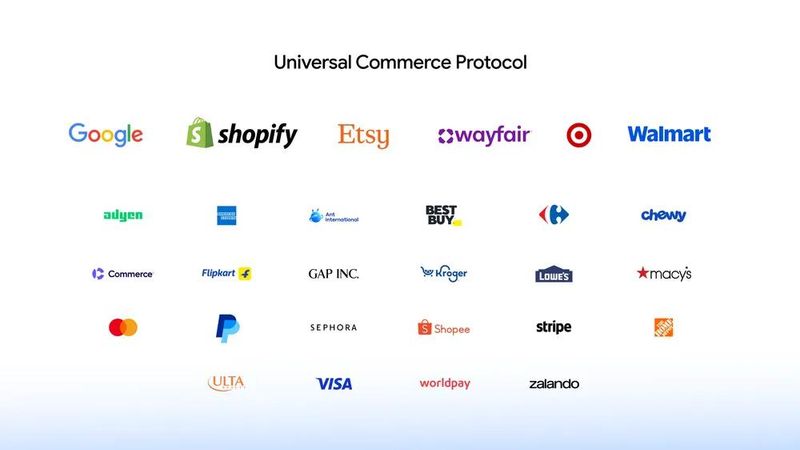
From the information made publicly available, these partners can be broadly divided into two categories:
The first category is retailer and electrician platforms, including etsy, wayfair, target, best buy, macy's, kroger, home depot, gap inc., sephora, ulta, zalando, chewy, carrefour, flipkart, shopee, etc.
Another category is payment and liquidation systems such as paypal, stripe, adyen, visa, mastercard, american express, worldpay。
It's interesting to note that ant financial has also appeared on ucp's cooperation list. “ants have access to ucp, but ariba has launched its own agentic company platform and ai protocol, which is probably only a matter of time.”
And in the light of ali's recent moves, that's not sudden。
Overall, it's hard to ignore the trend: in 2026, agent was no longer a "toy" used by a large factory to demonstrate technological power, but began to be used as a real money-making tool. Agent is significantly accelerating access to real applications, especially the hardest places of trade and services。
Let's be more radical: ai is likely to reshuffle the social + electrician + service set. Although the phrase "redo again" has already been used, the changes that have taken place do not seem to be a patch on the old system, but rather a rewriting of the mouths, links and distribution rules -- it's estimated that the platform at the level of poaching and kyoto will have to be put together sooner or later。
Moreover, this change has recently become very visible。
References:
Https://blog. Google/products/ads-commerce/regional-commerce-ai-tools-protocol-retailers-platforms/
Https://www. Youtube. Com/watch? V=oxun970yhvo
Https://www. Finextra. Com/pressarticle/108486/ant-international-embraces-googles-universal-committee-protocol
It's a good day
Conference recommendations
Infoq 2026 conference planning is online! From ai infra to agency ai, from ai engineering to industrial landing, from technology frontier to industrial applications, full coverage of ai and software development core tracks! • gathering global technology pioneers, dismantling real-life production cases, digging deep into technology and industries, exploring frontier areas, focusing on industrial empowerment, obtaining field-based and forward-looking insights, and efficiently transforming technology values. Take the key nodes of industry change and take over 2026