You're a reporter
Recently, a number of netizens at the sichuan province online mass work platform — questioning questioning sichuan revealed that telecommunications operators, such as mobile operators, have significantly reduced user broadband speed without user consent. The “sliding down” of the net has had various adverse effects on users。
Netizens questioned whether the frequent “tangibility” was a technical problem or whether the operator had done it intentionally. Kawagi journalists have conducted investigations。

Consumers are aware of business at a communications operational site. Photography
User reflects:
Limited access to broadband in enterprises, which seriously affects business development
Recently, mr. Kang, the head of a business in chengcheng hua district, told “governance sichuan” that the company had opened 300m mobile broadband at a similar rate in may 2024, but that since september that year, the rate had been limited to 50m, as the company's operations required remote access to beijing general service servers, which had seriously affected its operations and had not resumed。
Another business broadband user based in chengdu also indicated that the company had launched a 200m up-to-down rate of mobile broadband, which had been restricted at the beginning of december 2024, without being informed in advance, resulting in a number of failures to access the company's web site, and that after numerous complaints, cheng mobile company staff had been sent to conduct door-to-door checks and resumed the internet speed approximately six months later。
Similar problems were encountered by individual broadband users。
In late november 2024, it was found that broadband upload rates were limited to about 5m, only 1/10 of the original rate, making it very difficult to extract documents from outside because of work and life needs, the acquisition of an nas (network-plus storage) for working paper transmission, family photos and video sharing, etc. Following a complaint by mr. Jiang to the telecommunications company, the telecommunications passenger service staff came to visit the house several times before it resumed。
Journalists at the questioning sichuan platform found that almost all of the comments on the internet were restricted at an upward speed. Journalists have searched a number of forums and complaint platforms and have found that, in recent times, a large number of netizens have reported restrictions on the speed of movement。
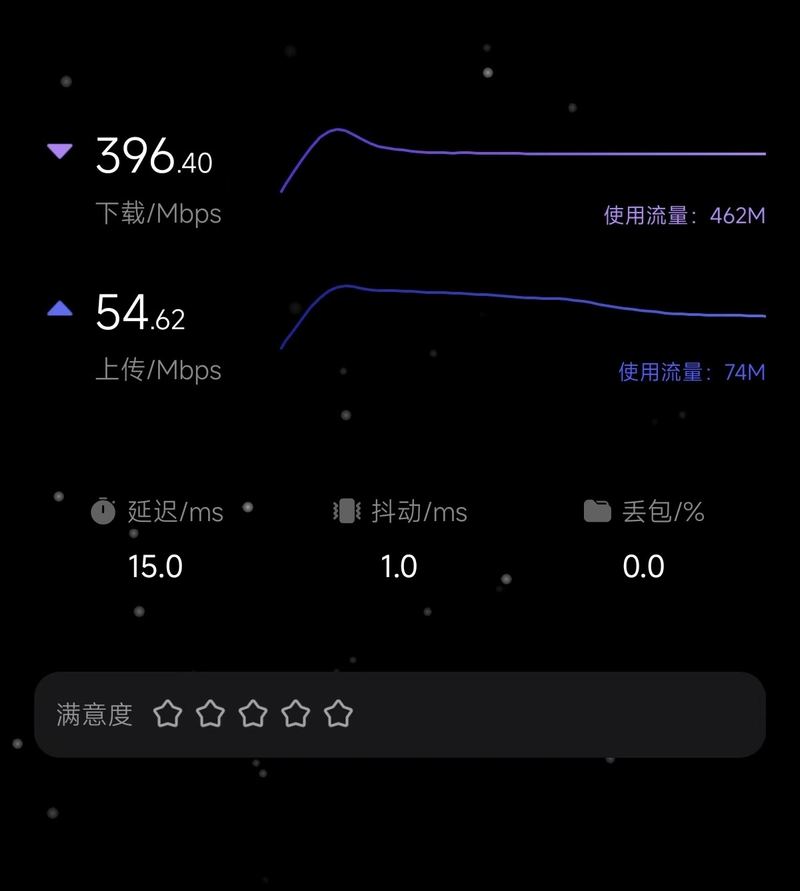
Speedchart for an enterprise: a broadband equivalent of 300m up and down, limited to around 50m
The upward rate refers to the speed at which data are transmitted from users to the internet, such as uploading photos, videos, etc. Via mobile phones or computers. The down rate is the speed at which users obtain data from the internet, such as downloading documents from the internet, viewing online videos or accessing web pages。
Kawagi journalists have learned that the current broadband set-up does not match up and down rates, usually “small up and down” (e. G., in the current mobile, telecommunications, and connected giga-broadband packages) with a down rate of 1,000 m, compared to a match of about 50 m. This is based on network architecture and user habits, most of which are based on download resources and have fewer uploading operations。
However, with the advent of the “twilight age” and the growing interest in video chats, cloud storage, etc., there is a growing demand for upload bandwidth, and the operator's uplink limitations inevitably affect the user's overall web experience。
Journalist survey:
Why communication operators cut off cliffs to limit broadband rates
It is very difficult to recover when the bandwidth of the user is limited by the cliff。
Mr. Kang's rate of upswing has not resumed so far, and the journalist consulted ms. Chengdu's mobile customer service manager, who stated that “the superior company stated that mr. Kang's company was not eligible for the restoration of the upper bandwidth for the time being”
Mr. Jiang's bandwidth recovery process was complicated by the fact that the operator sent two staff members to visit the premises, taking photographs of the scene “foreclosure”, after repeatedly confirming that mr. Jiang's nas (web-enabled storage) was not “unusual”。
Why does the operation of the chamber of commerce's cliff-breaker reduce the speed of uplinking users and delay the recovery of complaints
The journalist consulted with the telecommunications client engineer, mr. Zhao, and learned that the user speed rate had been slowed down, probably because of “unusual operations”, i. E. The user's upper bandwidth was running for long periods of time and the large amount of data was uploaded, which would be considered “unusual” and therefore the speed limit。
According to industry sources, some broadband users are restricted or cut off, mainly because of operators ' controls over pcdn technology and applications。
The so-called pcdn is a technique for excavating and using large amounts of debris-involved resources in the network and building low-cost content distribution networks where broadband users can share their idle top bandwidth with other netizens in exchange for cash and gifts。
For example, previously there had been many routers known as “profitable” on the market, which users could use to share free upband bandwidth and receive incentives commensurate with the size of their contribution。
Industry sources told journalists that such sharing was putting pressure on operators。
First, the current base network of operators is characterized by an increasing volume of up-to-date traffic, which increases the cost of network transportation and puts additional stress on the operator。
Second, the consolidation of idle uplink bandwidth at low prices has made it unnecessary for some internet companies to rent high-cost commercial bandwidth and machine rooms from operators and has moved the operator “cake”。
The operator will therefore limit the user's “abnormality” rate once it is discovered。
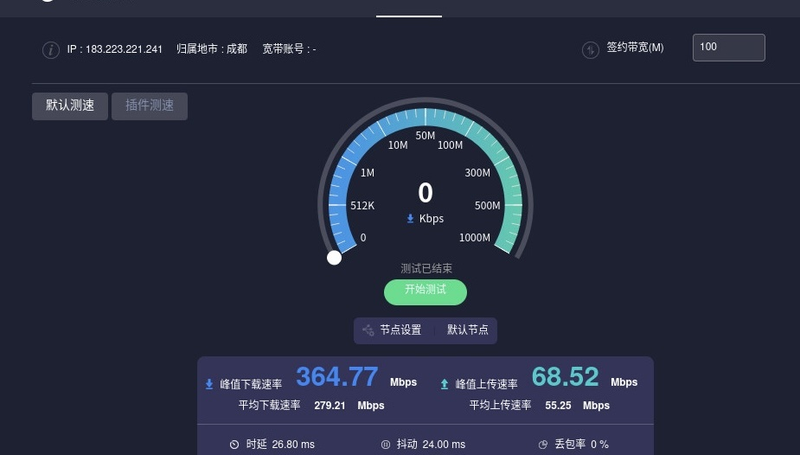
Speedchart for an enterprise: a broadband equivalent of 200m up and down, limited to around 60m
Extension exploration:
Has the operator violated his rights on suspicion of speed? What's the problem with user advocacy
Is it legitimate for the operator to directly limit the user speed rate by relying on “suspect” alone? Is it reasonable for users to purchase bandwidth that cannot be fully used
In response, yang yufang, a partner of the shanghai city attorney's office (beijing), argued that:
It is clear that some users may have greater use of the upper bandwidth due to, for example, work and usage habits, and that the operator “one-size-fits-all” controls the direct speed limit and the “self-cleaning” of the restricted user, which is clearly unfair to the user。
In addition, even if the operator identifies a pcdn user, the absence of actual evidence that the user uses pcdn for profit, and the absence of a unilateral right of the operator to limit speed, essentially results in infringement of the user's rights。
Is there any way to defend the right when the upper bandwidth is reduced by force and the user's interests are compromised
The survey of journalists found some difficulty because the operational service agreements concluded by many operators and users tended to blur or even avoid the issue of upward speed。
In a visit to a complainant, mr. Lee's business service agreement, the journalist found that the agreement contained only a “lower rate of 1,000 m” and did not specify an upward rate. Mr. Kang's business service agreement (osa) had a similar problem, with only a “bandwidth of 300m” indicated in the agreement and a reference to “peer-to-peer bandwidth” in the corresponding product manual。
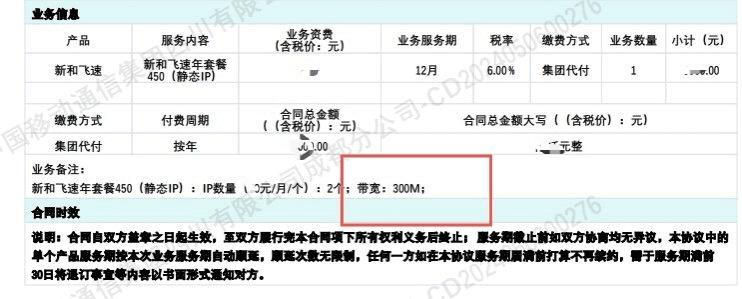
Mr. Kang's business service agreement
Despite the ambiguity in the agreement regarding the upper-speed rate, there is a clear requirement in the china communications standardization association's " requirements for the allocation of the upper- and lower-speed rate of public fixed broadband access " (industry standards) --
When a fixed broadband access service for public users is contracted at a rate below 200 mbit/s, the lowest rate of access contracted should be configured at a ratio of 1:5. When fixed broadband access is contracted at a rate higher than 200 mbit/s, the corresponding rate should be 40 mbit/s。
However, shanghai city's law firm, beijing, is of the opinion that:
It is still difficult to defend by this standard alone, as the industry standard is a recommendatory rather than a mandatory one, and it is still recommended that a clear agreement be made in the agreement to fully safeguard the user's interests if the user has a clear requirement for an upper bandwidth. In addition, users should retain materials such as product manuals or catalogues as supporting evidence for future claims。
At the same time, consumers are reminded that, despite the absence of relevant legislation and regulations, domestic users should be careful to use the PDF tool:
First, the use of such tools could lead to the disclosure of user privacy data
Second, as required by the ministry of industry and information technology circular on cleaning up the market for regulating internet access services, enterprises and individuals who do not have the corresponding telecommunications business licences are not allowed to operate idcs, isps, cdns, etc., and users may contribute to their own top bandwidth access incentives and may be identified as violating cdn distribution。
In addition, if the contract between the user and the operator expressly agreed that household broadband could not be used for commercial purposes, the user might also constitute a breach of contract。