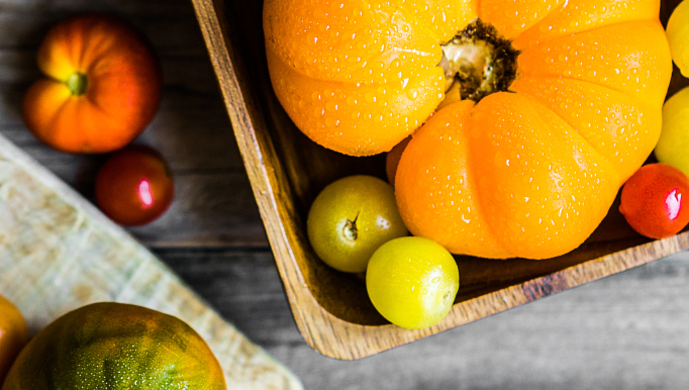
As summer approaches, the fruit of the holy virgin (commonly known as tomatoes), peppers, potatoes, pumpkins and cucumbers, among others, are widely on the market. Just as people were preparing for the big rush, it was said on the internet that the fruit, the pepper and the potato were genetically modified foods, on the grounds that we had not eaten tomatoes of this small size before, nor had we seen the coloured pepper and the potato. Therefore, these vegetables were produced later using genetically modified techniques and are not safe to eat。
Is that true? Let's hear what the experts say。
Is a strange vegetable a genetically modified food
“these agricultural products have nothing to do with transgenics. For example, tomatoes were born with their ancestors who were small, and then, because they were big, they were chosen. In the past, in the selection of varieties, the pursuit of high yields and durable storages by growers at the expense of the taste of the wind has resulted in tomatoes becoming large and boring and without their original characteristics.” zhu yi, associate professor, school of food science and nutrition engineering, agricultural university of china, said that。
The sacred fruit, which originated in south america, was the evolution of wild cherry tomatoes, which people used to feed as flowers. Our tomatoes, which may have been imported from europe or south-east asia, were in a pattern similar to that of the holy fruit, whereas the tomatoes that are now widely grown are actually grown by these little tomatoes. So the tomatoes are the “pre-ecological” tomatoes, and the big tomatoes are the derivatives of human intervention。
Zhu yi told the daily reporter of technology that the current consumers were willing to pay for their taste, and the growers chose to return to the truth, so the tomatoes went back to their small heads。
The vice-researcher of the institute of biotechnology of the chinese academy of agricultural sciences, yoo xiaoqin, noted that both the holy fruit and cucumbers were traditional varieties and that the colours of pepper and potato were the result of the accumulation of natural colours。
Potatoes, also known as black potatoes, are a hybrid variety of different types of sweet potatoes whose colours are pure natural and purple due to the abundance of pheasant. And we often eat tomato peppers, or peppers, which have evolved from the chili that originated in the tropical regions of central and south america, with long-term artificial choices and hybrid breeding, to give it a colorful look today。
“we cannot judge whether or not a product or crop is genetically modified by reference to whether it has ever been seen.” i wish to emphasize that the holy fruit, the potato and the peppers on our market are only natural evolution and artificially selected varieties。
Is there a way to identify genetically modified foods online
They say that people can't be seen, and that genetically modified food can't be seen. So, how do we identify genetically modified foods? Can you identify genetically modified genes
“in general, gmos and their processed products do not differ significantly from the traditional equivalents.” at present, all genetically modified products that circulate on the market cannot be identified by conventional sensory means, such as visual, smell or taste, and there is little evidence of the sophisticated methods of recognition that flow from the web。
“in the case of genetically modified agricultural products in circulation in our markets, they are derived largely from genetically modified crops that are resistant to insects, diseases and herbicides, but that are transferred without affecting the appearance of crops.” yoo xiaoqing said that a few genetically modified crops could be distinguished by changing the color of genetically modified crops or by changing the colour of seeds, as the transgenic genes functioned。
The presentation of yoo xiaoqing, such as transgenic “gold rice”, is the result of the transfer of a gene associated with the synthesis of beta carrots, which is graphically referred to as “gold rice” because it is expressed in the milk of rice, allowing rice embryos to synthesize and accumulate large amounts of beta carrots, which are yellow。
“others, such as genetically modified papayas, genetically modified maize, genetically modified soybeans, and their processed products, corn oil, soy oil, etc., can only be identified by detecting trace amounts of nucleic acid and protein remaining in the oil.” yoo xiaoqing indicated, however, that refined vegetable oils do not basically detect so-called “out-source genes and proteins”。
It is worth noting that, as early as 2002, it was made clear in our country's agricultural genetically modified organisms marking scheme that the direct processed products of genetically modified agricultural products should be labelled as “gmos x processing products (manufactured products)” or “processing raw materials are gmos x”. In july 2018, we issued the proclamation on the strengthening of the regulation of the marking of vegetable oils for food use, which specifically regulates the marking of both genetically modified and non-genetic oils. This gives consumers more choice and access to information。
Is it safe to eat genetically modified products
In the above-mentioned web-based legend, not only is it stated that the fruit of the holy virgin, the potato and the peppers are genetically modified foods, but they are also considered unsafe for genetically modified products. The safety of genetically modified foods has been a source and focus of controversy. Why then should we produce genetically modified foods, and what is the geometry of the safety of genetically modified foods
“gmo applications are designed to promote agricultural production and produce high-quality agricultural products at relatively low cost.” according to yoo xiaoqing, although the appearance is no different from that of agricultural products in general, genetically modified produce has a number of special functional genes, such as anti-worms, anti-virus, easy to preserve, etc。
"if there is no problem with the safety of genetically modified genes, why are there so many arguments?" even now, even if we are safe, how can we guarantee the future of genetically modified products。
In terms of scientific research, a number of international professional bodies have authoritatively concluded that the safety of genetically modified products is safe through safety assessments, which legally authorize their listing。
“a genetically modified crop is authorized for commercialization with a lengthy safety evaluation process to ensure safety. Simply put, there is a need for a rigorous safety assessment in terms of both environmental and food safety.” according to yao xiaoqing to the daily reporter of the ministry of science and technology, the country is a third-party, qualified testing agency designated by the ministry of agriculture and rural affairs to conduct a phased safety evaluation of the genetically modified crop under development, which will be terminated regardless of the stage at which safety risks are identified. Only when no safety risks are identified at all stages of the assessment will the genetically modified crop be issued with a certificate of safety in production applications。
Yoo xiaoqing stressed that it was up to the government to take a combination of multiple factors into account whether gm crops would eventually be authorized for commercial cultivation. In fact, a certificate of safety in production applications would make the genetically modified crop safe. It is therefore safe for genetically modified products to be listed in accordance with the law, subject to scientific safety evaluation and strict approval by the government。
As early as 2017, “gmo food causes cancer and infertility” was included by the chinese institute of agricultural biotechnology in the 10 major rumours of gm. From global production and consumption practices, more than 30 billion acres of genetically modified crops have accumulated in commercialization for more than 20 years, and no scientifically proven safety incidents of genetically modified food have been detected。
“genetic engineering is actually a precision breeding technique. However, given the current low public acceptance of genetically modified foods, it is important to clearly label genetically modified foods with full respect for the right of consumers to know and choose.” chu yi indicated。
Relevant:
What genetically modified products have been approved in our country
We clarified the misunderstanding about tomatoes and peppers, and many might ask: in my country, which genetically modified agricultural products are authorized for cultivation and marketing
According to yoo xiaoqing, the currently approved genetically modified agricultural products in our country can be divided into two categories, namely, genetically modified cotton and genetically modified papayas, which are grown and produced by the country itself. Another category is transgenic soybeans, transgenic maize, genetically modified oils, transgenic beet and genetically modified cotton imported from abroad, and derivatives of these five crops, which can only be used as processing materials and cannot be cultivated。
“the most common genetically modified foods on the market, in addition to papayas, soybeans, vegetableseed oils, are soybeans and vegetableseed oils, whose processed products can be legally marketed and distributed in accordance with the relevant laws and regulations。
It's called "sacre fruit is a genetically modified food
Editor-in-chief: zhang wu