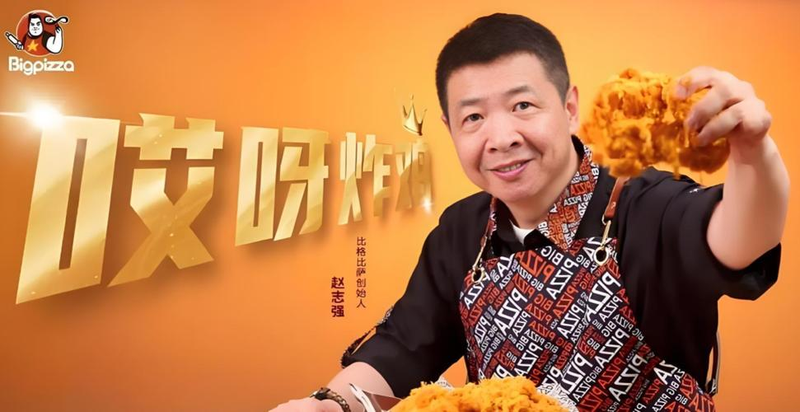
Since 2010, china's pizza market has grown at an average rate of 10 per cent per year, while the compound growth rate of big pisa in the last three years has reached more than 50 per cent, “if the epidemic does not affect us, the compound growth rate would be even higher.” according to big pisa founder zhao zhiqiang。
In fact, as a result of the epidemic, many head-to-head catering brands have been growing at a compound annual rate of only single digits, while big pisa has been able to achieve an annual compound growth rate of more than 50 per cent, the reason for which is that people want to find out。
On 5 july, the founder of big pisa, zhao zhiqiang, went to the official radio station to conduct a full-scale analysis of how big pisa had been able to grow in reverse and had developed over time. Zhao zhiqiang stated during the dialogue that “bigbisa has opened a path of “blaster buffets” and that, guided by the course of differential competition, bigbisa has developed a “7+2+1” product system, digitalization and fine-tuning of costs, which was interpreted in detail during the dialogue, while he also mentioned the ability of catering enterprises to be big and “up-to-down” and to grasp “one-old plus one” among future competition opportunities。
Zhao zhiqiang interpreted the core driving force of 20 years of sustainable development in big pisa in an in-depth and shallow manner. Below is a summary of the dialogue:
Improper competition - differential competition routes for big pisa
Q: how does big pisa keep his own tune and walk the path of differentiation in the face of a growing number of competitors who divide the tracks
A: the buffet was actually a “shell food” when it came to china twenty-three decades ago. China was in a time of material scarcity. People ate the buffet with a “feed-in-the-wall” mentality that attracted consumers as long as the cafeteria was rich, meat-rich and cheap。
But now, 20 or 30 years later, there are no hungry people and there is already a satisfaction for people. If you still rely on product abundance, meat abundance and cheapness to attract consumers, there is only one way to go, because if you have another cafeteria that is richer, more meat and cheaper than your product, you will die。
Thus, the cafeteria of the new era, in order to be sustainable in the long term, must no longer be based on product abundance, meat abundance and cheapness, but rather on the uniqueness of your product and taste, which makes you irreplaceable。
In this context, beagle began by opening a road of “explosive buffets”, of which i learned all over the world only one. Beagle's full name is "big pizza," and beagle's slogan is "no more than durian pizza," and we've been making pizzas, both in brand name, slogan and in shop-blast marketing, is the model that drives the whole pillar through "pizza" explosives。
Second, in the context of the chinese demand for pizza, after nearly 20 years of mapping and innovation, big developed the most popular series of chinese products — the fruit series. In italy, where there are not many people who actually use fruits for pizza, market research suggests that china’s consumers prefer fruit-based pizza, so we have been working to develop fruit-based pizzas, including bananas with “breaths”, twigs, strawberry chocolate pizzas, fruit garden pizzas, and the most popular guacamole pizzas。
Thirdly, chinese consumers are warm stomachs, food that likes hot soup and soup, but the real pizza stores are full of pizza, pasta, salad, dessert, ice cream, products that may be slightly monotonous for chinese taste, so we have expanded the pizza class to create a “7+2+1” product system。
In other words, 70 per cent are western-style products, such as pizza, pasta, curry, salad, ice cream; 20 per cent are medium-style products, including cabbage, stringing, medium-style fish; and “+1” is a geographical feature, because china has a particularly large market, a particularly large territory and a different demand for taste. We have milk tea in the store, for example, because the insider likes milk tea at the end of the meal, and it feels comfortable; in changsha, we've had little fried pizza and so on, and this product system of “7+2+1” can meet consumers' needs to a greater extent。

Fourth, you take the self-help model, which means you spend the same money, and you may have only one or two pizzas in other pizza shops, but you can taste 130-140 products in beagle, whether you spend 69 or 79. The self-help model is particularly easy for consumers to accept。
Now more children and young people love pizza. When we take the kids to dinner, the biggest confusion is actually to order. Because you don't know what the kid's gonna order, and then he won't like it. But beagle happens to be satisfied, and the child goes into the restaurant and runs, and he sees what he likes, and he picks it up. Take more, less, if you like, so that beagle can bring the best experience to consumers。
Fifthly, it is difficult to find a restaurant that meets the common choice of a three-generation family, including the elderly, parents and children. But beagle is able to get a three-generation consumer to find what they like. Dad may not want dessert, but he may have a couple of bottles of beer. The elderly eat noodles, vegetables, soup and fruit. Children can eat dessert, pizza, pasta. So they can find a common option。
In conclusion, the first point that big has been able to develop for 20 years to the present is the continuous innovation of products. Big pisa is a product that's been sharpened with consumers for 20 years, and we're putting out more than 10 pieces of product every issue, and we're gonna do a questionnaire after the new ones, and we're gonna finally pick the most popular products down. It was this sediment that led to the formation of a product system for the beagle。
The second point is that bigg has a very good model, a self-help model that allows consumers to choose their favorites and gives consumers a better meal experience。
Digital business transformation to help refine cost management
Q: how do you view the digital transformation of catering operations? What are our practices in digitalization
A: when we managed more than 100 shops, we had two problems, one of which was to have first access to the real-time business of all stores, including the number of guests, the number of transactions, the number of transactions, the number of transactions in each store. Because without timely access, my cash and income security are a major obstacle, including financial management。
And the second is that we felt that there were three cashiers at the time, and i said if we didn't cut off the cashiers, would we keep one and let the customer collect the cash? Can we save two
We chose a lot of suppliers, and finally, we chose. First, we change the whole cash collection scene, and the customers trade their own codes and write off their own transactions. We simply need an employee to assist some customers who are cashless and unworkable, or to help him do some additional service work. We save two employees, two fewer in each store and nearly 200 in each store. This saves a lot of money。
As of today, i think our choice was very right. I think it is also very positive that we have access to daily business data and statements in a timely manner, including updates on this side, through data from the back of the twilight system。
With the increasing number of biggmon stores, the value of the data is being tapped. In fact, we're already running data, and we say that a shop is good or bad, not that i'm going to evaluate him, but that we are running data out to evaluate it. If you're only 5% up at a joint store in one region when it's 10% up, i'll ask you how many eggs i'm going to need to sell for another $100,000. It's the data that comes out of 100 or 1,000 stores, 900 stores, 100,000 for a single store, 100 eggs for a single store, and 200 eggs for a hundred thousand. That's certainly a problem, so the bigger the data, the greater the value, the value of digital operations。
Real digitization also includes analysis of growth in performance sales, cost-end management analysis, consumer dynamics analysis, etc. Now we want to see all the dimensions of the data changes, and i'm getting more comfortable now that the end of the system is ready for us。

In the future, we hope to be able to pool all the dimensions of membership, supply chains and so on into one system, leading to integrated and intelligent management。
Q: how does big pisa address the high consumption and cost of food while meeting the needs of customers in terms of choice and self-help individualized consumption
A: at the heart of cost management is the menu, most cafeterias are 200 or 300 products, but the beagle is a combination of drinks, salads, pizzas, and so on, with only 138 items and fewer front-end dishes, making it easier for us to fine-tune。
First, at the product level, we will consider how to make our food, a raw material that can produce a few products and streamline its management. On the other hand, in product selection, our main diet consists of flour, vegetables, fruits, salads, chicken chests, only a small amount of beef balls, small fish, and other cow and goat products. We insist that we do not touch seafood, either at an uncontrollable cost, or a supply chain that is at risk, that we are willing to eat seafood, that we are willing to go to a specialized seafood store。
Second, the use of digitalization for cost refinement controls. For example, with 100 guests, how many eggs can be eaten, or how many cheeses, flour, etc., we calculate the value of thousands of people spent on each product through the bi to manage the combined costs. If all our stores cost 40, if one shop exceeds 40, then the data can be brought up to see if the egg or cheese, or if one of the other products is used more than another。
In this way, we can control the combined cost of each shop to this point and solve this point in order to solve the problem of why the buffet has not opened a thousand shops。
To be big, a catering enterprise must have the ability to eat up and down
Q: "sink the market" is a giant cake. How does big pisa fit
A: to be a big restaurant, you have to be able to eat "up and down" and sink to four or five lines. But chinese restaurant brands are interesting, and they don't go down, they don't come down, they don't go down much。
Why can't so many companies go down? At the heart of the problem now is the low per-carriage price, which, once high, is difficult for consumers to accept, resulting in low profits for chains. On the three or four lines, you find a couple running a small shop, selling $100,000 a month, making $20,000. If the fast-food chain goes down, the 200,000 may not be even。
But mcdonald's, kendrick's, they eat first, then new, then two or three, and now four or five. Brands need to be considered from a combination of product identification, product prices, etc., and must be done from line one to line five。
Pizza is also a very suitable species for sinking, unlike candour, which is not always accepted in the northeast. On the one hand, western-style fast-food consumers have largely adapted and there are few obstacles to pasta promotion in china。
Pizza, on the other hand, has the opportunity to sink down to the four or five lines, which is related to its cost structure, mainly flour, vegetables, etc., which is relatively manageable, so the future of pizza is a huge market. The key is what the operator delivers to the consumer, which is the core, which means that the model is important。
Businesses need to have not only good products, but also a good model, with beagle as a combination of product plus models, with very distinctive fruits and guacamole pizzas, the model being self-help. This combination has allowed us to operate smoothly on both the first and the new front lines, but it has not been thought that we are better off sinking because there is no competition. Even in five-line cities, high-income groups in five-line cities are able to feed their businesses。
Second, the catering industry wants to be big, but it takes a lot of cooks to be big, and if there's a lot of cooks needed, there's also a bottleneck of talent. It's a weird circle. How does biggs break the circle
The first thing we do is pizza, and we insist on making pizza now. We can't make it into frozen products. But our dough is processed in a single factory, so that while some standardization is done, the taste of pizza is preserved. Secondly, like salad, some hot vegetables, we'll use prefabricated vegetables, and it'll just be simple. We are part of a combination of manual industrialization, which meets the needs of large-scale development and is also skilled。
We have also found that young consumers today are passionate about doing what they do now, and that smelling stimulation is unparalleled. So our new generation of door stores, all the processing and handling of pizza, are at the front of the restaurant, and all the customers who walk by the door will see the whole process of making pizza。
The point of opportunity for future restaurants: super high value, silver hair
Q: how do you judge the changes that will occur in the catering industry over time
A: preferably, consumption is very weak at the end of consumption, at least within three to five years. Over the years, many businesses have actually survived on high indebtedness, with at least three to five years of hard work ahead, which means consumers are more rational. But these people have come a long way, and his consumption ideas and tastes are still there. In other words, consumer tastes do not want to decrease, but money does not want to spend more。
This requires that, while we are doing well, we be able to provide consumers with greater benefits and that “price versus value” becomes core competitiveness. I am also optimistic about the future because bigg has always emphasized “super high value for money”。
How can you offer a super-high-priced product from the firm itself? This is particularly a test of management. Digitalization is one of the answers. Only digitization can improve efficiency and make it possible for consumers to gain. In fact, in the midst of the epidemic, we are well on track to thank us for our escalation five years ago. At that time, our doors were concentrated around 350 square metres, then optimized to 280 or 290 square metres, saving an average of 60 to 70 square metres in one shop, but the revenue collection was not reduced and, together with the property and rent saved, was a huge profit. The same is true of the manual aspect, where a shop saves seven to eight more people, and now i can save a thousand people in 200 stores。
So you're trying to provide consumers with super-high-value products, but not what you can offer, and you have to spell it out。
Secondly, “capturing the stomach of two generations” is, i think, a very important core of future restaurants. In fact, we were beginning to think that catching the child caught the meal, but with the development of recent years. The silver family is actually a huge future market for catering。
In fact, the silver family is no longer the past. The silver hair we understood in the past could be 40, 50, or even 60. Soon, after 70 years, the elderly may also be counted. In fact, this generation is completely different from the older generation. This generation of older persons needs social attributes, so i think that what should be caught in the future is “one day plus a little”, a future for the food。
Beagle actually saw this early. It's been almost 20 years since beagle did “one plus one”. We have been providing benefits to older persons since we were first created, including that we provide free meals to older persons on the 9th yen festival every year, which may have lasted nearly 18 years since we were created, so it is a future to capture “one day plus one”。