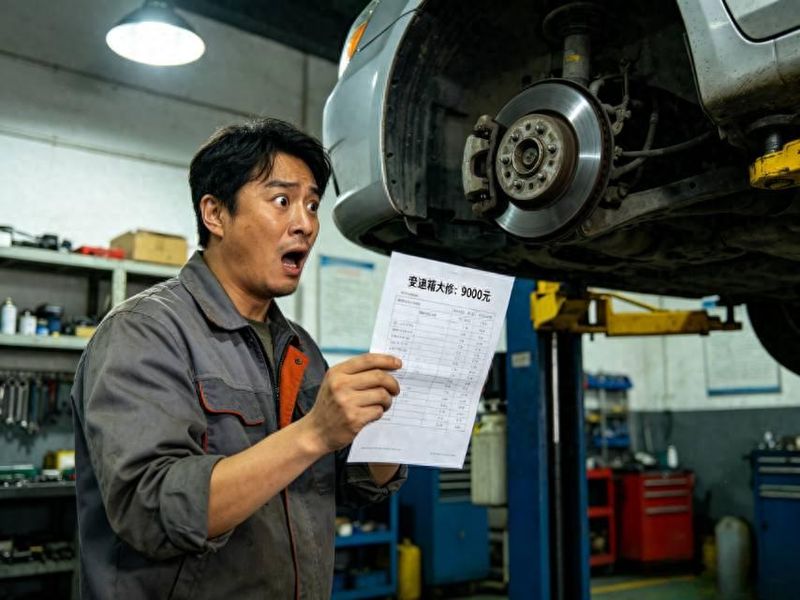
"new energy drives are less expensive than tankers," which is the central reason why many consumers choose new energy models, but when they actually use them, many of the car owners call "punching" -- – the price of small repairs is too high, and it is normal that one-time repairs cost 20 or 30% more than a tanker car, and that “affordable” is no longer an exaggeration for marketing numbers, but the real story of many new energy drivers. From the high calibration costs of smart parts to the hidden costs of precious body materials to the monopoly of spare parts, the difficulty of maintaining new energy vehicles is becoming the backbone of many of the owners, while the additional problems of insurance, charging and charging increase the pressure on new energy vehicles。

The main reason for the high cost of maintenance of new energy vehicles is the concentration of a large number of smart core parts in the body “high-risk areas”, which can lead to high detection and maintenance costs. In order to achieve high-level intellectual driving, sophisticated accessories, such as laser radar, high-resolution cameras and millimetre wave radar, are mostly placed at the point where the head, tail door and side of the car are highly vulnerable to collisions, and these parts are not mere hardware and are more closely tied to the engine system. Even if it is just a scratch, it cannot be repaired as simply as a gas truck, but it is a full computer test of the engine, followed by a series of operations, such as dismantling of pieces, pulling out of lines and recalibrating data, which alone cost twice as much time as the oil truck. More critically, the cost of calibrating a radar alone is up to a thousand, and the cost of replacing hardware is even higher if the accessories are damaged, and the cost of repairing minor injuries increases naturally。
Second, the new energy vehicle's bodyware, which makes small repairs a luxury, can only be replaced by the whole piece. For light quantification and renewal, new energy vehicles generally use aluminium alloy frameworks and integrated casting bodies, which appear to be highly resistant, but have “unattractive” short plates - once a small pit, a small scratch, cannot be repaired in the same way as the steel body of a traditional oil truck, only to replace the entire piece. Tesla model y requires $11,000 for a tail door, an offer that is not an example of the ignoble body damage, but is backed up by a massive replacement cost, which has led many drivers to call “the flesh pain” and has made the new energy vehicle a little tumbler, making it a real “money burn”。
The official monopoly of spare parts and the long cycle of equivalents add to the cost of repairing new energy vehicles, with hidden costs of various kinds. All core smart parts and body-specific parts of new energy vehicles can only be ordered from official brand channels, with few alternatives available on the market, which means that spare parts are priced firmly by the brand and have no bargaining space. Over the period of at least one week from the date of shipment and deployment of official spare parts, the owner's travel costs, such as commuter and rental costs, are borne by himself, and these hidden costs make maintenance expensive and additional costs. What makes it even more difficult for the owner is that the new energy vehicle at the same price, the annual premium is more than 1,000 for the oil truck, from the cost of insurance for daily use to the cost of abrupt maintenance, the pressure on the vehicle to keep the new car is doubled。
The use of new energy vehicles is painful, much more than repairing costs, and the difference in charge-charging experiences, which makes the use of vehicles by different owners, is a cause of “second regret” by many of them. The low-cost advantage of the charge, even if it has no effect on the day after the day when electricity is plugged in, the owner of a private stake, who has no private stake, can rely only on a public charging stake, not only facing the embarrassment of waiting in line, being surrounded by oil tankers, but may also encounter three or four days of charge, eight hours of single charge, the time and energy cost of charging, which has completely offsets the advantage of the cost of electricity, even when the owner has stated, “you know how to buy a tanker”。
In the face of the cost of repairing the new energy vehicle, the owner has also proposed a solution to the “life guarantee of the whole car”, but the reality is not “one-size-fits-all”. For the most part, brand life-long quality assurance is subject to clear qualifications, not all maintenance scenarios are covered, vulnerable items, such as tyres, rain scratches, etc., are not covered by the warranty, and the costs of minor scratching fittings, body repair, etc., are ultimately borne by the owner, which also makes life-long quality security a “seemingly bottom-up, but limited” guarantee。
A number of the owners of the cars have expressed a sense that “the cost of the electricity saved has finally been spent in other ways”, saying that the reality of new energy vehicles is fulfilled. The low electricity cost advantage of new energy vehicles does exist, but the maintenance costs, high insurance premiums, monopoly of spare parts, and the absence of a charge-back problem make it no longer a simple “lower than a tanker” for the whole life cycle. For consumers, the selection of new energy vehicles should not focus solely on the price and cost advantage of the vehicle, but rather on the combined costs of subsequent repairs, insurance, charging, etc., in advance, especially when there are no private charging stakes, owners who are sensitive to the cost of maintenance, and more carefully choose to avoid falling into the “affordable, unaffordable, unrepairable” car-keeping dilemma. In the case of cars, it is urgent to move new energy vehicles into more households, in addition to improving product performance, reducing maintenance costs, improving spare parts supply systems and optimizing quality assurance policies。