Distinguishing between pro-cyclical and counter-cyclical economic variables of price levels helps to identify whether economic-cyclical fluctuations are caused by aggregate demand shocks or by aggregate supply shocks. The overall price level of our country is characterized by a clear pro-cyclical pattern. At this stage, our price sensitivity to economic growth continues to be low, with a lower probability of stagnation in our economy。
Price volatility is closely related to economic cycle volatility, through which it can be judged whether the economic cycle fluctuations are the result of aggregate demand shocks or aggregate supply shocks. As is known from the gds curve, when the source of shocks from economic cycle fluctuations comes from aggregate demand, the price level will normally change in the same direction as the output level, except for the cairns extreme of the gsp level. For example, macroeconomic policy shocks that expand aggregate demand can lead to simultaneous increases in price levels and output levels; on the contrary, a contraction in aggregate demand will result in simultaneous declines in output and price levels, i. E. Price levels are characterized by pro-cyclicality。
When economic cycle fluctuations are caused by aggregate supply-side factors, such as the invention and use of new technologies, they will lead to reverse directional changes in output and price levels, i. E. Higher (or lower) output levels accompanied by lower (or higher) price levels, i. E., price levels are characterized by a reverse cycle。
Thus, it is important to distinguish between pro-cyclical and counter-cyclical economic variables. It helps to identify whether economic cycle fluctuations are caused by aggregate demand shocks or by aggregate supply shocks。
Our total price levels are clearly pro-cyclical
Studies have found that, prior to the second world war, the price levels in the united states had strong pro-cyclical characteristics and that lucas had classified pro-cyclicality of prices as a fundamental economic feature, and that pro-cyclical behaviour of prices appeared to be a generally accepted fact. After the war, there was a change in price levels in the united states during the period 1954-1989, which were clearly countercyclical, and in recent years the cyclical nature of prices was not。
So, is the overall price level in china evidently cyclical? Since the reform and opening up of the economy, the country has experienced an average annual economic growth rate of 9. 9 per cent and an average annual increase in consumer prices of 5. 4 per cent, maintaining a high rate of economic growth and moderate prices. Price levels reached 5. 4 per cent, mainly higher in the late 1980s and mid-1990s。
The price volatility cycle in our country since the reform and opening up
Our country has experienced four large price fluctuations since the reform and opening up. From 1978 to 1983, our country experienced its first price fluctuations, at a stage in which the state imposed strict price controls and prices, albeit with some volatility, did not fluctuate significantly. In 1984-1990, the country experienced a second round of price volatility, which was a policy shift caused by price shocks, and in 1982 the cpi continued to rise upwards, reaching a small height in 1985 and falling back two years, but rapidly peaked at 18. 8 per cent in 1988. From 1991 to 1999, the country experienced third price fluctuations, with the cpi continuing to grow in 1991 and peaking in 1994 after three years, after five years of slow decline to the bottom and turn negative. Of these, cpi in 1994 was as high as 24. 1 per cent, the highest in terms of phase, which was dominated by price hikes caused by the overheating of investments as a result of loose monetary and active fiscal policies. From 2000 to the present, our country experienced its fourth price fluctuations, which were long, small and relatively stable, and which, in general, were flat。
As can be seen from the correlation between the trends in economic growth and the evolution of the overall price level, the rate of economic growth in the country has gone through roughly two phases。
In 1978-1995, the first phase, during which the growth rate of the economy and the changes in the overall price levels were marked by a significant decline, the total price level reached 24. 1 per cent in 1994 and the correlation between the total price level and the rate of economic growth was calculated at 0. 17 per cent, with positive coefficients showing some pro-cyclicality。
During the second phase, 1996-2009, when economic growth and total price changes were smoothed down, price levels continued to decline, and in 1998-1999 the overall price level was negative. With the beginning of the new economic cycle in 2002, the total price level gradually turned positive, but remained at a low level. The correlation between the total price level and the rate of economic growth at this stage was measured at 0. 41, with a positive and significantly greater coefficient than at the previous stage, and the procyclical character of the price was further enhanced。
In general, the trends in the rate of economic growth and the movement of the total price levels are broadly consistent, with clear pro-cyclical characteristics, but the variation in the total price levels is significantly greater than that in the rate of economic growth。
Our price sensitivity to economic growth continues to decline at this stage
Based on data on our rates of economic growth and consumer prices for the period 1978-2011, the spatial model of the state of variable parameters was used to obtain the coefficient of reaction of our inflation rate to the rate of economic growth (see table)。
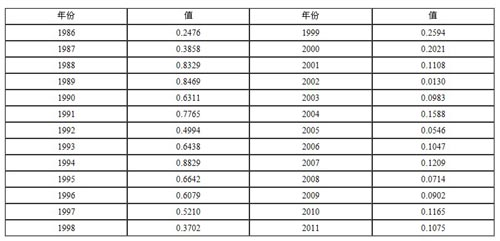
Response factors to economic growth rates of inflation
In terms of the overall contours, the trend in coefficients is characterized by "crumbs," which suggests that the coefficients have evolved through a process of low-to-high-to-high-to-low stabilization. The process of change in the reaction coefficient can be broadly divided into four phases。
The first phase, 1980-1987, was characterized by a low and highly volatile reaction factor, which remained essentially between 0. 15 and 0. 38, with a high frequency of fluctuations; the second phase, 1988-1993, was characterized by a high and highly volatile reaction factor, which remained almost between 0. 5 and 0. 85, with a high frequency of fluctuations; the third phase, 1994-2002, showed a constant downward trend, from a peak of 0. 88 in 1994 to a low of 0. 013 in 2002, with a drop of 0. 867 in only seven years; and the fourth phase, from 2003 to the present, was characterized by a low swing in the reaction factor, which was roughly around 0. 1. The stability of the reaction coefficient contributes to the simultaneous achievement of economic growth and price stabilization objectives。
After the country entered the new economic cycle in 2002, the rate of economic growth was steadily smoothing at a high level, while the overall level of prices remained low and the volatility was small. Overall, the picture of “high growth”, “low inflation”, and a prosperous and stable picture, which was closely related to the low reaction coefficients during that period. As a result, our economic cycle has fluctuated since the reform and opening up mainly from the shock of aggregate demand。
We're less likely to be stagnating at this stage
The general downward trend since 1994, from 0. 88 to 0. 11 today, indicates that changes in china's economic growth rate have had less and less impact on changes in price levels, i. E. In recent years the phillips curve has gradually slowed down。
When positive economic fluctuations occur as a result of increased aggregate demand, price levels rise only marginally, that is to say, the pressure on price increases from changing demand is not significant. At the same time, it is indicative of a marked increase in the level of supply in the country, where the increase in demand is more reflected in a corresponding increase in supply, while the price level remains constant or increases are limited。
China's economy contracted in 1998-1999, which led to a worsening of deflation. Deflationary pressure was eased in 2002 when the country entered a new cycle of economic expansion. Since 2003, our economic growth rate has remained relatively high, but the overall price level has not increased significantly, with a good combination of high growth and low prices, owing to the continued weak sensitivity of price volatility to economic volatility。
With the current price fluctuations continuing to have a smaller response factor to economic fluctuations, if economic growth slows, the scope for price increases will also be limited, with a lower probability of stagnation in our economy at this stage。